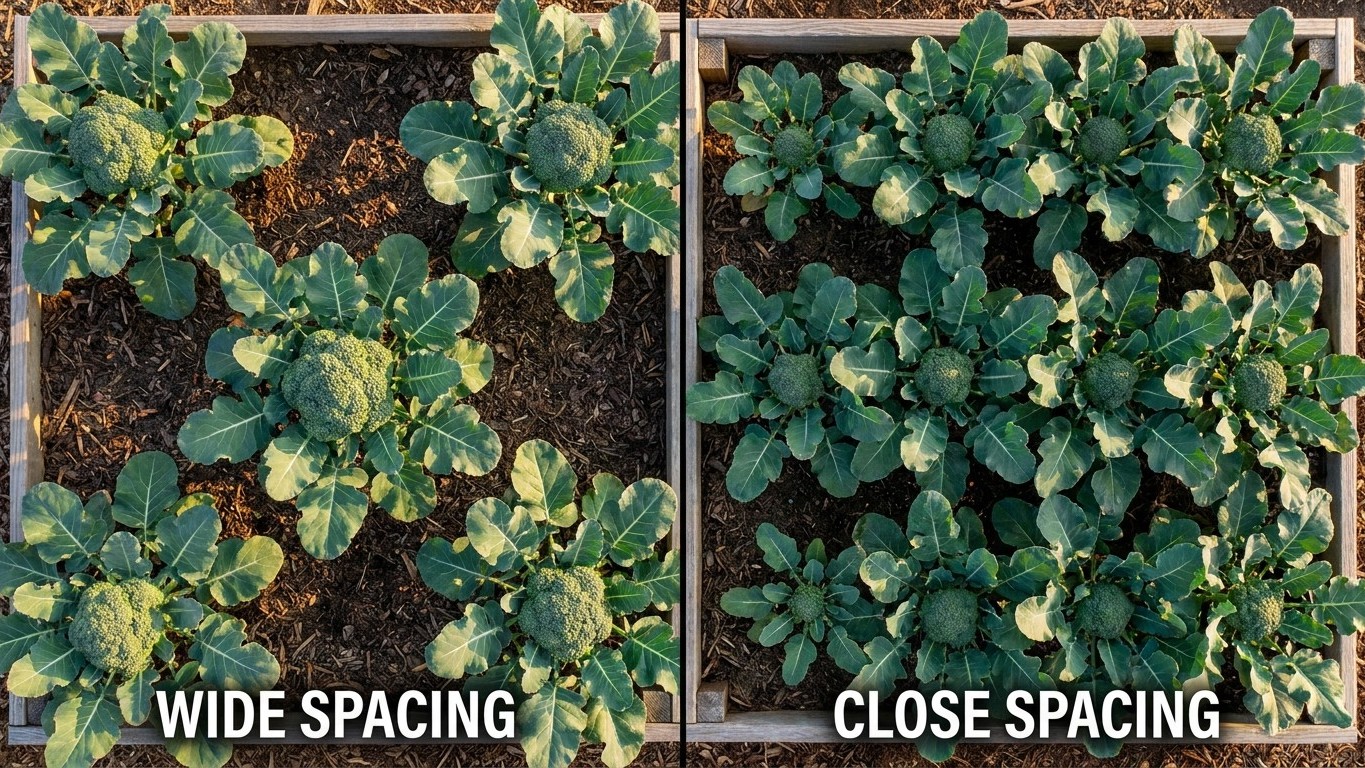

Utah State University Extension puts it plainly: broccoli can go in at the standard 12-18 inches between plants with rows 2-3 feet apart, or you can crowd it to 1 foot by 1 foot. That tighter grid fits more plants in the same bed, but it comes at a direct cost. Head size shrinks, and side shoot development gets inhibited. There’s no trick that avoids that trade, only a choice about which one you’d rather have.
The short answer
Closer rows don’t ruin broccoli. They just change what you get from it. At the standard spacing, 12-18 inches between plants with 2-3 feet between rows, each plant has enough root room and light to push a full-size central head. Squeeze that down to 1 foot by 1 foot and the plant survives fine, it just can’t build the same head. Utah State University Extension is direct about this: closer spacing can be used, but head size is reduced and side shoot development is inhibited.
That second part matters as much as the first. Side shoots are the small secondary heads that form along the stalk after you cut the main head, they’re the reason a single broccoli plant can keep producing for weeks. When plants are crowded, the stalk doesn’t get the light and reserves it needs to push those shoots. So a tight planting doesn’t just give you smaller main heads, it also shortens the harvest window per plant, because there’s less coming after the first cut.
Why would anyone plant tight, then? More plants per square foot of bed. If you’re working a small raised bed or a narrow row and want to squeeze in extra broccoli, 1-foot spacing lets you do that. You’re trading head size and follow-on shoots for plant count. For a household that wants a handful of small heads spread across more plants rather than fewer large ones, that might be a reasonable swap. For anyone growing for storage, or wanting the biggest possible central head to freeze or can, standard spacing wins.
The yield numbers help put this in perspective. Utah State University Extension figures 7-10 pounds per 10 feet of row at standard spacing, and recommends 3-5 plants per person for fresh eating, with another 5-10 plants per person if you’re growing to store. Those figures assume plants have the room to develop properly. Cram twice as many plants into that same 10 feet and you won’t double your yield, because each plant is working with less light and root space and turns out a smaller head. You gain plant count, not proportional pounds.
So there isn’t a wrong answer here, just a mismatch if you don’t know what you’re picking. Tight spacing is a legitimate choice for small spaces. It’s a poor choice if you expected the same head size and the same repeat harvest you’d get from a properly spaced row.
What actually decides it

Head size and side shoot production aren’t determined by one factor, they’re the result of separate competition for light, water, and nutrients happening at the same time. Crowding affects each of these differently, which is why the plant doesn’t fail outright, it just underperforms in specific, predictable ways.
Light competition at the leaf canopy
Broccoli builds its head from energy captured by its leaves. At standard spacing, each plant’s leaves get open exposure most of the day. Pack plants at 1 foot by 1 foot and neighboring canopies start shading each other within a few weeks of transplanting. Less light reaching each plant means less energy available to build the head, so the plant produces a smaller one and stops there, rather than continuing to add mass.
Root competition below ground
Roots need room to spread and pull water and nutrients from a large enough volume of soil. Crowded plants have overlapping root zones, so each plant draws from a smaller effective pool. Even with identical watering and fertilizing, a plant fighting its neighbor for root space has less to work with per plant, and that shows up directly in head size.
Resource allocation after the main head is cut
Side shoots are a second event, not an automatic continuation. Once the central head is cut, the plant reallocates energy to smaller shoots along the stalk, but only if it has reserves left to do it. A plant that’s been crowded and undersized from the start has fewer resources banked by harvest time, so it has less to put into shoots afterward. This is why Extension notes side shoot development is specifically inhibited by tight spacing, not just head size. It’s a downstream effect of the same light and root competition, showing up later in the season.
These three mechanisms don’t cancel each other out, they stack. A crowded plant is short on light, short on root room, and then short on reserves for its second act. That’s the full cost of closer rows, not just a smaller vegetable but a shorter overall harvest from each plant.
How to do it
- Decide your priority before you plant: biggest possible central heads and a longer side-shoot harvest calls for the standard 12-18 inches between plants with 2-3 feet between rows; more plants in less space calls for the tighter 1-foot by 1-foot grid, accepting smaller heads and fewer shoots.
- Set transplants at your chosen spacing Before the Last Frost date in your area. Broccoli tolerates cold better than warm-season crops like tomatoes and peppers, so it goes in ahead of frost rather than after it.
- Water deeply and infrequently rather than with light daily sprinkles. Utah State University Extension recommends 1-2 inches of water per week, delivered by drip irrigation where possible, to keep growth steady without stressing the plant.
- Feed nitrogen on a schedule tied to plant stage, not the calendar alone. Apply 1/2 cup of 21-0-0 per 10 feet of row four weeks after transplanting (or after thinning, if you direct-seeded). Counting that in words: mark the transplant date, then move forward four full weeks, and that’s your first feeding date.
- Apply a second feeding of 1/4 cup of 21-0-0 per 10 feet of row once the developing head reaches roughly the size of a quarter. This is a size cue rather than a date, so check the plants directly instead of counting days.
- Once temperatures climb above 80 F, add an organic mulch layer around the plants. This keeps root zones cooler and holds soil moisture during the hottest stretch of the season, when both matter most.
- After cutting the main head, apply another round of nitrogen to push side shoot development. This feeding is what gives the plant the reserves it needs for a second, smaller harvest, so don’t skip it if you’re growing for repeat picking.
What goes wrong

- Small heads despite good care. If spacing is 1 foot by 1 foot or tighter, small heads are the expected outcome, not a sign of a problem elsewhere. The remedy is spacing out future plantings to the standard 12-18 inches between plants if head size matters more than plant count.
- No side shoots after the main harvest. Crowded plants often stop after the central head with little or no follow-up growth. Feeding nitrogen right after cutting the main head, as recommended, gives the plant a better shot at pushing shoots, but crowding limits how much that feeding can accomplish.
- Uneven watering causing stress. Light, frequent watering keeps roots shallow and the plant stressed in heat. Switch to 1-2 inches per week delivered deeply, ideally through drip irrigation, so moisture reaches the full root zone rather than just the surface.
- Overfeeding too early. Applying nitrogen before the four-week mark after transplanting can push leafy growth at the expense of head formation. Hold the first feeding until that four-week point, then follow with the second application once the head reaches the size of a quarter.
- Soil drying out and overheating in summer. Bare soil around broccoli roots bakes once temperatures pass 80 F, stressing the plant right when it needs consistent moisture. Adding organic mulch at that threshold keeps root temperatures down and moisture more even.
Common questions
Does closer spacing kill the plant or just shrink the head?
It doesn’t kill the plant. Utah State University Extension is clear that 1-foot by 1-foot spacing can be used, it simply results in a reduced head size and inhibited side shoot development, not plant failure.
Can I fix a too-tight planting mid-season?
Not really, once roots have spread into each other’s space, transplanting to fix spacing risks damaging the plants further. The better move is planning spacing correctly before transplanting next time.
Does variety choice change how spacing affects the plant?
Cultivars vary mainly in days to maturity. Packman matures around 50 days, Green Comet around 55, and Premium Crop around 65. Faster-maturing types may reach harvest before crowding effects compound as much, but the underlying spacing trade-off still applies.
Is tight spacing ever the better choice?
Yes, if the goal is more total plants in a small footprint and smaller individual heads are acceptable. It’s a legitimate trade, not a mistake, as long as it matches what you actually want from the harvest.