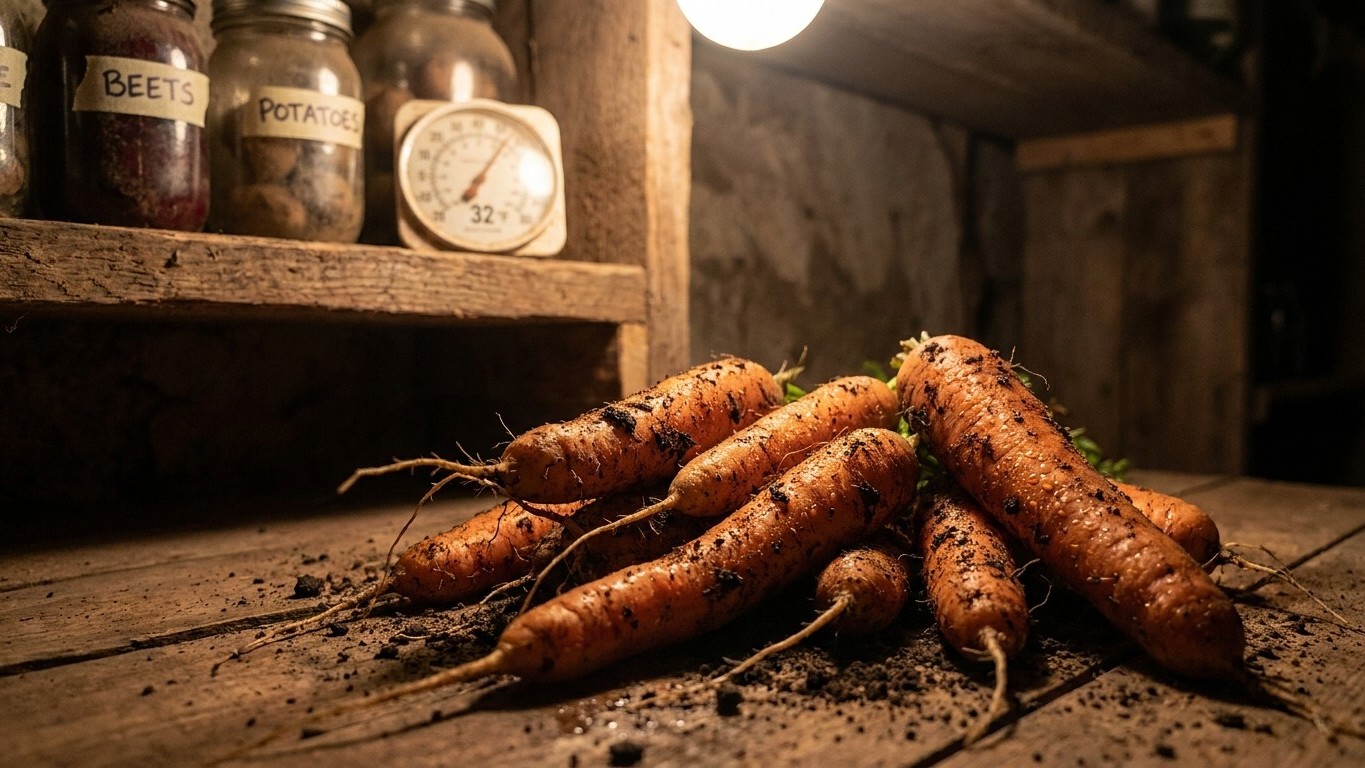

Store carrots at 32 F and 95 percent relative humidity, the benchmark set by Utah State University Extension. Harvest runs 70 to 100 days from seeding, since carrots grow from a direct-sown seed with no transplant step in between. Miss either number, storage too warm or too dry, and roots turn limp or shrivel within weeks instead of holding through winter.
The short answer
Utah State University Extension’s fact sheet on carrots, Carrots in the Garden, gives a two-number target for storage: 32 F and 95 percent relative humidity. That combination is the answer to most of the “why did my carrots go soft, moldy, or rubbery” questions gardeners run into after digging their crop. Warmer air speeds up respiration and rot. Drier air pulls moisture straight out of the root, which is why a carrot left in a warm, dry kitchen drawer goes limp in days while the same root in a cold, humid root cellar can hold firm for months.
Harvest timing is a separate number from storage, and it’s easy to conflate the two. Carrots are ready 70 to 100 days from the seeding date, not from a transplant date, because this is a crop sown directly into the bed. There’s no seedling tray, no hardening-off period, no second start date to track. One date matters: the day the seed went into the ground.
Between sowing and harvest sits a thinning step that shapes how the roots turn out. Utah State University Extension recommends thinning once seedlings reach 3 to 4 true leaves, leaving 2 to 3 inches between plants in rows spaced 12 to 18 inches apart. Skip that step and the roots crowd each other underground, competing for space in a way that shows up later as stunted or misshapen carrots, not as a storage problem.
One fact rarely makes it onto a carrot page: the root isn’t the only edible part of this plant. As NC State Extension puts it, “Leaves, roots, flowers, and seeds are edible. The roots are a common vegetable and can be cooked or eaten raw. The flower clusters can be french-fried to produce a carrot-flavored dish, the aromatic seed is used as a flavoring in stews, and the leaves can be cooked or made into a pesto.” That’s specific to the garden carrot, Daucus carota subsp. sativus, not to wild carrot or Queen Anne’s lace, which is a different plant with dangerous look-alikes and should never be foraged on the strength of this fact.
What actually decides it
Two forces shape whether a carrot grows straight and stores well, or comes out forked, split, or coarse: water consistency and soil texture. Utah State University Extension calls for water that is “frequent and uniform,” and flags uneven watering, alongside heavy soil, as the two causes behind a split root. Understanding why each one matters lets a gardener reason about a bed this page never saw.
A carrot root grows by elongating a single taproot. When soil moisture swings between soggy and bone-dry, the root’s growth rate swings with it: a dry spell slows expansion, a heavy soak after that spurs a sudden growth surge, and the outer tissue can’t stretch fast enough to keep up with the inner tissue. The result is a crack running down the root, sometimes deep enough to split it in two. Steady, predictable watering avoids that stop-and-start growth pattern in the first place.
Soil texture works on the root mechanically rather than physiologically. A taproot needs to push straight down through loose, crumbly ground. Dense or compacted soil resists that push, and the root does one of two things: it forks around a clump or a compacted layer, or it thickens and splits under the pressure of trying to force its way through. This is where a state-level description of “heavy clay” or “sandy loam” stops being useful, because a single state spans hundreds of distinct soil series, and a home garden bed can sit on soil nothing like the state average.
The test that settles the question for a specific yard doesn’t require a lab. Squeeze a handful of moist soil from the actual bed. Soil that forms a slick, shiny ribbon and holds its shape is leaning heavy and clay-rich, the kind of ground where a taproot has to fight for every inch. Soil that falls apart the moment pressure releases, feeling gritty rather than smooth, is leaning sandy and loose, generally friendlier to a straight-growing root. Anything in between, crumbly rather than either sticky or gritty, is closer to what a carrot bed wants. That five-second test, done on the actual bed rather than assumed from a regional soil map, tells a gardener more than any state average can.
How to do it
- Sow carrot seed directly into the bed. This crop has no transplant stage, so the seeding date is the only start date to track.
- Once seedlings reach 3 to 4 true leaves, thin them to 2 to 3 inches apart, keeping rows 12 to 18 inches apart, per Utah State University Extension.
- Water on a frequent, uniform schedule through the growing season, avoiding the swing between soggy and dry that drives split roots.
- Mark the seeding date and count forward: most crops mature 70 to 100 days from that date, not from any later event.
- Pull roots as they reach maturity within that 70 to 100 day window rather than leaving a mature crop standing in the bed.
- Move harvested roots into storage promptly, holding them at 32 F and 95 percent relative humidity to preserve texture and flavor.
What goes wrong
- Roots split or fork underground. Utah State University Extension names two causes: heavy soil and uneven watering. Fix the watering side first, since it’s the one under direct control, by switching to a frequent, uniform schedule instead of letting the bed dry out between soakings. If the squeeze test shows heavy, ribbon-forming soil, that’s a structural issue worth addressing before the next sowing rather than mid-season.
- Mature carrots turn woody, harsh, or fibrous. Clemson Extension explains it plainly: “Carrots near maturity that are allowed to remain in the garden under high temperature conditions tend to develop a strong flavor and roots that are coarse and fibrous.” The fix is timing, not variety or soil: once a crop is near maturity, get it out of hot ground rather than leaving it to sit.
- Stored carrots go limp, moldy, or shriveled within weeks. This almost always traces back to storage conditions drifting from the 32 F and 95 percent relative humidity target. Warmer temperatures accelerate spoilage; drier air pulls moisture out of the root. Check both numbers before assuming the crop itself was the problem.
- Roots come out stunted, crooked, or tangled together. This is usually a skipped or delayed thinning step. Thin at the 3 to 4 true leaf stage, not later, to the 2 to 3 inch spacing Utah State University Extension recommends, so roots have room to grow straight from early on.
Common questions
Is it true that carrots are only good for the root?
No. NC State Extension notes that leaves, roots, flowers, and seeds are all edible on the garden carrot: the flower clusters can be french-fried, the seed used as a stew flavoring, and the leaves cooked or turned into pesto. This applies to the cultivated garden carrot, not to wild carrot, which has dangerous look-alikes.
How long does it take carrots to mature?
70 to 100 days from the seeding date. Carrots are sown directly in the garden, so there’s no transplant date to count from, only the day the seed went in.
What’s the ideal Temperature and Humidity for storing carrots?
Utah State University Extension recommends 32 F and 95 percent relative humidity. That combination slows respiration and keeps roots from drying out, which is why carrots held at those conditions can outlast a batch left in a warm kitchen by months.
Why do my carrots split or fork instead of growing straight?
Utah State University Extension points to two causes: heavy soil and uneven watering. Watering on a frequent, uniform schedule addresses one cause directly; a simple squeeze test on the actual bed’s soil, rather than assumptions based on the state’s general soil type, tells you whether the second cause applies to your garden.