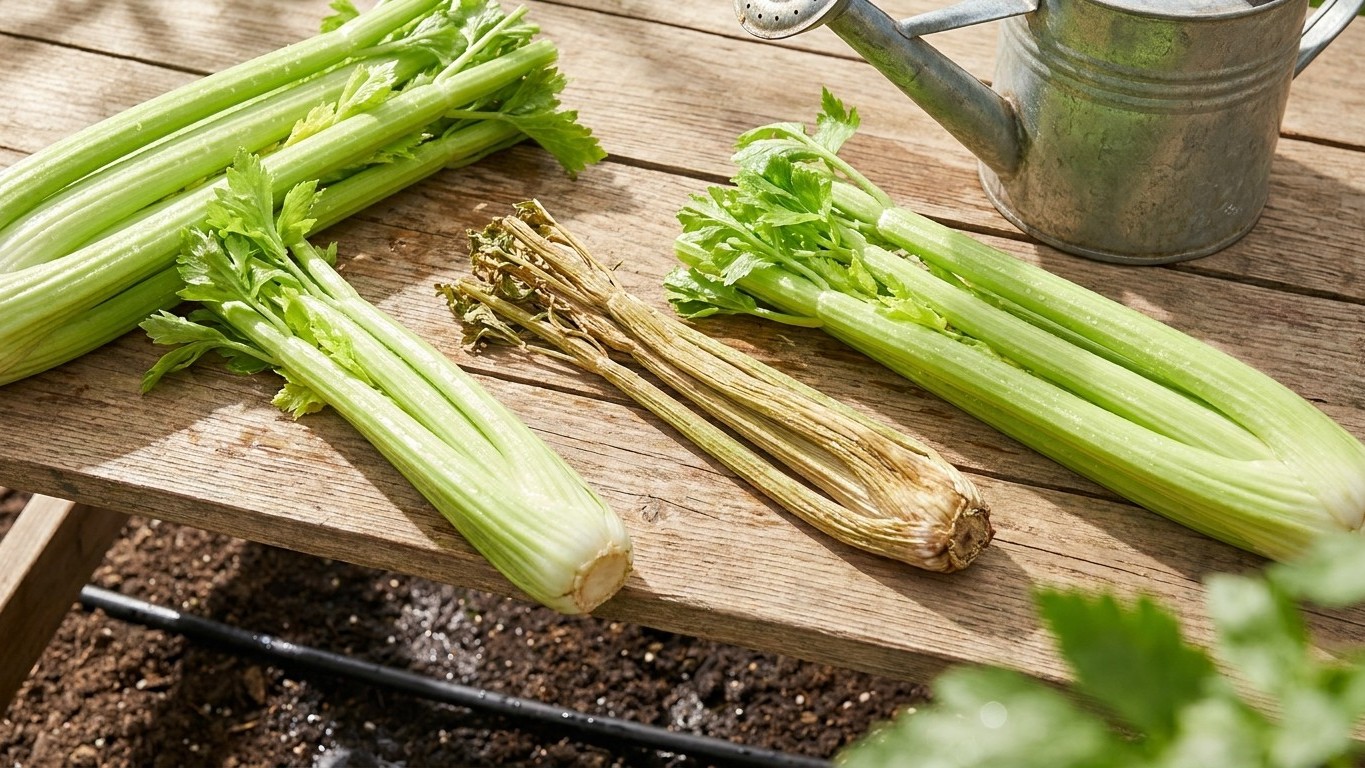

Stringy celery isn’t a phase you catch mid-harvest and fix with a heavier watering can. Once the stalks turn tough and fibrous, that texture is already locked in, a record of a dry stretch that happened weeks before you ever pulled a stalk from the ground. There’s no rewriting it after the fact. The only real lever is upstream: steady moisture in the root zone, from the seedling stage through the days right before harvest, decided the texture of every stalk in that bed.
The short answer
Celery needs at least 1 to 2 inches of water from rainfall or irrigation each week during the growing season, according to Utah State University Extension’s guide, Celery in the Garden. That’s not a suggestion for a lush-looking plant. It’s the minimum threshold below which the stalks start building the tough fiber that reads as “stringy” on a fork. Miss that weekly water mark, even once, and the plant responds by thickening its vascular strands, the same strands that later refuse to chew.
Utah State University Extension is blunt about the cause and effect here: any water stress during the year causes the stalks to become stringy and gives them a strong flavor. Notice the wording. Not “may cause.” Causes. This isn’t a plant that shrugs off a missed watering and bounces back cosmetically unchanged. Celery has a small, shallow root system, so it can’t reach down for a reserve of moisture the way a tomato or a squash plant might. When the top few inches of soil dry out, the plant has almost nothing left to draw on, and it starts protecting itself by building structure into the stalk instead of staying soft and full of water.
That’s the whole mechanism in one sentence: a shallow-rooted plant with no backup water supply turns dry weeks into permanent fiber. Extension also notes that celery is crisper and more tender when watered regularly, especially in the stretch right before harvest, and that drip irrigation is the efficient way to deliver that consistency because it keeps the shallow root zone evenly moist without the swings a hose or sprinkler can cause.
So the short answer to whether you can fix stringy celery once it happens: you can’t. The stalk you’re holding is a water log written in cellulose, and there’s no editing it after the fact. The only thing you control is whether the next planting avoids writing that same entry.
What actually decides it
One root cause explains nearly every celery texture problem gardeners run into, and it comes down to the plant’s inability to store water reserves the way deeper-rooted vegetables do. Everything else below is a consequence of that single fact, not a separate rule to memorize.
The shallow root system sets the entire watering schedule
Because celery’s roots stay close to the surface, the soil around them dries out faster than it would for a plant rooting 2 or 3 feet down. That’s why Utah State University Extension specifically calls for soaking the soil thoroughly at each watering, rather than a light daily sprinkle. A shallow root system doesn’t need water spread thin and often. It needs the zone it actually occupies to be saturated, then given a chance to stay that way until the next irrigation. A quick surface wetting that never reaches the root mass does almost nothing for the plant, even if the topsoil looks damp.
Heat and dryness compound the stress at the worst possible moment
Extension warns that celery harvested in hot, dry weather may be tough, stringy, and bitter. That’s the same root-system limitation showing up at the end of the growing cycle instead of the middle. A shallow-rooted plant facing high heat loses water to transpiration faster than it can pull replacement moisture from the soil, so even a planting that was watered adequately for months can turn stringy in its final weeks if a hot, dry stretch hits right before harvest. This is why Extension singles out watering “especially prior to harvesting” as the detail that determines whether the crop comes out crisp or fibrous.
Strong flavor and toughness travel together
The bitterness and the stringiness aren’t two separate problems. Both trace back to the same stress response: the plant diverts resources into structural fiber and concentrated flavor compounds instead of staying soft and mild. If a stalk tastes unusually strong, that’s a second signal confirming the same underlying story the texture already told.
How to do it
- Start seed indoors 9 to 13 weeks before your last frost date. Celery seedlings grow slowly at first, so that long a head start is needed before they’re sturdy enough to move outside around your area’s last frost.
- Transplant seedlings outdoors around your last frost date, once they’ve hardened off and the soil has warmed enough to work.
- Space plants 12 inches apart, in rows 2 feet apart. Utah State University Extension notes that this tighter spacing helps force tall growth and long petioles, which is what you want from a stalk crop. Wider spacing lets the plant sprawl instead of stretching upward.
- Water immediately after transplanting to settle the shallow roots into contact with moist soil, since celery has almost no reserve to draw on if that first watering is skipped.
- Deliver at least 1 to 2 inches of water per week for the rest of the season, counting both rainfall and irrigation, and soak the soil thoroughly each time rather than watering lightly and often.
- Switch to drip irrigation if possible. Extension identifies it as the efficient method for keeping the shallow root zone consistently moist without the wet-dry swings that sprinklers or hand watering can cause.
- Increase attention to watering in the weeks right before harvest. This is the window Extension flags specifically, since celery is crisper and more tender when watering stays regular right up to harvest, and hot, dry conditions at this stage are what most often turn a good crop stringy at the finish line.
What goes wrong
- Stringy, tough stalks at harvest. This means water stress happened at some point earlier in the season, and Utah State University Extension is explicit that any such stress causes this outcome. There’s no remedy for the stalks you’re currently holding. The only fix applies to the next planting: keep the 1 to 2 inch weekly minimum consistent from transplant through harvest, with no gaps.
- Strong, bitter flavor alongside the toughness. Since this comes from the same stress response as stringiness, treating one without the other isn’t possible. If flavor is off, assume the texture is compromised too, and look at your watering log for the weeks that led up to harvest rather than anything you did on harvest day itself.
- Wilting or stalling despite what looks like enough surface moisture. A shallow root system can be starved even when the top of the soil looks wet, if watering has been light and frequent instead of a thorough soak. Switch to fewer, deeper waterings that fully saturate the root zone, then let the surface dry slightly between sessions.
- Short, thin petioles instead of tall, thick stalks. This usually traces back to spacing wider than 12 inches, which lets plants sprawl instead of stretching upward the way tight spacing forces them to. Spacing can still be corrected in future plantings, but it can’t be tightened after the plants are already established in the row.
- Toughness that shows up specifically at harvest despite a decent season overall. Extension attributes this to hot, dry weather right before pulling the crop. It’s a separate failure point from season-long neglect, which is why watering has to stay a priority in the final weeks, not just earlier in the growing cycle.
Common questions
Can stringy celery be fixed by watering it more once it’s already tough?
No. Utah State University Extension frames stringiness as a direct result of water stress that already occurred. The texture is set by that point, and no amount of additional watering after the fact changes the stalk you’re harvesting.
How much water does celery actually need each week?
At least 1 to 2 inches per week from rainfall or irrigation combined, according to Utah State University Extension, delivered as a thorough soak rather than light, frequent sprinkling, since celery’s shallow root system needs the full root zone saturated.
Why does spacing affect how tall celery grows?
Utah State University Extension recommends 12 inches between plants, in rows 2 feet apart, specifically because tighter spacing forces plants to grow taller with longer petioles. Wider spacing lets plants spread out instead of stretching upward.
Does hot weather at harvest time matter even if the season was watered well?
Yes. Extension notes that celery harvested in hot, dry weather can turn tough, stringy, and bitter regardless of how the earlier season went, which is why watering attention has to continue right up through the days before harvest.