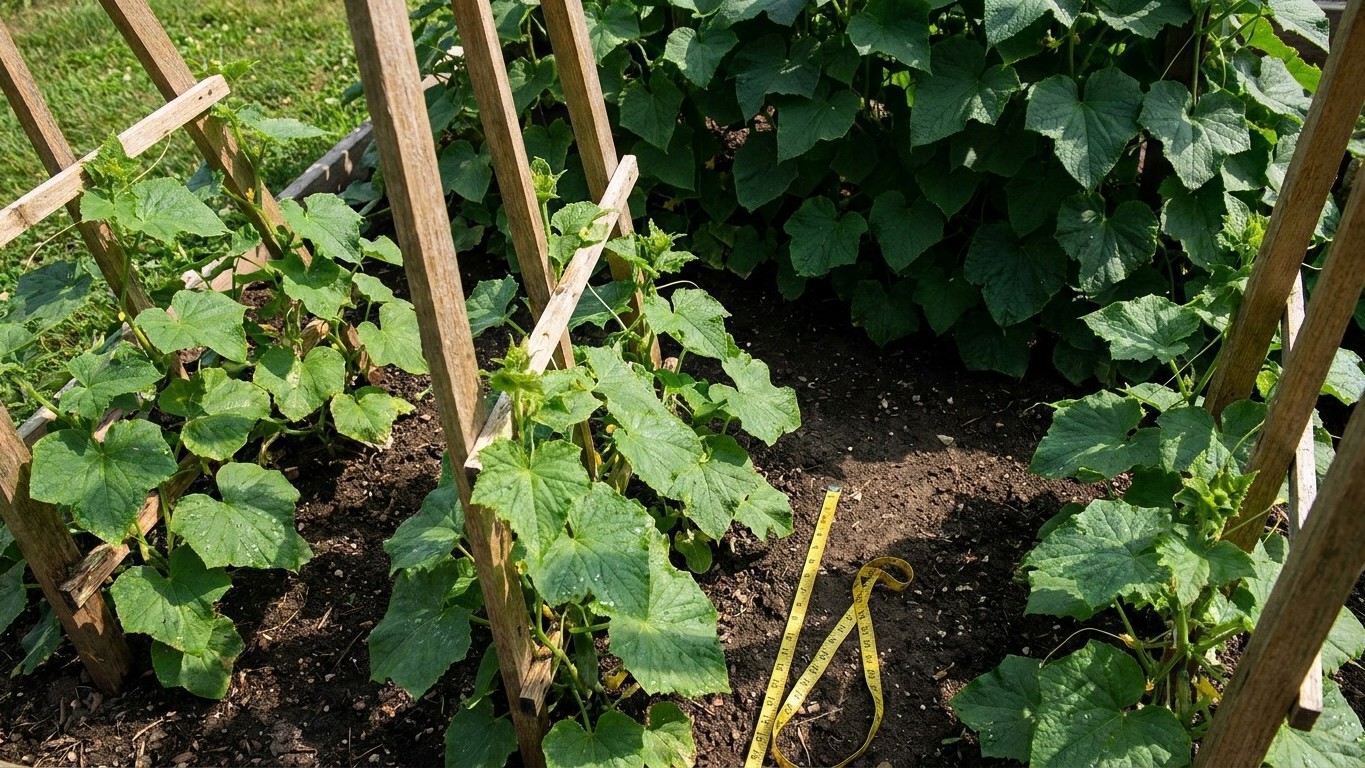

Ground-grown cucumbers need roughly 36 to 48 inches between plants, with rows spaced 5 to 6 feet apart. Trellised or vining plants can be tightened to 12 to 18 inches at the base, since the vertical growth handles the spread. The tighter number only works if something is holding the vines up and off the ground.
What is actually going on

The thing to understand here is airflow. A cucumber leaf is broad, low to the ground, and covered in fine hairs that trap moisture. When plants sit close together, the canopy closes in on itself, and the air between the leaves stops moving. That still, humid pocket is exactly where powdery mildew and downy mildew establish. Both fungal diseases spread through spores that need a damp leaf surface to germinate, and a crowded planting keeps that surface damp for hours longer after dew, rain, or overhead watering than a properly spaced one does.
Spacing is, in effect, the cheapest disease control a home gardener has. It costs nothing beyond a tape measure and a little patience at planting time, and it works whether the plant is a pickling type destined for the brine crock or a slicing type headed for salads. Bush varieties, bred to stay compact, still need airflow around their shorter vines. Vining types, left to sprawl on the ground instead of climbing, actually need more room than the trellis numbers suggest, because a sprawling vine covers ground in every direction and shades its own base.
Parthenocarpic and burpless types, often grown in greenhouses or high tunnels, get treated as an exception by some growers because they set fruit without pollination and are frequently trained onto a single leader. That single-stem training is itself a spacing strategy: removing side shoots reduces the leaf density around the stem, which is why these plants can be set closer than a sprawling bush type while still keeping the airflow a mildew-prone leaf needs.
Yield loss from crowding is real but it is the second problem, not the first. A crowded planting yields less mainly because the plants get sick before they get productive, not because the roots are fighting for nutrients. Cucumber roots are relatively shallow and don’t compete as aggressively below ground as, say, squash. Above ground is where the real competition happens: for light, and for the dry leaf surface that keeps fungal spores from taking hold. Understanding that distinction matters, because it changes what a gardener does when disease shows up midseason. Thinning a few leaves for airflow can help more than any spray, and it costs nothing.
For which specific pickling, slicing, or burpless types perform well in a given climate, a state cooperative extension service will have trial data local to that region. That information changes yearly and varies enough by state that a general page like this one is the wrong place to name a variety.
In the garden
The spacing question really splits into two very different plants: one grown flat on the ground, one grown up a support. They are not the same crop to space, even if the seed packet looks identical.
| Growing method | Spacing between plants | Row spacing | What goes wrong when it’s too tight |
|---|---|---|---|
| Ground-grown, bush type | 36 to 48 inches | 5 to 6 feet | Leaves overlap early, the center of the plant stays wet after rain, mildew starts at the crown and spreads outward before fruit even sets |
| Ground-grown, vining type left unsupported | 48 to 60 inches | 6 feet or more | Vines run into each other by midsummer, fruit hides under foliage and rots or gets overlooked at harvest, the whole bed becomes one solid mat with no air movement at all |
| Trellised or staked, vining type | 12 to 18 inches | 3 to 4 feet | Vines still climb fine at this spacing, but if pushed tighter than 12 inches the base foliage shades itself out and drops, weakening the plant right when fruit load peaks |
| Single-leader trained, greenhouse or tunnel style | 12 inches or slightly less | Varies by structure | Skipping the side-shoot pruning that makes this spacing work turns a trained plant back into a bush, and the tight spacing that was fine for a pruned stem becomes crowding for a bushy one |
Notice the pattern in that last column: almost every failure mode is the same failure showing up in a different form. Tight spacing plus full foliage equals a wet, still, shaded interior. The fix is never really “spray something,” it’s “open the plant up.” That can mean wider spacing from the start, or it can mean training and pruning a vining plant so it needs less room to begin with.
One detail that trips up a lot of first-time growers: seed packet spacing is often written as sowing distance, not final plant spacing. Packets frequently recommend sowing several seeds every 12 inches or so and then thinning to the wider final spacing once seedlings are established. Skipping the thinning step, because every seedling looks healthy and it feels wasteful to pull one, is how a bed that was planted “by the book” ends up crowded anyway.
Raised beds and containers change the math slightly, mostly by limiting how far roots can spread rather than changing the airflow rules above ground. A container-grown plant still needs the same distance from its neighbor’s leaves that a ground-grown one does. The pot just makes the root competition arrive sooner if that spacing is ignored.
What it depends on where you are
Everything above is the mechanical, national part of the answer: how mildew behaves, why airflow matters, what the spacing ranges are. What this page can’t tell a reader is how those ranges should shift for their own backyard, because that depends on season length, summer heat, and summer humidity, none of which are the same from one region to the next.
A gardener in a short-season, cooler climate is often working with a narrower window to get a crop to harvest, which pushes some growers toward tighter, trellised spacing simply to fit more productive plants into less growing time. A gardener in a long, hot, humid summer is fighting fungal pressure for a longer stretch of the calendar, which argues for the wider end of every range above, and for trellising over ground-growing wherever it’s practical, since it keeps foliage drier for more of the season. Arid regions with low humidity but intense heat face a different problem again: less mildew pressure, but more risk of leaf scorch and moisture stress if plants are spaced so tight that soil dries out unevenly.
Rainfall pattern matters as much as temperature. A region with frequent brief thunderstorms in summer gets more leaf-wetting events than one with the same annual rainfall delivered in fewer, longer soakings, and that changes how much airflow margin is worth building in.
None of that can be answered with a single number on a general page. The reliable local source is the reader’s own state’s cooperative extension service, which tracks regional disease pressure, tests varieties under local conditions, and publishes planting guidance specific to that state’s counties. Other pages in this guide series cover cucumber varieties and disease management in more depth; pairing that general information with a state extension recommendation is the combination that actually fits a specific garden, rather than a national average.
The mistake that costs the most
The single costliest mistake is planting too many cucumber plants too close together on the theory that more plants means more cucumbers. It’s an understandable instinct, and it’s backwards. A tightly packed row of six plants fighting each other for airflow will often produce less usable fruit, later, and with more disease loss, than four plants given proper spacing on the same footprint.
This mistake is easy to make because the damage isn’t visible at planting time. The seedlings look fine, spaced a foot apart, healthy and green. The problem shows up six to eight weeks later, when the canopy has filled in, the plants are shading their own lower leaves, and the first spots of mildew appear on leaves that never fully dried out after a rain. By then, thinning the planting means removing plants that are already carrying fruit, which feels like a bigger loss than it would have been to simply plant fewer in the first place.
The fix is to commit to the wider spacing before the first seed goes in the ground, based on the growing method actually being used rather than the one that seemed like it would save space. That means measuring at planting time, not eyeballing it, and it means being willing to thin extra seedlings even when they all look healthy. It also means matching the plant type to the space honestly: if the plan is to let cucumbers sprawl on the ground rather than train them up a trellis, that decision should come with the wider spacing built in from day one, not adjusted after the vines have already tangled together. A local cooperative extension service can confirm which pickling, slicing, or trellis-friendly types are best suited to a given garden’s size and season, but the spacing discipline itself doesn’t change from one variety to the next.