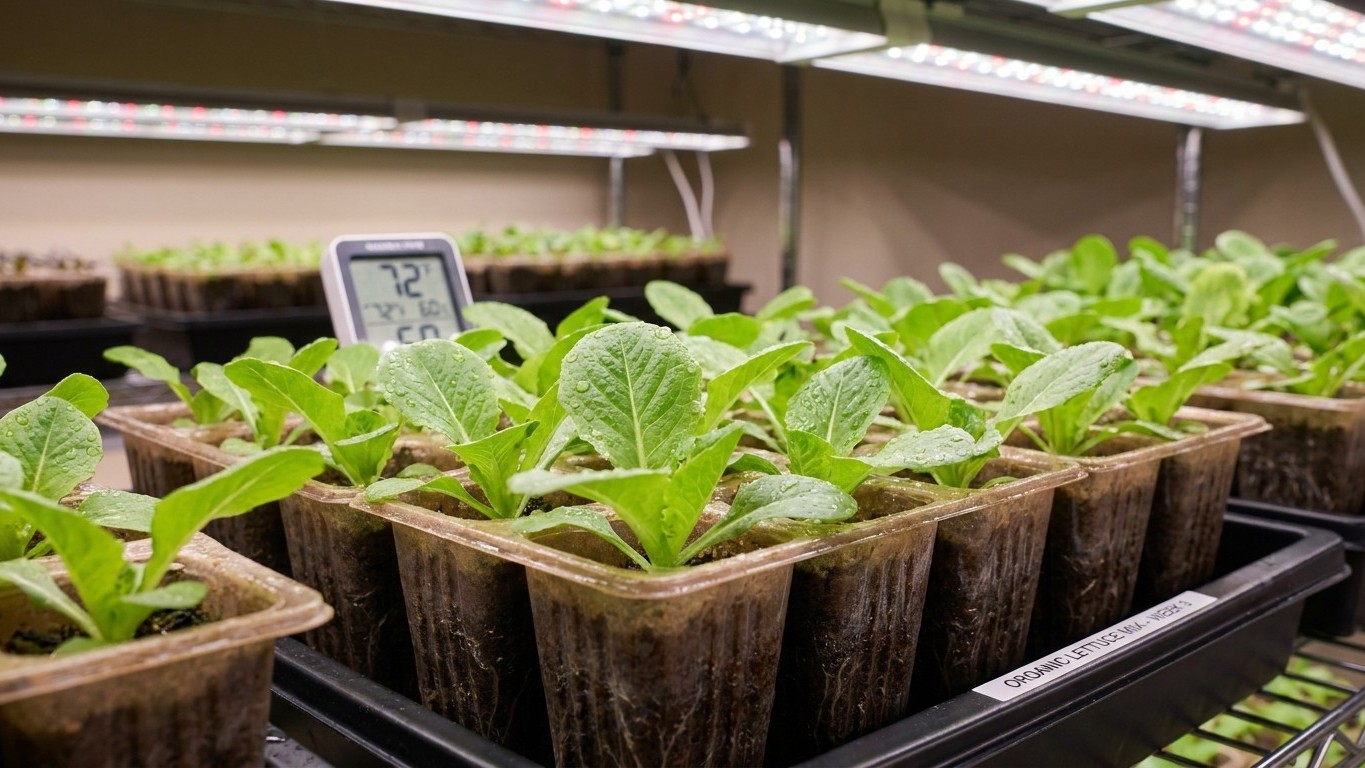

Lettuce rewards speed over patience. Utah State University Extension’s guide “Lettuce in the Garden” lays out the timing precisely: transplants need 5-6 weeks indoors before they carry 4-6 mature leaves and a solid root system, and direct-seeded lettuce goes into the ground 2-3 weeks before that transplant date. Get the spacing tight, the water steady, and the crop finishes before summer heat turns it bitter.
The short answer
Utah State University Extension answers the timing question in two separate tracks, and the tracks point in opposite directions from what most gardeners expect. Transplants should be planted near the last frost-free date for the growing area. Seeded lettuce, by contrast, may be planted 2-3 weeks earlier than that. So the direct-sown row goes in first, and the tray of nursery-grown seedlings follows it to the garden weeks later, once the frost risk has genuinely passed.
Growing those transplants takes its own count. Generally 5-6 weeks are required to grow transplants to the point where they carry 4-6 mature leaves and a well-developed root system. Count backward from your own last frost date, not from a calendar month, since that date shifts by region and even by yard. A gardener in a valley with a late frost and a gardener two towns over on a warmer slope are working from different clocks entirely.
The seed itself has a temperature ceiling that matters as much as the calendar. Lettuce can be sown after soils reach 40°F, though seeds germinate best at 55-65°F and will emerge in 7-10 days. Temperatures above 80°F reduce seed germination. That’s a distinct fact from the plant’s own heat tolerance. Heat can stop a seed from ever sprouting, well before it stops a growing plant from producing leaves. A late, hot start to spring can quietly kill a direct-sown planting before a single leaf appears, and the gardener may never know why the row came up thin.
Once established, the plant has its own comfort zone. Lettuce grows best when temperatures do not exceed 75°F. Temperatures down to 32°F do not seriously damage young plants, which is why an early planting date is worth the risk of a light frost. The logic runs the same direction the whole season: get ahead of the heat, because lettuce tastes best when plants grow rapidly and mature before the heat of summer arrives. A fall crop follows a separate arithmetic. Plant 50-75 days before the anticipated maturity date, and aim for that maturity date to land about 1-2 weeks before the first fall frost. Plants can be left in the garden after light frosts, which gives a fall planting more cushion than a spring one has.
What actually decides it
Three separate mechanisms govern how a lettuce crop turns out, and each one has its own point of failure. None of them is really about the variety chosen. They’re about temperature, water rhythm, and how much room a leaf has to work with.
Heat stress and flavor
High summer temperatures reduce growth, decrease quality, and cause bitter or off-flavors to develop. This is the reason the entire timing strategy in this guide exists: race the crop to harvest before the thermometer works against it. But this defect, unlike most in a vegetable garden, is partly repairable after the fact. Avoid water stressing the plants and growing lettuce in temperatures above 80°F as prevention, and if bitterness still shows up, wash and store the leaves in the refrigerator for a day or two. Much of the bitterness will disappear. That’s a rescue for a harvested crop, not a substitute for growing it right in the first place. A gardener who lets the whole bed bake through a heat wave will still lose crispness and yield that a cold soak can’t bring back.
Moisture rhythm and tipburn
Moisture fluctuations will cause leaves to become tough, slow head development, and contribute to off-flavors. There’s a more specific failure hiding inside that general one: wet and dry periods favor the development of tipburn, a browning of the edge of some of the internal leaves. Internal is the key word. Tipburn shows up on leaves buried inside the head, invisible until it’s cut open, which means a gardener can water carelessly for weeks and only discover the damage at harvest. The mechanism isn’t a nutrient shortage in the soil. It’s an irregular growth rhythm, the same pattern behind tipburn in cabbage and blackheart in celery. The remedy is consistency: water lettuce regularly, supplying 1-2 inches per week, using drip irrigation where possible and mulch to steady soil moisture between waterings.
Spacing as weed control
Lettuce does not compete well with weeds, and weed control is particularly important during establishment. The Extension guide frames spacing itself as the fix: dense plantings will reduce weed pressure, and closely spaced plants will help control weeds. Spacing isn’t just about giving roots room. For this crop, closing the canopy quickly is the weed control strategy, not an afterthought layered on top of it.
How to do it
- Choose a route and count backward from your last frost date. For transplants, start seed indoors 5-6 weeks before you intend to set plants out. For direct seeding, mark a date that falls 2-3 weeks before your transplant date, since that row goes into the garden earlier, not later.
- Check soil temperature before direct sowing. Wait until soil reaches at least 40°F, though germination is fastest and most reliable at 55-65°F, with seedlings emerging in 7-10 days. If a warm spell has pushed soil past 80°F, hold off. Germination drops in that heat even though the mature plant would tolerate it fine.
- Set transplants out near your last frost-free date. Wait for 4-6 mature leaves and a well-developed root system before moving seedlings to the garden. Light frost, down to 32°F, won’t seriously damage young plants, so a slightly early date is a reasonable gamble.
- Space plants for both light and weed control. Set plants 8-12 inches apart in the row, with 12-18 inches between rows, in a spot that gets full sunlight.
- Thin without wasting the extras. Plants removed at thinning can be transplanted to adjacent open areas if some roots are maintained, or simply eaten as an early salad.
- Feed once, at a specific point. Apply 1/4 cup of a 21-0-0 fertilizer per 10 feet of row, 4 weeks after transplanting or at thinning time, to push rapid growth.
- Cultivate carefully as the crop fills in. Cultivate shallowly and avoid root pruning so growth isn’t interrupted through the rest of the season.
- For a fall crop, work backward from the first fall frost instead. Plant 50-75 days before the anticipated maturity date, targeting a harvest window that lands 1-2 weeks before that first frost. Light frosts afterward won’t force an immediate harvest.
What goes wrong
- Bitter, off-flavored leaves. Caused by high summer temperatures and water stress. Prevent it by keeping plants below 80°F where possible and watering evenly; if it happens anyway, wash the leaves and refrigerate them for a day or two, which removes much of the bitterness, though it won’t fix a whole season of stress.
- Tipburn on internal leaves. Wet and dry cycles are the trigger. The fix is regular watering, 1-2 inches per week, delivered through drip irrigation or steadied with mulch rather than left to swing between soaked and dry.
- Weeds overtaking young plants. Lettuce doesn’t compete well with weeds, especially while establishing. Closer spacing closes the canopy faster and is itself the control, alongside early, consistent weeding before the row fills in.
- Toughness from moisture swings. Uneven watering makes leaves tough and slows head development even without visible tipburn. The remedy is the same steady 1-2 inches per week rather than occasional heavy soakings.
- Aphids crinkling leaves. Watch for curled or distorted foliage and treat before populations build.
- Slugs chewing holes in leaves. Avoid moist conditions that favor slugs, since damp mulch and standing water invite them in.
- Flea beetles killing seedlings outright. Use floating row covers to exclude beetles from young plants, since seedlings have little tolerance for this kind of damage.
- Leaf spotting in storage. Refrigerate lettuce at 34-36°F for up to 1-2 weeks, eliminate excess moisture on the leaves, and keep it away from ethylene-producing fruits like apples or pears, which cause the same spotting problem seen in stored cabbage.
Common questions
Which lettuce type should I plant?
Utah State University Extension groups lettuce into four head types: crisphead (including Summertime, Salinas, Great Lakes, and Iceberg), butterhead (Buttercrunch, Esmeralda), cos or romaine (Lentissima, Cimmaron Red Romaine, Italian Blonde Romaine), and leaf lettuce (Red Sails, Oakleaf, Salad Bowl, Black Seeded Simpson). Varieties vary greatly in maturity, flavor, texture, and tolerance to garden conditions, and planting a range of different types makes salads more interesting. The source gives no days-to-maturity figure or size rating for any of these, so the choice comes down to texture and taste preference rather than a numbers comparison.
When do I harvest, and how much will I get?
Lettuce can be harvested almost any time during growth. Crisphead types are ready when heads are firm; butterhead and cos are picked in the early heading stage; leaf lettuce can be cut any time after leaves form, but before the seed stalk forms. Older leaves are often stripped off the plants first, which lets young leaves keep growing, so one plant can supply several pickings rather than a single cut. A 10-foot row yields 4-6 pounds, and the guide suggests planting 5-10 feet of row per person to cover regular eating.
Can I fix bitter lettuce after it’s already picked?
Partly. Washing the leaves and storing them in the refrigerator for a day or two removes much of the bitterness caused by heat and water stress. That’s a genuine rescue for a harvested crop, but it doesn’t restore the crispness or yield lost to a plant that struggled through a heat wave in the ground. Prevention, meaning even watering and avoiding temperatures above 80°F, still matters more than the after-the-fact fix.
Why did my direct-seeded lettuce come up thin?
Check soil temperature at planting time. Seeds germinate best at 55-65°F and will emerge in 7-10 days, but germination drops once soil climbs above 80°F, even though a mature plant would handle that heat without much trouble. A row seeded during a warm spell can fail at the germination stage for reasons that have nothing to do with how the established plants would have performed.