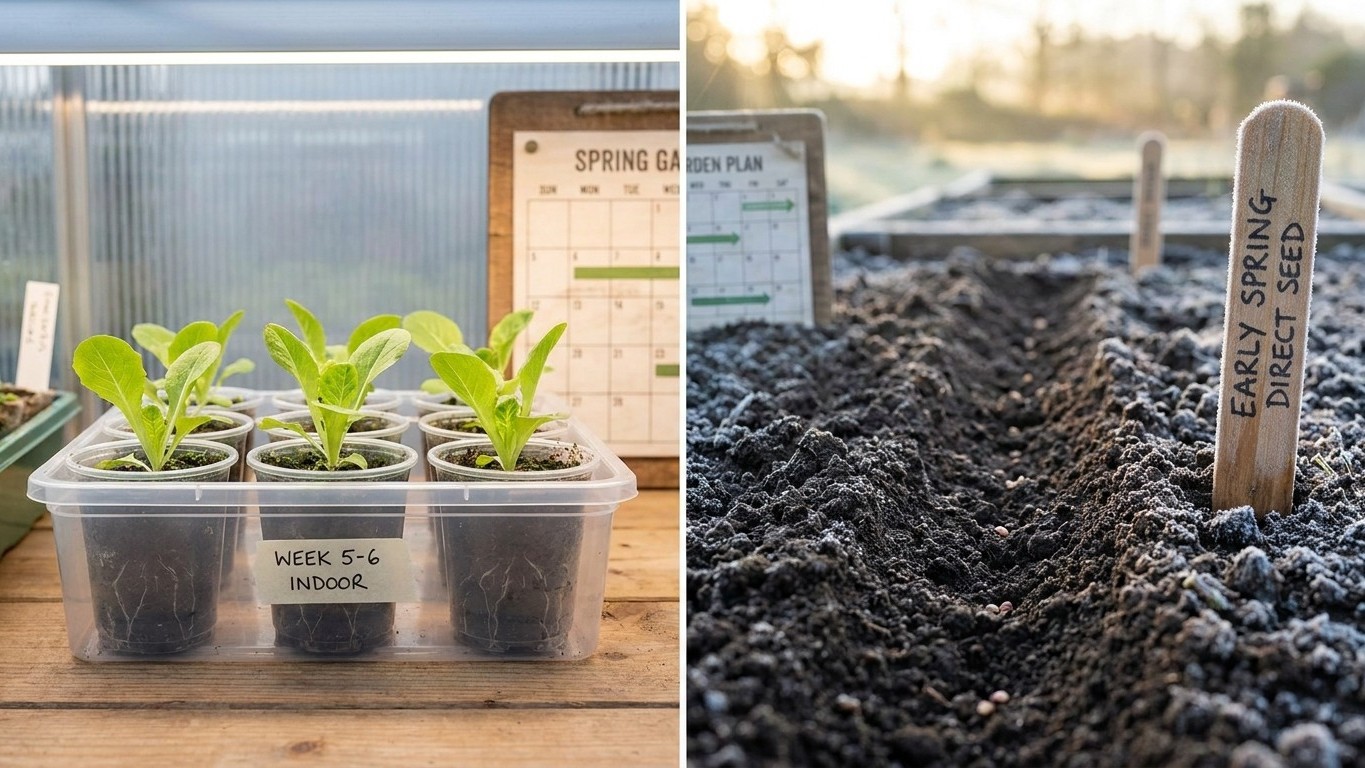

Five to six weeks. That’s how long Utah State University Extension says it takes to grow a lettuce transplant with 4-6 mature leaves and a well-developed root system, ready for the garden. But the timing question has a second layer most gardeners miss: seed goes in the ground before transplants do, not after. The two routes to a lettuce bed run on different clocks, and mixing them up costs you weeks.
The short answer
Utah State University Extension states it plainly in its guide, Lettuce in the Garden (Dan Drost, April 2020): “Generally 5-6 weeks are required to grow transplants” that reach “4-6 mature leaves and a well-developed root system.” That’s the window for starting seed indoors, in a cold frame, or under any protected setup, before those seedlings are strong enough to face outdoor conditions.
The part that trips people up is what happens next. Transplants go into the garden “near the last frost-free date for the growing area.” Direct-seeded lettuce, on the other hand, “may be planted 2-3 weeks earlier.” Most vegetables work the opposite way, wait for the soil to warm, then direct-sow or set out transplants around the same time. Lettuce flips that logic. The seed itself tolerates cold soil better than a tender transplant does, so it earns an earlier slot on the calendar, while the nursery-grown plant waits for safer conditions.
So the five-to-six-week figure answers only half the question. It tells you how long to run the indoor clock before setting transplants out near your last frost date. It does not apply if you’re sowing directly in the garden bed, because that seed goes in two to three weeks ahead of that same frost date, with no indoor growing period required at all. Two paths, two different countdowns, both starting from the same anchor point on your calendar: your local last frost-free date.
This distinction matters most for anyone planning a spring crop from scratch. If you intend to transplant, start counting backward five to six weeks from your last frost date and begin seed indoors then. If you intend to direct-seed, skip the indoor phase and mark your calendar two to three weeks before that same frost date instead. Both methods reach the same garden bed, just from opposite directions in time.
What actually decides it
The reason these two timelines diverge comes down to what lettuce seed and lettuce roots can each tolerate, and what a repair can and can’t fix once a mistake has already happened.
Soil Temperature sets the floor
Lettuce seed can be sown once soil reaches 40°F, but Utah State University Extension notes it “germinates best at 55-65°F and will emerge in 7-10 days.” That 40°F figure is a floor, not a target. Seed sown into barely-thawed ground will still germinate, just slower and less evenly than seed sown once the soil has warmed into that 55-65°F range. This is why direct-seeded lettuce can go in Weeks Before the frost-free date: the seed doesn’t need frost protection the way a leafy transplant does, it needs soil that’s merely workable and above that 40°F threshold.
Heat is a ceiling, not just a stress point
The flip side matters just as much. “Temperatures above 80 F reduce seed germination,” according to the same source. This isn’t a plant-growth problem showing up later in the season, it’s a germination problem that can end the attempt before a seedling ever appears. A gardener who sows too late, once soil temperatures climb past that mark, may see thin, patchy stands regardless of how good the soil or the seed itself was. That’s not a fault you fix with more water or fertilizer; it’s a timing fault, and the only real correction is sowing again earlier, or waiting for the fall window when soil temperatures are dropping back through that ideal range instead of climbing past it.
Thinning is repairable, timing mostly isn’t
One error in this process does have a fix. If a direct-seeded row comes up too thick, Utah State University Extension notes that “plants removed at thinning can be transplanted to adjacent areas if some roots are maintained.” Thinned seedlings aren’t waste, they can be moved and given a second spot in the garden, or simply eaten as young greens. That flexibility doesn’t extend to the calendar itself. Thinning fixes a spacing mistake. It does not undo a germination window missed because soil ran too hot, and it does not replace the five-to-six-week transplant-growing period if seedlings were started too late for that particular route.
How to do it
Both routes anchor to the same reference point, your local last frost-free date, but the arithmetic runs in opposite directions from there.
- Find your last frost-free date. Every date below is counted from this single anchor point, so pin it down first for your specific location.
- If transplanting: count back five to six weeks from that frost date and start seed indoors then. That’s the window Utah State University Extension gives for producing a seedling with 4-6 mature leaves and a well-developed root system, strong enough to handle the move outdoors.
- Grow those seedlings until they hit that 4-6 leaf, well-rooted stage. Don’t rush transplants out early just because the calendar reads close to the frost date; the plant needs to reach that developmental point, not just a certain number of days old.
- Set transplants into the garden near the last frost-free date itself. This is the point where the indoor-grown route rejoins the outdoor calendar.
- If direct-seeding instead: skip the indoor phase entirely and sow two to three weeks before that same last frost date. This is the earlier of the two planting windows, and it only works because seed tolerates cold soil in a way a transplant does not.
- Confirm soil has reached at least 40°F before sowing seed directly, and expect emergence in seven to ten days if conditions sit closer to the 55-65°F range that Utah State University Extension identifies as best for germination.
- For a fall crop, count backward from the first fall frost instead of forward from the last spring one. Utah State University Extension recommends planting “50-75 days before the anticipated maturity date,” with that maturity date landing “about 1-2 weeks before the first fall frost.” Light frosts afterward aren’t a problem, plants “can be left in the garden after light frosts.”
What goes wrong
- Treating the transplant date as the seed-starting date. Some gardeners count five to six weeks back from the frost date, then also sow their direct seed on that same later date. That wastes the two-to-three-week head start direct seeding is built for. If you’re not transplanting, sow earlier, not on the transplant schedule.
- Sowing direct seed once soil has already climbed above 80°F. Germination drops off at that point, according to Utah State University Extension, and no amount of watering fixes a seed that struggled to sprout in soil that hot. The remedy is timing the sowing for when soil sits in the 55-65°F range, or waiting for the fall window when temperatures are heading down instead of up.
- Holding transplants indoors past the five-to-six-week mark because the frost date hasn’t arrived yet. Overgrown, root-bound seedlings don’t transplant as well as ones that reach that 4-6 leaf stage right on schedule. If the frost date is still weeks away and seedlings are already there, the timing of the original sowing was off, not the transplant date itself.
- Letting a direct-seeded row come up too thick and leaving it that way. Crowded lettuce competes for space and light. The fix is thinning, and since Utah State University Extension notes thinned plants “can be transplanted to adjacent areas if some roots are maintained,” or simply eaten, there’s no reason to leave an overcrowded row untouched.
- Aiming a fall crop’s maturity date too close to the first fall frost, or too far from it. The source calls for a maturity date roughly one to two weeks before that frost, counting back 50-75 days from planting to reach it. Miss that window in either direction and the crop either matures too early or risks a harder freeze instead of the light frost the plants can tolerate.
Common questions
Do all four lettuce types (Crisphead, Butterhead, Cos/romaine, leaf) follow the same timing?
Utah State University Extension’s guide covers all four types under the same general planting framework: the same 5-6 week transplant-growing window, and the same near-frost-date transplant timing paired with the 2-3-weeks-earlier direct-seed timing. The source doesn’t assign different schedules by type; the type affects the mature plant’s shape and leaf structure, not the calendar it’s grown on.
Can I direct-seed and transplant in the same garden, same season?
Yes, and doing so effectively means running two separate calendars off the same frost-date anchor. Direct seed goes in two to three weeks before the frost date; transplants, started five to six weeks earlier indoors, go into the ground near that frost date itself. Both crops can share the same bed on a staggered schedule rather than competing for the same planting day.
What if my soil never reaches 55-65°F before it jumps toward 80°F?
That’s a narrow spring window in some regions, and it’s part of why Utah State University Extension also lays out a fall planting schedule. Counting 50-75 days back from a maturity date set one to two weeks before the first fall frost gives a second opportunity to hit that germination sweet spot, this time as soil temperatures fall through the range rather than climb past it.
Is a thinned lettuce seedling worth transplanting, or should I just compost it?
Worth keeping, according to Utah State University Extension, provided “some roots are maintained” during the thinning process. Seedlings pulled to relieve crowding can go into an adjacent open spot in the garden rather than the compost pile, or be eaten directly as an early, tender green. Either use avoids wasting the seed and labor already invested in that row.