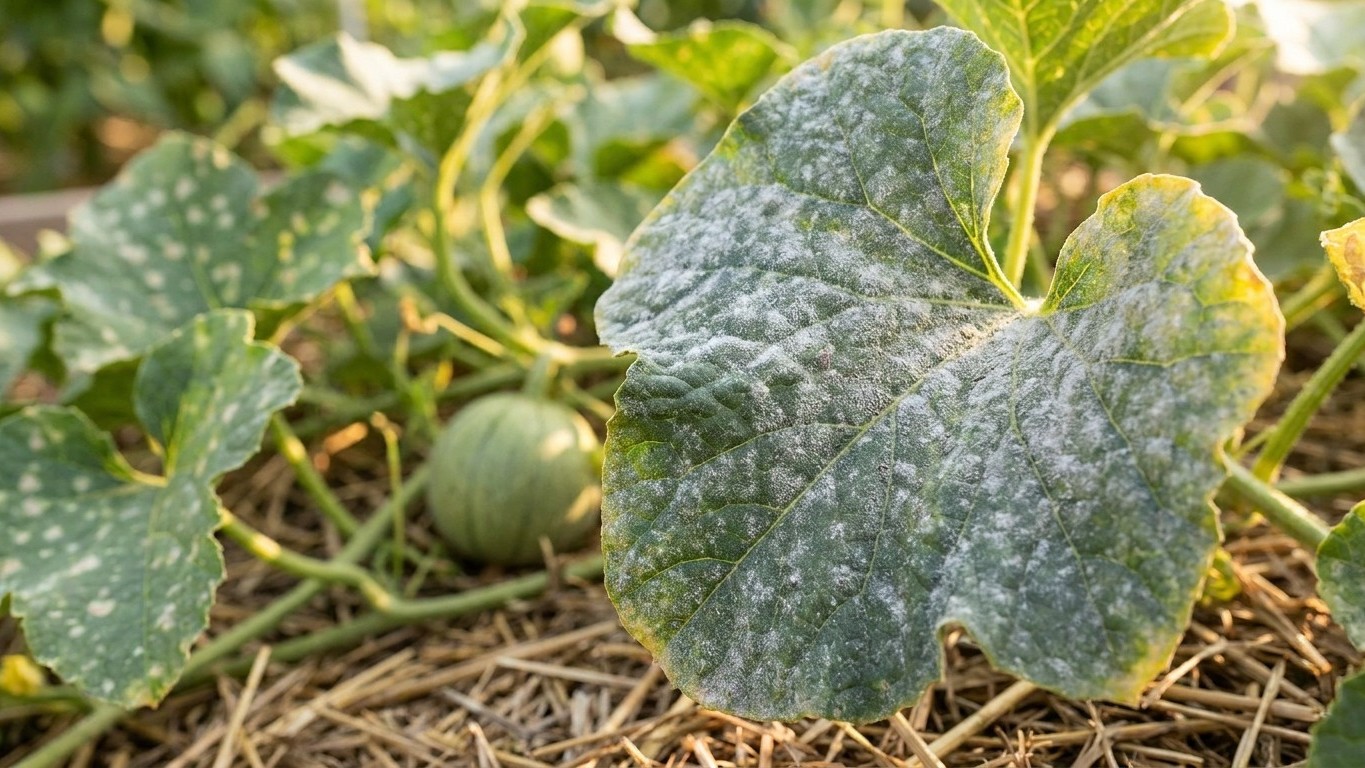

White powder on melon leaves is powdery mildew, a fungal disease that coats the leaf surface and blocks the plant’s ability to make sugar. It rarely kills the vine outright, but if it takes hold while fruit is sizing, the melon stays under-sweet no matter how big or how netted it looks at harvest.
What is actually going on

The thing to understand here is that powdery mildew doesn’t need wet leaves to spread. Unlike many garden fungal diseases, the spores that cause it (mainly Podosphaera xanthii and related species, according to research from land-grant universities) germinate best in humid air with dry leaf surfaces. That’s why it often shows up during stretches of warm days and cool, damp nights, even when the garden hasn’t seen rain in weeks. Overhead irrigation, oddly enough, can sometimes slow it down by washing spores off the leaf.
The fungus starts as small white or gray patches, usually on the older leaves near the base of the plant and on the undersides where humidity sits longest. Left alone, it spreads outward and upward, covering more leaf surface with each generation of spores. A melon leaf coated in mildew can’t photosynthesize at anywhere near its normal rate. It’s still green underneath the powder for a while, but its sugar output is already dropping fast.
That matters more on melons than on almost any other vegetable garden crop, because melon sweetness comes entirely from sugar the leaves send into the fruit while it’s still attached. A melon does not sweeten after picking. It softens, the flesh texture changes, but the sugar content is locked in at the moment the stem parts from the vine. So when mildew strips the canopy during the two or three weeks when the fruit is filling out, the plant simply runs out of manufacturing capacity right when the fruit needs it most. The melon can still reach full size on stored reserves, but it won’t reach full flavor.
This is also why timing the disease matters more than eliminating it. A little mildew on lower leaves late in the season, after fruit has already finished sizing, costs almost nothing. The same amount of mildew showing up three weeks earlier, while the fruit is still swelling, can flatten the flavor of an otherwise perfect-looking melon. Gardeners who’ve grown a picture-perfect netted melon that tasted like wet cardboard usually lost the canopy at exactly the wrong moment, not necessarily the whole plant.
In the garden
Once the white patches show up, the response depends on how far along the fruit is and how much canopy is left to lose. A few actions matter more than the rest, and each one has a real cost if it’s skipped or done at the wrong time.
| Action | Why it helps | What happens if skipped or mistimed |
|---|---|---|
| Scout the undersides of older leaves weekly once vines start running | Catches the first patches before spore counts build up and spread to leaves shading the fruit | By the time powder is visible from a walk-by glance, the infection is usually already several leaf-layers deep |
| Remove the worst-affected leaves rather than the whole vine | Cuts spore load without stripping photosynthetic tissue the fruit still needs | Over-pruning healthy leaves to “be safe” reduces sugar production just as much as the disease would have |
| Space plants and prune for airflow early in the season | Lower humidity around the leaf surface slows spore germination | Dense, tangled canopies stay humid at the leaf level even in a dry week, and mildew moves faster through them |
| Apply a fungicide labeled for powdery mildew on cucurbits (sulfur-based, potassium bicarbonate, or horticultural oil products, rotated by mode of action) | Slows new infections and can stop light cases from progressing | Applying the same material repeatedly builds resistance in the fungus population fast; rotation matters more than the specific product |
| Watch nitrogen levels rather than pushing extra growth mid-season | Lush, soft new growth is more susceptible than mature, moderately fed foliage | Heavy late-season nitrogen produces exactly the tender leaf tissue mildew colonizes fastest |
| Track fruit maturity signs (stem slip, ground-spot color, aroma) rather than pulling fruit early out of worry | Sugar delivery only stops at the actual cut or slip, so every extra day on healthy vine tissue counts | Picking early because the plant “looks sick” locks in whatever sugar level the fruit has already reached, permanently |
None of these steps eliminates powdery mildew completely once conditions favor it. That’s not really the goal. The goal is keeping enough working leaf area alive through the fruit-fill window, since a plant that loses half its canopy after the melons are already sized can still finish a decent crop.
What it depends on where you are
How fast this disease moves, and how much damage it does before frost, has almost everything to do with a garden’s season length and summer weather pattern. A short growing season with a narrow window between last frost and fruit maturity leaves less room to recover from mid-season leaf loss than a long, hot season does. Regions with high summer humidity tend to see mildew pressure build earlier and harder than dry-summer regions, even at similar temperatures, because the fungus favors humid air over wet leaves specifically.
Heat also changes the calculation in a less obvious way. In climates where nighttime temperatures stay warm through summer, the humid-night, dry-day pattern that favors spore germination is less pronounced, and mildew pressure can actually be lower than in regions with cooler, damper nights even during a hot spell. None of that is something a national gardening page can specify without guessing at a location, and guessing here would do more harm than leaving it open.
The practical move is to use the mechanism here and the state extension service as the local translation of it. Extension plant pathology bulletins track which years and which counties see early mildew pressure, and they base spray-timing recommendations on regional weather monitoring that a general guide simply doesn’t have access to. Land-grant university cooperative extension offices also run the variety trials that show which melon types have held up best against local mildew pressure in actual field conditions, which is the right place to look for resistant types rather than any single article. This site’s other melon guides cover planting windows and harvest timing in more general terms, but the state-by-state disease pressure and spray-timing detail belongs with the extension service closest to the actual garden.
The mistake that costs the most
The single costliest mistake isn’t ignoring the white powder. It’s panicking over it and pulling the fruit early to “save” it once the vine starts looking rough. That instinct feels responsible, like getting ahead of a problem, but it works against the plant’s biology in exactly the wrong way. A melon showing decent size and some netting or color change might look ready when the vine around it is half-covered in mildew, and the temptation to cut losses and harvest early is strong. But since sugar accumulation stops the instant the fruit separates from the vine, picking early on the assumption that it’ll finish ripening indoors just locks in an under-sweet melon permanently. There is no windowsill stage that adds sugar back.
The better move is to protect the leaves that are still healthy for as long as possible, remove only the leaves that are clearly compromised, and judge harvest timing by the fruit’s own ripeness signals, stem slip, ground-spot color, and aroma at the blossom end, rather than by how alarming the foliage looks. A vine can lose a meaningful share of its canopy to mildew late in the fruit-fill period and still finish a melon with reasonable sweetness, as long as enough leaf area survives long enough. Reacting to the disease by harvesting early trades a fixable problem (some lost leaf area) for an unfixable one (a permanently under-sweet melon), and that trade is the one that costs gardeners the most flavor for the least reason.