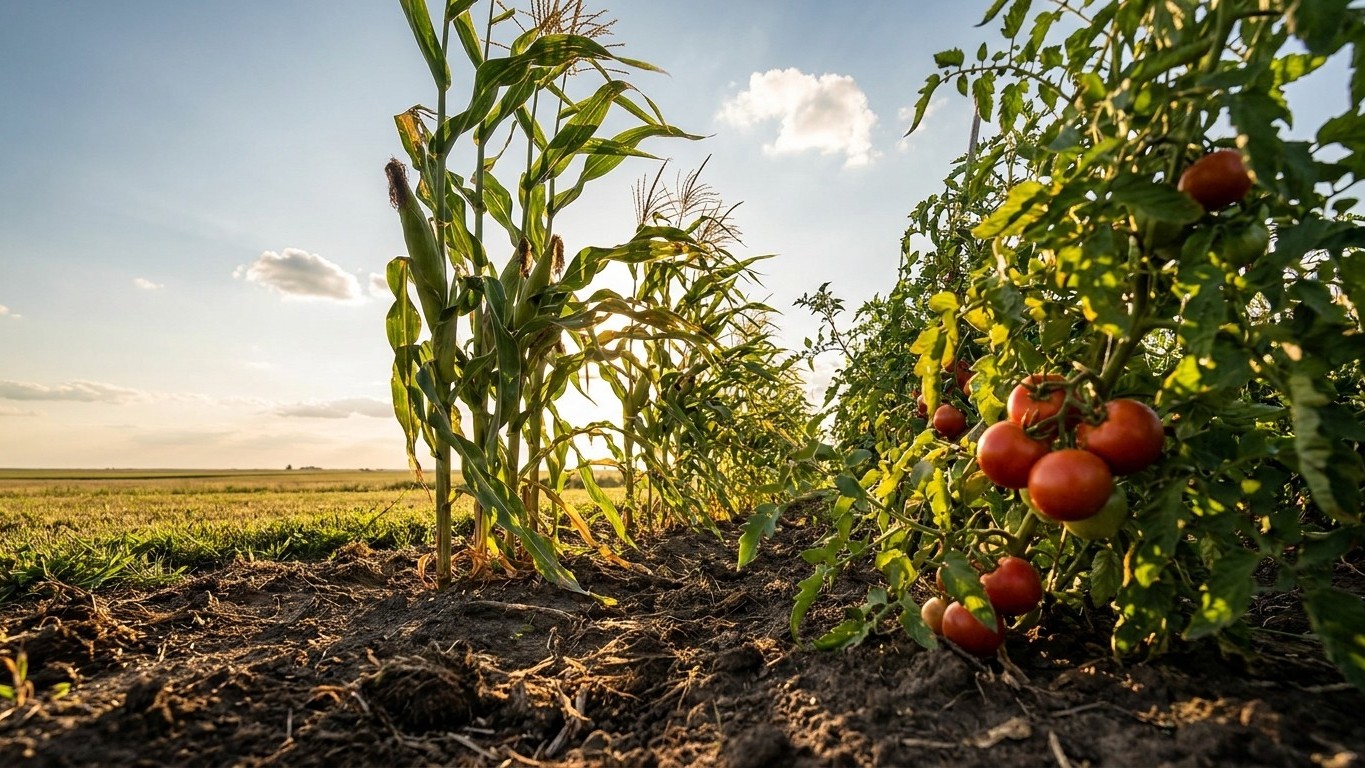

Sweet corn in Quebec gets eaten in three waves. Soil-dwelling insects and birds go after the seed and seedlings first. Chewing caterpillars and beetles show up around tassel and silk. Mammals and birds arrive last, when the ears fill with sugar. The short frost-free season packs all three waves into a few months, so the calendar matters nearly as much as the species. What you see on the plant tells you which wave you are in.
Which pests attack corn in Quebec
The species that matter differ from one region of the province to the next, and the lists come from the extension and advisory offices that serve each area. A single province-wide roster would mislead. What holds everywhere is how the pests feed, and that sorts them into a few groups you can recognize in the row.
Which pests go after seed and seedlings?
Insects living in the soil chew on the seed before it sprouts or hollow out the germinating kernel. Caterpillars that feed at the soil line cut young plants off at the base, so a seedling lies on the ground with the leaves still green. Birds pull sprouts to get at the kernel attached underneath. All three hit in the first weeks, while the plants are small and slow to grow in cool soil.
Which pests go after leaves, silks and ears?
Leaf-chewing caterpillars feed inside the whorl, the tight funnel of new leaves at the top of the plant. Borers tunnel into the stalk and the ear shank, the short stem that holds the ear. Ear-feeding caterpillars enter at the silk tip and work down the cob. Beetles that clip silks reduce pollination, because each kernel needs its own silk to be fertilized. Once the kernels turn sweet and milky, mammals and birds come for the ears.
Identify the damage pattern before you treat anything. A treatment aimed at the wrong group costs money and does nothing for the crop. The extension or advisory office serving your area can name the species active near you, and a photo of the damage is usually enough to start that conversation.
When each one shows up, and what it does first
The reference station at Montréal/St-Hubert A shows a mean last spring frost of May 6 and a mean first fall frost of October 5. Those are midpoints. In one year out of two, the last spring frost falls later than May 6, and in one year out of two the first fall frost arrives before October 5. Northern and upland districts run weeks behind this station, so measure your own season from the plants, not from a date.
Corn does not start on the frost date anyway. Clemson Extension says: “Do not plant before the soil temperature at the 4-inch depth is at least 50 ºF. Wait to plant extra-sweet varieties until soil temperatures reach 65 °F.” Soil at 50 ºF at the 4-inch depth is about 10 °C, and 65 °F is about 18 °C. Both come well after the last frost, and the pest calendar starts from planting, not from the frost date.
- Planting to emergence: seed that sits in cool soil is the easiest target. The first sign is a row with gaps, and digging shows a hollowed or missing kernel.
- First weeks after emergence: seedlings cut at the soil line, or small leaves with ragged edges.
- Whorl stage through tassel: holes that line up across unfurled leaves, and sawdust-like debris at the leaf axils or along the stalk. Stalks that bend or break can follow.
- Silk emergence to harvest: brown, chewed or clipped silks, then missing kernels at the ear tip. Raiders arrive as the ears fill, and the cobs may be stripped overnight.
Sweet corn needs soil above 60 °F (about 16 °C) and 60-90 days from planting to mature. Once silks appear, watch the ears closely, as that is the window for raiders. A late planting moves silking into a different part of the summer, so the pests that meet it may not be the ones that met an early row. If you want more on timing, see When to Sow Sweet Corn in Quebec.
Telling the damage apart from everything else
Many corn problems that look like insect damage are not. A wrong diagnosis sends a gardener to treat for a pest that is not there, while the real cause, usually water, wind or soil, keeps going. The table gives the sign that separates each look-alike from insect feeding.
| What you see | Possible causes | What settles it |
|---|---|---|
| Seedling lying flat | Insect cutting at the soil line, or a rot at the base | A clean cut with no soft tissue suggests an insect. A water-soaked, brown or soft base suggests rot. |
| Ragged, shredded leaves | Chewing insects, or hail and wind | Hail damage appears on every plant after one storm. Insect damage is patchy and often comes with droppings in the whorl. |
| Leaves rolled in the afternoon | Dry soil or heat stress | If the leaves open again in the evening and the soil is dry a few inches down, water is the cause. |
| Yellow or purple lower leaves | Nutrient shortage or cold soil | Insects leave marks on the leaf. A shortage shows up as an even color change across the plants. |
| Gaps in the kernel rows | Poor pollination, or insects feeding on the ear | Chewed kernels with debris point to insects. Clean, empty spots point to pollination. |
| Tough, starchy kernels in a sweet ear | Types that tassel at the same time | No chewing is involved. Sweetness is lost when su, se and sh2 types tassel together. |
| Broken or leaning stalks | Borers, or wind | Split a stalk. A tunnel inside means an insect. A clean stalk that snapped at one height suggests wind. |
Heat is rarely the explanation in Quebec. At Montréal/Pierre Elliott Trudeau Intl A, 9.3 days a year reach 30 °C, and only 2.8 days a year reach 32 °C. Hot spells are short, so dry soil is the first thing to check when leaves curl.
What actually works here, and what is a waste of time
A physical barrier placed at the right moment beats a treatment. Netting or row cover over the seedlings keeps birds and some insects off during the weeks when the plants are most vulnerable. Take the cover off before tassel, because sweet corn is pollinated by wind and a covered plant sets poor ears. Fencing around the patch works the same way: it has to be up before the ears fill, since animals that learn the patch will return to it.
Timing does more than any product on a short season. Sowing when the 4-inch soil has reached its threshold means the seed germinates fast and spends fewer days in the ground as a target. Extra-sweet types sown in 50 °F soil rot instead of sprouting, and that loss is often blamed on insects. Plant in blocks of three or more rows, as Utah State University Extension advises, so the pollen reaches the silks. Stagger the types so su, se and sh2 do not tassel at the same time.
Harvest on time too. Pick when the silks are dry and brown, the husks are still moist and green, and a punctured kernel gives milky juice. Clemson Extension explains why waiting costs you: “Sweet corn loses sugar from the kernel rapidly at high temperatures… Sweet corn can be stored under optimal conditions for about five days, but will lose sweetness with each day of storage.” The su type loses sugar fastest, se holds it longer, and sh2 longest.
Several common habits waste effort. Scarecrows, reflective tape and plastic decoys work for a few days, then birds and animals ignore them. Spraying on a schedule without knowing what you have treats pests that may not be there. Putting down any treatment before you have identified the damage is the costliest mistake. What is registered for sweet corn in Quebec is a question for the extension office, which knows what is approved and when it can be used.
Where to check this for your own county
Your regional agricultural extension or advisory office, the one serving your county (an MRC in Quebec), is the place to confirm what is active near you. Ask which pests were recorded in your district recently, and whether anything unusual has been reported this season. A province-wide record says what exists somewhere in Quebec. It does not say what is in your garden.
Pest presence changes inside a territory because of soil, nearby crops and local weather. A patch next to a field of corn faces different insects than one in a village backyard. The frost means above come from 30-year climate normals, so treat them as the midpoint of a window.
If you are weighing varieties against the season, Will Sweet Corn Ripen in Quebec? covers how 60 to 90 days from planting fits the frost-free period. For the full picture of the crop, see Growing Sweet Corn in Quebec.
The next step is simple: push a thermometer 4 inches into the soil before you sow, take a photo of any damage you find, and bring both to the office that serves your county.
Common questions
Can I plant sweet corn earlier to avoid pests?
No. Planting before the 4-inch soil reaches 50 ºF for ordinary sweet corn, or 65 °F for extra-sweet types, leaves the seed sitting in cold ground, where it rots or gets eaten. The frost date is not a planting date.
When do animals start raiding the ears?
They come when the kernels fill with sugar, after silk emergence. Have fencing in place before then.
Is cross-pollination damage easy to mistake for insects?
Yes. Tough, starchy kernels in a sweet ear come from types that tassel at the same time, and there is no chewing at all. Chewed kernels with droppings point to an insect, so look at the ear tip before deciding.
Is heat a big problem for corn in Quebec?
Rarely. When leaves curl in the afternoon, check how dry the soil is a few inches down before looking for insects.