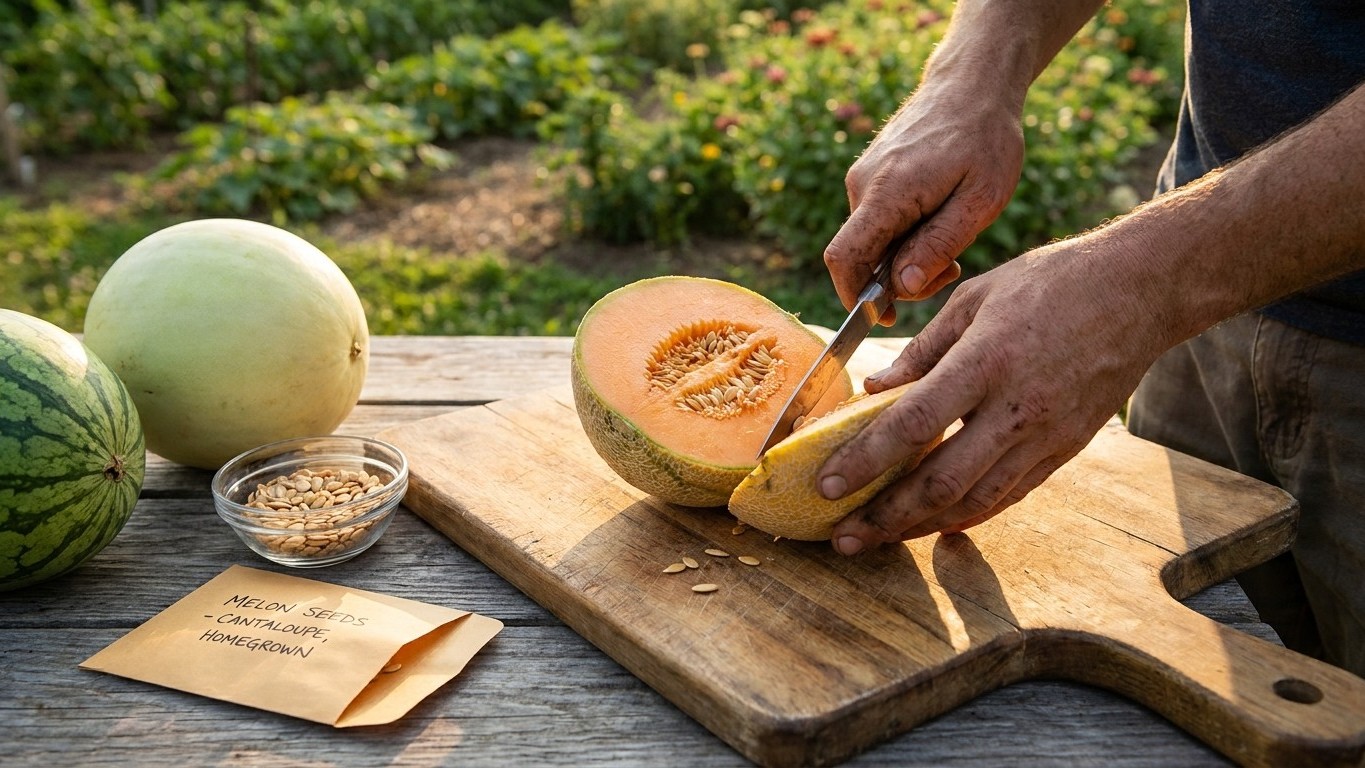

Melon seed saving comes down to one biology fact: cantaloupes, honeydews, and other muskmelon types belong to the same species and cross freely with each other, while watermelon is a separate species and won’t cross with any of them. Save seed from an isolated single variety of the melon-type you grew, and skip seed from anything grown near a different variety of the same species.
What is actually going on

The thing to understand here is cross-pollination: bees move pollen from flower to flower, and they don’t care whether two plants are “different varieties” in a seed catalog. What matters to the plant is species. Cantaloupe, honeydew, casaba, canary melon, and most of what gardeners lump together as “muskmelon” are all Cucumis melo. Grow two of them within bee range of each other and the flowers will cross. Watermelon is Citrullus lanatus, a different genus entirely, so it can sit right next to a muskmelon patch all season and never cross with it.
Here’s the part that trips people up: a cross doesn’t show up in this year’s fruit. The melon on the vine right now grew from the mother plant’s own tissue, so it looks and tastes exactly like it’s supposed to, even if a bee carried in pollen from a different variety three rows over. The cross lives inside the seed. Plant that seed next spring and you might get a fruit with different flesh color, different sweetness, or a rind pattern nobody planted on purpose. This is why a gardener can save seed for years, get burned once, and have no idea which season the mixing actually happened.
Isolation distance is the tool that prevents this, and it works because bee traffic drops off with distance, not because it hits some hard wall. Seed-saving organizations generally recommend a substantial separation, measured in hundreds of yards to a half mile depending on how much pollinator pressure is in the area, or hand pollination with bagged flowers when garden space doesn’t allow that kind of spread. Neither option is exotic. Hand pollination just means taping a female flower shut the evening before it opens, pollinating it by hand the next morning with pollen from a flower on the same variety, and re-covering it until the fruit sets.
Ripeness deserves its own line here because seed maturity and eating maturity are not the same clock. A melon does not sweeten after picking, it only softens. Sugar accumulation stops the moment the stem separates from the vine, so a melon picked early for the kitchen table is picked early for seed too, and the seed inside it may not be fully developed even if the flesh tastes fine. Seed-saving fruit generally needs extra time on the vine past the point you’d normally harvest for eating, which is one more reason to mark a saved-seed fruit early and leave it alone.
In the garden
Most backyard gardens grow more than one melon type, which is exactly where saved seed goes wrong. The table below covers the common combinations, what separation actually protects the seed, and what shows up next year if that separation gets skipped.
| Combination grown together | What’s needed for pure seed | What happens if skipped |
|---|---|---|
| Two different muskmelon/cantaloupe varieties | Isolation distance or hand pollination with bagged flowers | Next year’s fruit shows mixed traits: altered flesh color, changed sweetness, odd rind texture |
| Muskmelon and honeydew (or other C. melo type) | Same isolation rules as above; they’re the same species | Same risk as above; the cross is invisible until the seed is grown out |
| Watermelon and any muskmelon type | None required for cross prevention; different species | No cross occurs; seed stays true even grown side by side |
| Muskmelon and cucumber | None required; different species, don’t cross | No cross occurs, despite the common assumption that “melon family” plants all interbreed |
| Two different watermelon varieties | Isolation distance or hand pollination; watermelons cross with each other | Next year’s fruit shows mixed rind pattern, flesh color, or seed size |
The row people get wrong most often is the muskmelon-and-honeydew pairing, because the two fruits look so different on the outside that gardeners assume they’re safely unrelated. They aren’t. If isolation wasn’t practiced and a gardener saves seed from both anyway, the honest fix isn’t to guess which fruit stayed pure. It’s to treat both batches as unreliable for variety-true seed and either grow them out as a curiosity or start isolation fresh next season.
Hand pollination is the more reliable option in a small yard where distance isn’t available. It takes attention at the right hour of the morning when flowers first open, and it takes marking the pollinated flower so the resulting fruit is easy to find later. A fruit that was hand-pollinated and left unmarked is a fruit that gets picked by mistake at the wrong time, which brings the ripeness problem back into play: once it’s off the vine, the seed inside stops developing, full stop.
What it depends on where you are
Some of this is fixed biology, true everywhere melons grow. Muskmelons cross with muskmelons, watermelons don’t cross with muskmelons, that doesn’t change by state. But a few pieces of the picture are genuinely local.
Season length decides whether a seed-saving fruit even has time to reach full seed maturity. In a short growing season, a fruit left on the vine long enough to develop mature seed may be racing an early frost, and a gardener working with a compressed window needs to choose early varieties and plant timing that leaves margin for that extra ripening period. In a long, warm season, that margin is rarely a concern, and the bigger issue tends to be keeping enough plants isolated across a longer bee-active period.
Humidity and rainfall around harvest time affect what happens after the seed comes out of the fruit, not before. Wet, humid conditions during the fermentation and drying stage raise the risk of mold on the seed, which pushes some gardeners toward faster drying setups or extra attention to air circulation. Dry climates make that stage more forgiving but can dry fruit out unevenly on the vine if irrigation isn’t managed.
Local land-grant university extension services run variety trials suited to their own soil, heat, and disease pressure, and their recommendations for a given state carry more weight than a national list ever could. Checking the other melon guides on this site for state-specific coverage, alongside a call or visit to the local extension office, fills in the part of this answer that depends on where the garden actually sits.
The mistake that costs the most
The single costliest mistake is judging seed purity by how this year’s fruit looks or tastes. It doesn’t work that way, and it’s the reason so many home seed-savers get a surprise a year or two down the line. A cross-pollinated flower still produces a completely normal-looking, normal-tasting fruit in the same season, because the fruit’s flesh is the mother plant’s own tissue. The cross is locked inside the seed, invisible until that seed gets planted and grows into a plant of its own.
This leads gardeners to a false sense of security. They grow two muskmelon varieties a short distance apart, eat both, find both delicious, and conclude the seed must be fine too. Then next spring they plant saved seed expecting one variety and get fruit with a blended set of traits instead, unable to trace which season the mixing happened in because nothing looked wrong at the time.
The fix isn’t a taste test or a visual check. It’s active isolation, decided before the flowers ever open. That means either physical distance between different varieties of the same species, or hand pollination with bagged flowers marked clearly enough to track through harvest. Skip that step and there’s no after-the-fact way to confirm purity; the only honest option at that point is to treat the saved seed as unreliable for variety-true results. For anyone naming specific varieties to plant, the local extension service is still the better source than guessing from a seed packet description, since it can point to what’s actually been trialled and performed well under local conditions.