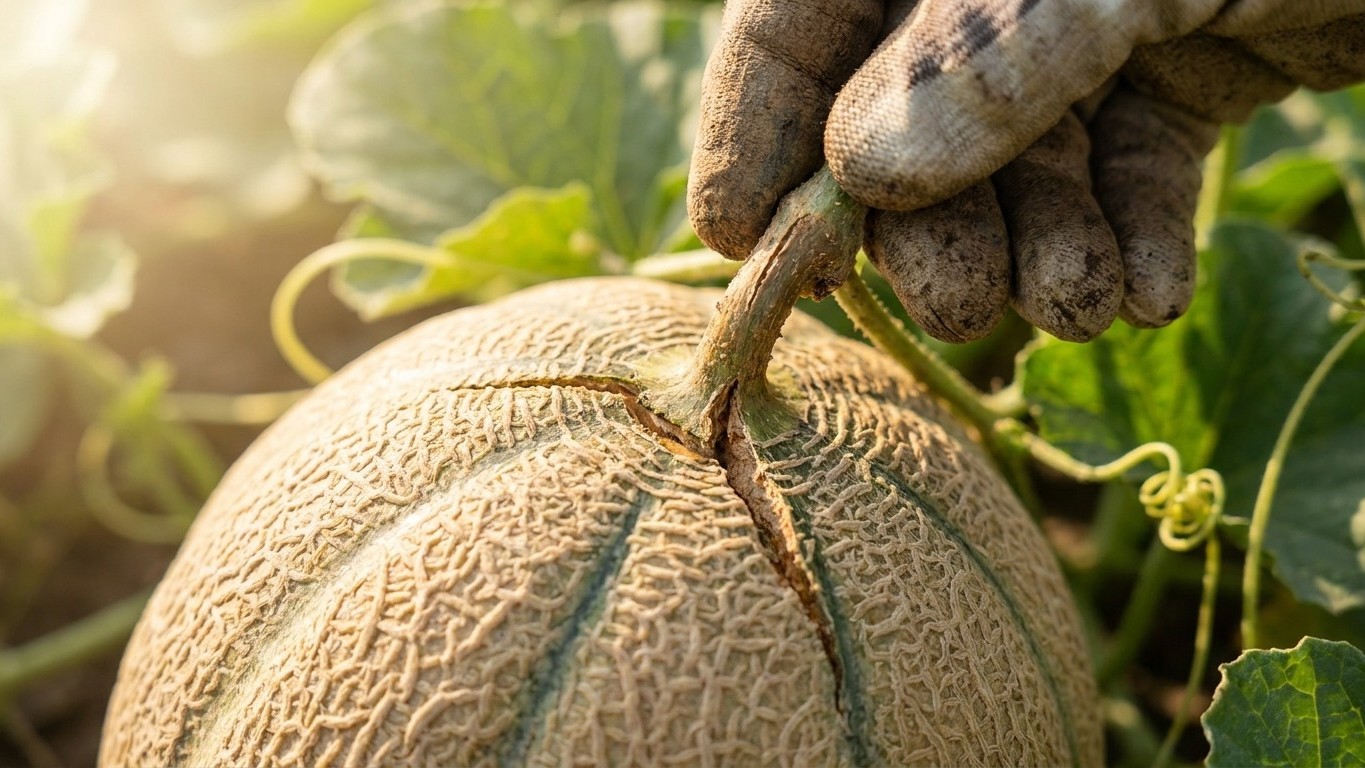

The stem is doing the ripening report for you. On a full slip, the fruit separates from the vine with barely a nudge because the plant has built a clean break layer at the stem. On a half slip, that layer is only partway formed, which on some melon types is exactly when growers used to pick, and on others is a sign to leave the fruit alone a while longer.
What is actually going on

The thing to understand here is abscission: a layer of cells forms right where the stem meets the fruit once the plant has finished pushing sugar into it. That layer is a deliberate structure, not decay. As it matures, a visible crack appears in the stem tissue before the fruit actually lets go. That crack is the “slip” you’re watching for, and it’s the plant’s own signal that transport of sugars from vine to fruit has stopped or is about to.
This mechanism only exists in muskmelons, the group that includes cantaloupe-type and netted melons. Watermelons don’t have it at all. Honeydews and most winter melon types don’t either. That single fact explains a lot of confusion: gardeners who grew up picking cantaloupe by the stem sometimes go looking for the same crack on a honeydew vine and never find it, because it was never going to happen. Those types have to be judged by other cues instead, like a change in rind color, a waxy bloom on the skin, or the way the blossom end gives slightly under thumb pressure.
Here’s the part that trips people up most: a melon does not sweeten after it’s picked. It softens. The texture keeps changing on the counter because moisture and cell structure keep shifting, but the sugar content is locked in at the moment the stem parts. Once that abscission layer separates, whatever sucrose and fructose made it into the flesh is all there’s going to be. There’s no windowsill fix for a melon pulled early. That’s different from a tomato, which can still convert stored compounds into sugars off the vine, and treating a melon the same way is a common and costly mix-up.
Full slip means the separation layer has finished its job, and the fruit comes free with almost no resistance, sometimes even dropping on its own. Half slip means the layer is still incomplete. Applying pressure at that stage will detach the fruit, but it takes real effort and it’s an act you’re forcing rather than one the plant has completed. Whether that’s a problem depends entirely on the melon type in question, which is where the practical decisions actually live.
In the garden
For gardeners, the useful question isn’t “what does slip mean” in the abstract but “what do I do with this specific vine, right now.” The table below covers the main melon groups and what tends to go wrong at each stage.
| Melon type | Slip behavior | If picked too early | If left too long |
|---|---|---|---|
| Cantaloupe / netted muskmelon | Develops a true abscission crack; full slip is the marker to use | Flesh stays pale, watery, and underwhelming; no fix once it’s off the vine | Fruit can drop and split on impact, or soften into a mealy texture in humid weather |
| Honeydew and other smooth-skin types | No reliable slip; judge by rind color shift and blossom-end softening | Rind stays dull green with a firm blossom end; flavor is thin | Rind can go slightly yellow and the fruit becomes prone to splitting at the stem scar |
| Watermelon | No slip mechanism at all; relies on tendril drying, ground spot color, and sound | Hollow interior, pale pink flesh, hard white seeds | Flesh turns mealy and the rind can weaken enough to crack in the field |
| Casaba and canary-type melons | Little to no slip; rely mostly on rind color and slight give at the stem end | Flesh is firm and largely flavorless | Rind can develop soft spots and the fruit becomes vulnerable to rot at the vine |
Half slip has a real history for muskmelons headed to market. Fruit picked at that stage handles shipping better because the flesh is still firm, and decades of commercial practice built around that fact. For a home garden, though, there’s rarely a reason to pick before full slip. Nobody’s trucking the melon across three states, and the flavor difference between half and full slip on a muskmelon is not subtle once you’ve tasted both side by side.
The other thing worth building into a routine: check by touch, not by tug. Cradle the fruit and press gently with a thumb near the stem rather than yanking on the vine. Pulling on a fruit that isn’t ready can tear the stem and open a wound that invites rot, and it tells you nothing useful anyway, since the plant hasn’t finished the job. For the varieties best suited to a given growing season, a state extension service is the right place to check what’s been trialled locally, since regional trial data will always beat a generic description of “cantaloupe.”
What it depends on where you are
The mechanism itself, abscission layer forming and cracking, is the same everywhere melons are grown. What changes by region is the timing and the reliability of the signal, and that part genuinely depends on local conditions.
Season length sets how much runway a vine has to finish the ripening process before frost or harvest deadlines force an early pick. A shorter growing season can mean a gardener pulls fruit at half slip out of necessity, accepting a flavor tradeoff rather than losing the melon entirely. Summer heat changes how fast sugars accumulate and how quickly that abscission layer forms once it starts, so the window between “starting to slip” and “fully slipped” can be a matter of a day or two in hot conditions and considerably longer in cooler ones. Summer rainfall matters too: heavy rain near harvest can dilute sugar concentration and also soften rinds in ways that make the slip test less reliable, since a fruit weakened by excess moisture can separate early without having finished ripening properly.
Humidity plays a role as well, particularly for how long a fruit can safely sit at full slip before it starts to break down. In a humid climate, that window can be short. In a dry climate, a fully slipped melon might hold in decent shape for longer before it needs to come off the vine or into the kitchen.
None of this is something a national page can specify without guessing, and guessing on dates or zones is exactly what leads gardeners astray. The more reliable path is checking the state-specific pages on this site for the growing conditions in question, and pairing that with a call or visit to a local extension office, which will have actual trial data for melon types performing well in that specific region and climate pattern.
The mistake that costs the most
The single costliest error is picking a muskmelon at half slip and assuming it will finish ripening on the counter. It won’t. The plant has already told you, through that incomplete abscission crack, that the sugar transfer isn’t done. Removing the fruit at that point locks in whatever sweetness has accumulated so far, and nothing that happens afterward, not sitting in a warm kitchen, not wrapping it in a paper bag, not any trick borrowed from tomato or avocado ripening, will add to that. The melon will get softer. It will not get sweeter.
This mistake usually comes from good intentions. Gardeners worry about squirrels, raccoons, or a coming storm, and pick early to protect the fruit rather than lose it outright. That’s a reasonable tradeoff to make consciously, but it should be made knowingly, not on the mistaken belief that a half-slipped melon just needs a few more days indoors to catch up. If protecting the fruit is the real concern, better options include netting the vine, harvesting slightly earlier only when a genuine threat is imminent, or simply accepting a milder flavor as the cost of getting the fruit at all.
The fix is straightforward: check daily once a melon starts showing any separation at the stem, using gentle thumb pressure rather than pulling, and let the fruit tell you when it’s actually ready by coming free on its own with minimal effort. For melon types that don’t slip at all, that same patience has to be redirected toward the other signals, rind color, ground spot, blossom-end softness, since waiting for a crack that will never appear is its own version of the same mistake. Either way, the fruit’s flavor was decided on the vine. The harvest moment only decides whether you get to taste it at its best or settle for whatever sugar had accumulated by the day you picked.