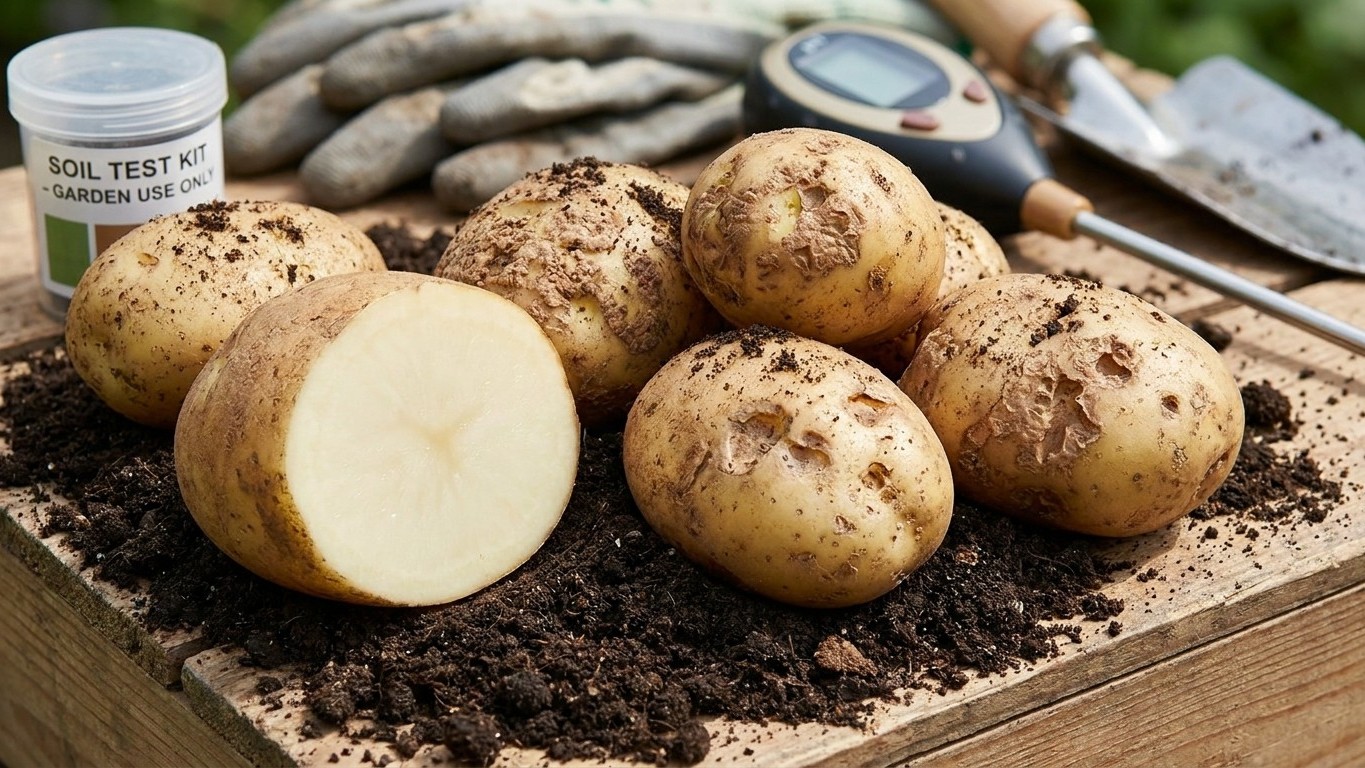

Common scab shows up as rough, corky patches on potato skin, and one factor predicts it better than anything else: soil pH. Soils that sit neutral to alkaline, above pH 7.0, favor the bacterium behind the disease. Drop below that line and the risk falls sharply. That threshold comes straight from the Pacific Northwest Plant Disease Management Handbook, and it’s the number worth checking before you touch a shovel.
The short answer
The disease gets its name from what it does to the tuber, not the plant. Corky lesions appear on the tuber’s surface. Lesions may be small and superficial or consist of deep pits. Some potatoes come out of the ground with a light, rough rash you can barely feel. Others come out scarred with craters deep enough to change how you peel them. Either way, the flesh underneath is usually fine to eat once you cut around it, but the crop looks bad enough that a lot of gardeners assume they’ve lost the harvest.
The Pacific Northwest Plant Disease Management Handbook, produced jointly by Oregon State University, Washington State University, and the University of Idaho, is the reference document behind almost everything reliable written about this disease in North American home gardens. Its authors, P. B. Hamm and C. M. Ocamb, trace the problem to a single culprit: Streptomyces scabies […] a filamentous bacterium that lives in soil and on diseased tubers. It’s not a fungus, not a virus, and not something that arrives on the wind. It’s already living in the ground, waiting for conditions that favor it.
Those conditions come down to chemistry more than climate. The handbook states plainly that neutral or alkaline soils favor common scab development. That’s the figure that decides more outcomes than seed source, variety choice, or watering habits combined. A garden bed sitting at pH 6.2 can grow the same seed potatoes, in the same weather, with a fraction of the scab damage you’d see in a bed at pH 7.4. The bacterium isn’t picky about temperature or rainfall nearly as much as it’s picky about pH.
One more detail matters here, and it’s easy to miss: this isn’t strictly a potato disease. The same organism attacks other root crops, which changes how gardeners should think about rotation, addressed further down. For now, the short version stands on its own. Test your soil, know where you land relative to 7.0, and you already know most of what you need to know about your scab risk before a single tuber goes in the ground.
What actually decides it
The mechanism is bacterial, not fungal, and that distinction matters because a lot of home remedies aimed at fungus do nothing here. Streptomyces scabies survives in soil and on infected tubers between seasons, then multiplies when the chemistry around it turns favorable. Neutral to alkaline pH is the main driver, but it isn’t the only one. The handbook also flags a second condition that trips up a lot of well-meaning gardeners: organic matter that hasn’t finished breaking down.
Soils containing high levels of organic matter which is not fully-decomposed can have more severe disease. That’s the counter-intuitive part. Compost has a reputation as an unqualified good in the vegetable garden, and in most cases it is. But half-finished compost, the kind still warm in the middle or full of recognizable food scraps, doesn’t behave like finished compost once it’s turned into soil. It feeds a different microbial community during its breakdown phase, and that phase seems to give the scab bacterium exactly the boost it needs. A gardener who dumps a wheelbarrow of unfinished compost into a potato bed thinking they’re improving the soil can be doing the opposite.
The two factors compound each other. Alkaline soil creates favorable pH conditions. Undecomposed organic matter adds fuel on top of that. A bed with both, alkaline and freshly amended with raw compost, is about as friendly to this bacterium as a garden gets. A bed with neither, acidic and amended only with fully finished, cured compost, tends to show far less damage even when the seed potatoes came from the same source.
None of this means compost is the enemy. It means timing and maturity matter. Compost that’s fully broken down, dark, crumbly, and no longer heating up, doesn’t carry the same risk. The problem is specifically the undecomposed stage, the transitional period where organic material is still actively breaking down in the soil. Gardeners who till in fresh kitchen scraps, half-rotted manure, or green yard waste directly into a potato bed right before planting are recreating exactly the conditions the handbook describes as worse for scab, even if their intention was the opposite.
What to do about it
The published controls follow a logical order, starting before the season begins and running through the growing window itself.
- Start with certified seed. Seed potatoes certified as disease-free are the first line of defense, since the bacterium travels on infected tubers as easily as it lives in soil. Planting uncertified seed of unknown origin brings the risk in with the seed piece itself.
- Avoid ground with a history of severe scab. The bacterium persists in soil, so a bed that produced badly scabbed tubers before is likely to do it again unless the underlying conditions change. Do not plant potatoes where the disease has been severe in past seasons.
- Choose resistant varieties by name. The handbook is specific here: Russet varieties are generally less affected than smooth-skinned varieties, and within that group, the Russet varieties Norgold, Nooksack, Russet Burbank, and Targhee have good resistance, while the variety Red Norland has moderate resistance. Choosing among these names is a real, low-effort way to cut losses before anything else changes.
- Test your soil pH, and lower it if it’s above 7.0. This site tracks the surface pH of each state’s representative soil as a starting point, but a state figure spans hundreds of individual soil series, so it tells you what to expect, not what you have. Test your own bed. If it comes back above 7.0, the handbook’s guidance is direct: lower the soil pH if above 7.0 or greater. Below that threshold, the same soil supports far less disease.
- Manage soil moisture through a specific window. The handbook found that high soil moisture for 1 week before emergence and 8 weeks after reduced common scab in ‘Russet Burbank’, with high moisture defined as 80% or above of available moisture, measured at 9 inches in the soil. Keeping the bed consistently moist through that nine-week stretch, rather than letting it dry and rewet, is one of the few controls a gardener can apply after planting rather than before.
What goes wrong
- Confusing it with powdery scab. The handbook notes directly that this disease may be confused with powdery scab, a separate problem caused by a different organism entirely. Corky, dry, irregular lesions point toward common scab; raised pustules that later break open into a powdery mass point elsewhere. Treating one as the other wastes a season’s worth of effort on the wrong fix.
- Rotating into a bed that grew carrots, parsnips, or beets. A lot of gardeners treat any non-potato crop as a valid rotation partner. This bacterium doesn’t respect that logic, because it also infects carrots, parsnips, and red beets among other crops. Moving potatoes into last year’s carrot bed, or carrots into last year’s potato bed, isn’t rotation at all if the underlying bacterium is common to both. A real rotation plan for scab-prone ground needs to skip that whole family of root crops, not just the potato itself.
- Adding half-rotted compost right before planting. As covered above, soils containing high levels of organic matter which is not fully-decomposed can have more severe disease. Tilling in fresh, uncured organic material with good intentions can hand the bacterium exactly the boost it needs, especially paired with alkaline soil.
- Ignoring the moisture window because the plants look fine above ground. Foliage can look completely healthy while the tubers underground go through the exact one-week-before and eight-week-after stretch that determines scab severity. Waiting for visible stress before watering skips the window the handbook identifies as protective.
Common questions
Can you still eat potatoes with common scab? Yes. The lesions are cosmetic and confined to the tuber’s surface. Peeling away the corky patches removes the affected tissue, and the flesh underneath is unaffected.
Does common scab spread to other plants in the garden? It can, but only to specific hosts. The bacterium infects carrots, parsnips, and red beets among other crops, so a bed shared or rotated among these crops carries risk across all of them, not just potatoes.
How do I know if my soil pH is a risk factor? Test it directly rather than relying on regional averages. A state’s representative soil pH is a starting point, not a diagnosis, since a single state can span hundreds of distinct soil series. Anything above 7.0 puts you in the range the handbook associates with more severe disease.
Are Russet potatoes always safe from scab? Not entirely, but they fare better than most. Russet varieties are generally less affected than smooth-skinned varieties, and named Russet types like Norgold, Nooksack, Russet Burbank, and Targhee carry good resistance specifically, according to the handbook.