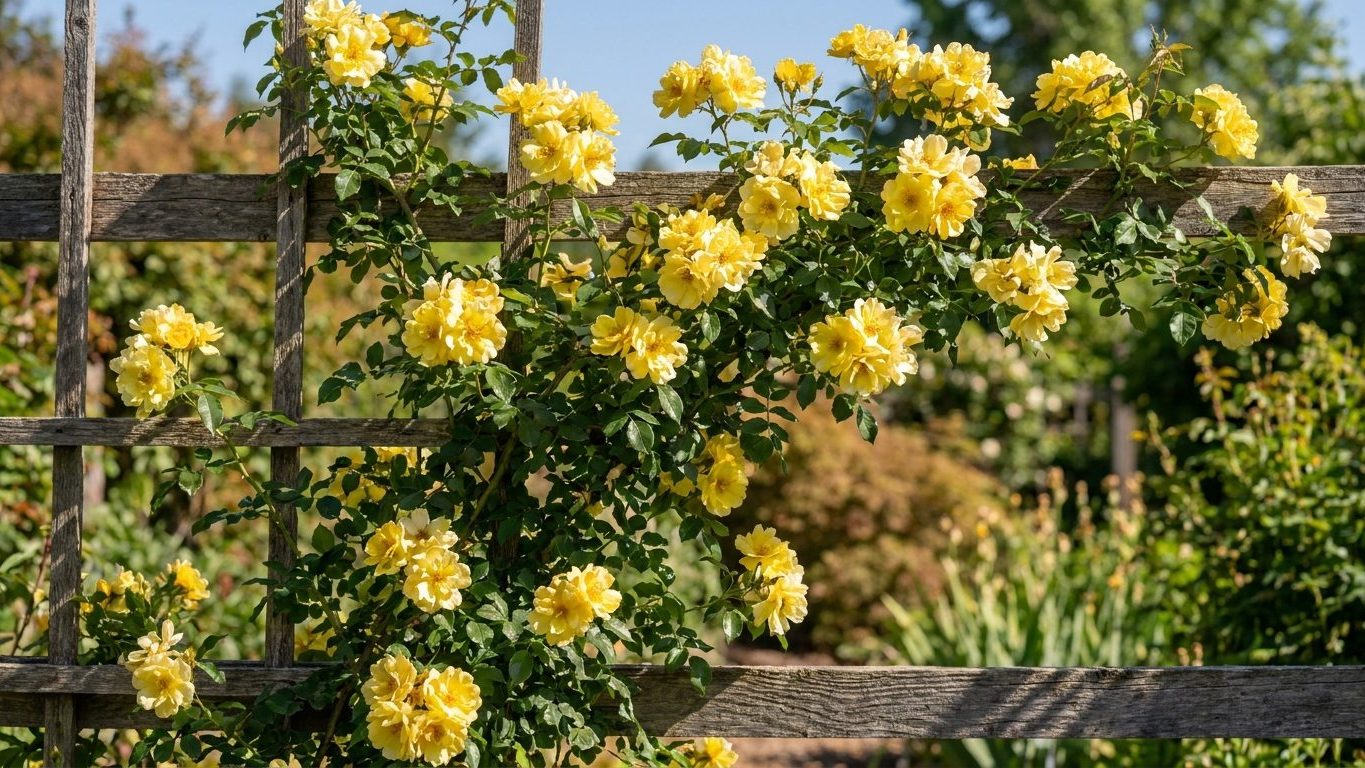

Golden Showers is a climbing rose with large, semi-double yellow blooms, hardy in USDA zones 5a through 11b, and it flowers on new wood grown each season off a permanent framework. That fact decides how the plant is pruned and how well it blooms before winter, which makes it the real question a gardener needs answered before planting one against a fence or trellis.
What Golden Showers actually is
Golden Showers belongs to the climbing group, and the source description is blunt about it: grimpant, large semi-double yellow flowers. Climbers don’t produce a single upright stem the way a hybrid tea does; they throw long canes that need to be tied to a support, and the flowers come from side shoots, called laterals, that grow off that framework each year.
The genus-level figures from the NC State Extension Gardener Plant Toolbox put roses generally at 1 to 8 feet tall and 1 to 6 feet wide, and Golden Showers sits toward the taller, spreading end of that range because of its climbing habit. The toolbox rates maintenance for the genus as HIGH and growth rate as medium: this isn’t a plant you tie up once and ignore.
The detail that matters most for management is the flowering wood. Golden Showers blooms on new laterals off a permanent, older framework of canes, which has to survive winter for the plant to flower well the following year, the opposite of a rambler that flowers on wood grown the previous season. Everything about pruning timing follows from that distinction, and the exact calendar date lives on the per-state page for the reader’s zone.
What Golden Showers is good for
A climbing rose covers vertical structure a shrub rose can’t. Golden Showers suits a trellis, arbor, wall with wire support, or fence line where height is wanted without a hedge’s footprint. Because it flowers on new laterals off an older framework, once that framework is established the plant produces flowering wood along its full length each season rather than only at the tips.
The flowers are semi-double, between a simple five-petaled bloom and a fully double one with more than 20 petals. Semi-double flowers open faster and shed petals sooner than heavily double blooms, but show their yellow color and center more openly, which is part of why the cultivar reads as bright and informal. The source doesn’t grade Golden Showers for fragrance; roses generally fall into five fragrance types (old rose, fruity, tea, myrrh, and musk), but which applies here isn’t documented.
For cutting, the rule for any rose applies: cut once the sepals have folded back and the first one or two petals are starting to unfurl, or the bud often just sits in the vase. Once flowers finish, the rose hip, an edible accessory fruit holding the plant’s achenes, turns from green to red in fall if left on the plant instead of deadheaded, which matters for dormancy, covered further down.
Where it ripens in time, and where it is a gamble
Golden Showers is hardy from USDA zone 5a through 11b, one of the wider ranges a rose cultivar can carry. But that width hides a real split in how much work the plant asks for at each end, coming down to whether the permanent framework survives winter intact.
In zone 5a, winters routinely stress any wood above the snow line or mulch depth. Because Golden Showers flowers on new wood grown off that framework, losing canes to dieback costs bloom directly, since the laterals that would have flowered simply aren’t there. Whether that framework needs mounding, wrapping, or a thicker mulch collar depends on the reader’s specific zone and is addressed on the per-state page.
At the other end, zone 11b removes winter dieback as a concern almost entirely. The framework persists year-round, new laterals keep emerging across a longer season, and the plant behaves closer to its full climbing potential. The trade-off shows up as summer heat instead, covered next.
| Zone range | Main risk to the framework | What that costs the plant |
|---|---|---|
| 5a to roughly 6b | Winter dieback of exposed canes | Fewer laterals, delayed and reduced bloom the following season |
| 7a to 9b | Minimal winter dieback | Framework builds year over year, bloom is more consistent |
| 10a to 11b | No meaningful winter dieback | Framework persists fully; summer heat becomes the limiting factor instead |
The colder the zone, the more the framework needs deliberate protection each winter, and the more that decides how much of the plant is flowering the following summer. In the mildest zones, that calculation drops out, and the plant’s ceiling is set by heat rather than cold.
The two ways a season goes wrong
A wide hardiness range doesn’t mean a trouble-free one. Golden Showers can have a disappointing year at either end of its zone map for reasons a hardiness rating alone won’t show.
In the colder end, the subtler risk isn’t a hard freeze killing the plant outright, since the rating already accounts for that. It’s new growth that pushes late in the season, stays soft, and doesn’t ripen before the first freeze. Soft, unripened wood is more vulnerable to winter injury than mature wood of the same age, so late-season pruning or feeding that stimulates a tender flush can leave more winter damage than the zone rating alone suggests.
In the warmer end, the limiting factor flips to heat stress during peak summer. Climbing roses generally slow their bloom cycle under punishing conditions, redirecting energy into survival, and resume fuller bloom as temperatures ease. For a cultivar like Golden Showers, which depends on producing fresh laterals continuously, that midsummer pause is a temporary lull a gardener in zone 10 or 11 should expect rather than treat as a problem.
Given that Golden Showers flowers on new wood built fresh each year, the cold-end risk, soft growth failing to ripen before frost, costs this cultivar more directly, since it removes next year’s flowering wood before it’s ever used.
What it resists, and what it does not
The source documents pest and disease pressure at the genus level, not cultivar by cultivar, and publishes no specific resistance grade for Golden Showers.
The diseases named for roses generally are botrytis, blights, powdery mildew, leaf spots, and anthracnose. Black spot overwinters both in fallen leaves and in lesions on canes, so raking leaves in fall helps but doesn’t eliminate it if infected wood remains on the plant. Powdery mildew, by contrast, overwinters in dormant buds and on stems, not in leaf litter, so cleanup does nothing to reduce it; that one has to be managed on the plant itself.
The pests named for roses generally are Fuller rose beetle, Japanese beetle, rose chafer, rose thrips, southern red mite, and two-spotted mite. The last two are arachnids, not insects, a distinction that matters because many insect-targeted treatments don’t work on a mite problem. Since no cultivar-specific resistance data exists for Golden Showers, the safest assumption is that it carries the same general vulnerability as roses without documented resistance, and should be watched rather than assumed protected.
Growing it without the usual mistakes
The most common mistake with a climbing rose like Golden Showers is pruning it hard every year like a shrub. Because it flowers on new wood off a permanent framework, that framework must be preserved from year to year; what gets pruned is the laterals coming off it, not the older structural canes. The specific month for that pruning depends on the reader’s zone, and that date lives on the per-state page rather than here.
Support has to go in early and be sturdy. A trellis, wire grid, or wall support strong enough to carry a mature framework of canes for years is worth installing before the plant needs it, not after canes are already sprawling loose. Spacing should account for eventual width, which for the genus runs up to 6 feet, though the exact figure for this cultivar is best confirmed on its own cultivar page.
Feeding and deadheading both need to taper as the season winds down. Continued feeding late in the year pushes the soft, unripened growth described earlier. Deadheading has a similar effect: every cut pushes a new shoot, so deadheading into fall inadvertently forces new growth right when the plant should be settling into dormancy. Letting the last flowers form hips instead of cutting them helps stop that cycle. And when winter cleanup happens, dead stems should be cut back to 12 to 24 inches and left standing rather than removed to the ground, since hollow stem sections provide nesting habitat for native stem-nesting bees.
Common questions
Are rose thorns dangerous? They are prickles, not true thorns. Prickles grow from the outer skin of the stem, which is why they snap or rub off sideways rather than staying rigid like a true thorn, a modified stem woody to the core.
Is Golden Showers rose fragrant? The source doesn’t grade this cultivar’s fragrance specifically. Roses generally fall into five fragrance groups (old rose, fruity, tea, myrrh, and musk), but which group, if any, applies to Golden Showers isn’t documented here.
Does Golden Showers rose need a trellis? As a climbing rose it needs some form of sturdy support, a trellis, wire grid, or wall system, put in place early enough to carry a mature framework of canes for years rather than added after growth is already sprawling.
Can I grow Golden Showers rose in zone 5? Yes, the documented hardiness range starts at zone 5a, but at that cold end winter protection for the permanent framework matters more, since losing canes to dieback also costs the following season’s flowering wood.