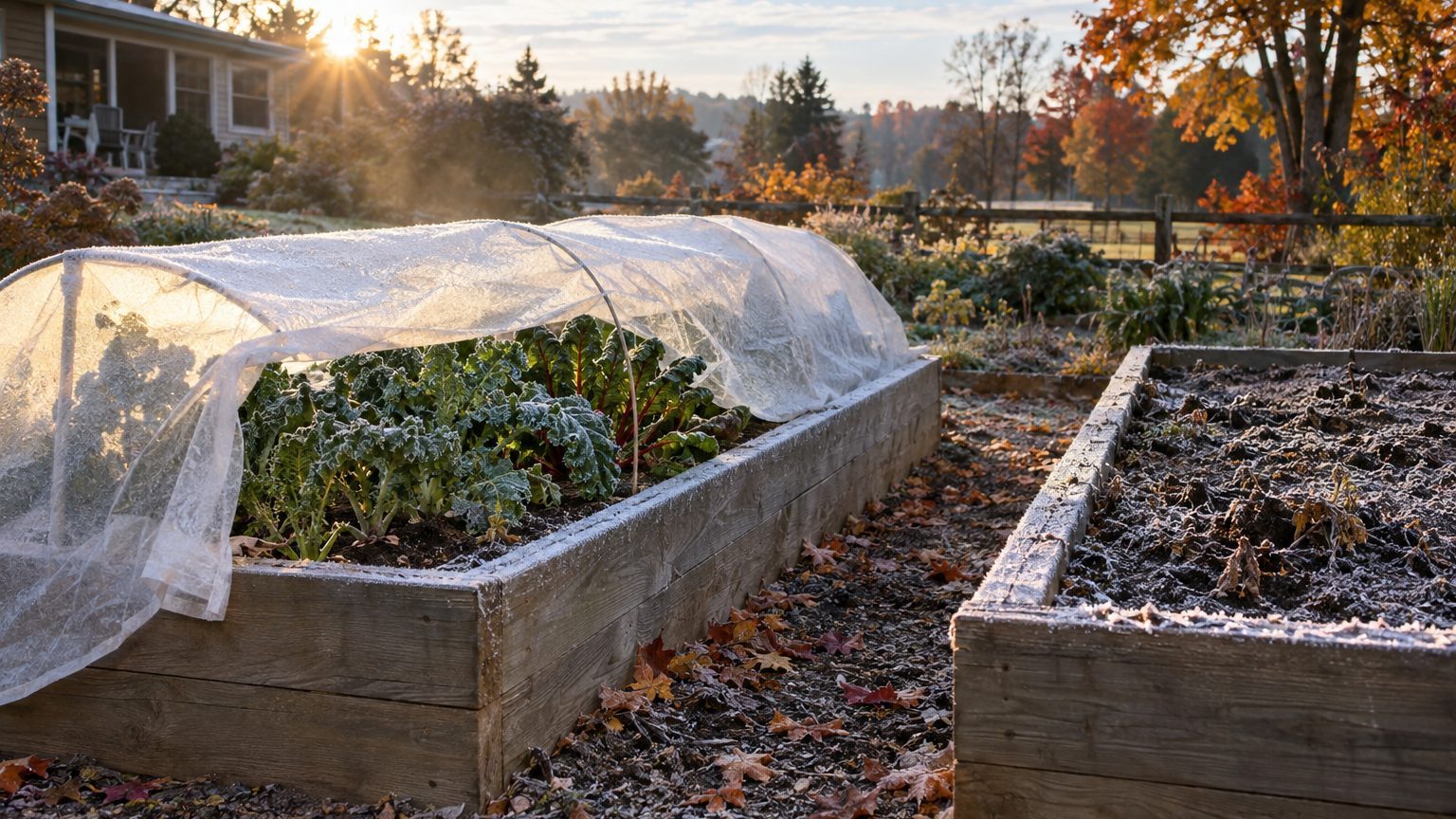

A cover buys a margin, not a new climate. On the right night it keeps the air around your plants a little warmer than the open garden, enough to carry a hardy or semi-hardy crop through a light frost or to push harvest further into fall and start it sooner in spring. On the wrong night it buys very little. The size of the gain swings with four things you can check yourself.
What is actually going on
The four variables are the material, the wind, how warm the soil was, and whether the night is clear or cloudy. Anyone who hands you one number of degrees has ignored at least three of them. The gain from a cover is real, and it varies from night to night and bed to bed. Once you see where the warmth comes from, you can judge a bed this guide never saw.
Where does the warmth under a cover come from?
A cover makes no heat of its own. The soil soaks up sunlight all day and gives that heat back after dark, rising off the ground as invisible infrared radiation. In the open, most of it escapes to the sky. A cover slows that escape and holds a pocket of still air against the plants. Think of it as a lid on heat the ground already stored.
That is why a damp bed that sat in full sun the day before gives much more protection than dry soil after a gray, cold week. Moist soil holds and passes along more heat than dry, loose soil. It is also why every method here stays passive. No heater, lamp or flame belongs under a cover. The fire and carbon monoxide risks are real, and the stored heat in the soil is the only source you need.
How do the four variables change the result?
Material comes first. Light fabric traps a thin layer of still air and lets some heat pass through. Heavier fabric holds more but admits less light. Plastic film seals tightly and traps well, though any leaf touching the cover conducts cold straight into the plant.
Wind is next. It pulls the trapped air out through gaps and loose edges, so an unsecured cover can lose most of its benefit by midnight. Soil warmth sets the supply of heat to hold in. Sky condition decides how fast that heat drains away, because clouds send radiation back down and a clear sky does not.
Any closed structure, such as a cold frame or a sealed tunnel, has a second problem in daytime. In spring sun it can cook its contents within an hour, so venting is part of keeping the crop alive. Covers also do nothing about short days, a limit covered in Why Plants Stop Growing in Winter, Cover or Not. The broader picture sits in Extending the Season: What a Cover Buys, and What It Cannot.
In the garden
The hard case is a clear, still night, especially after a cold, dry day. With no clouds and no wind, the ground sheds heat to the sky as fast as it can, and cold air pools in low spots. A single cover still helps, but the margin is thin. The cover shifts the limit a little. It does not remove it, and a bed that looked fine on a cloudy night can freeze solid on a clear one.
Why does a second layer beat a thicker one?
Still air is the insulator, and a gap between two layers holds more of it than one thick sheet pressed against the plants. The inner layer also keeps the outer one off the leaves. Two light covers with an air space generally outperform one heavy cover, which is the argument made in Two Layers Beat One Thick One. The gain is real, but it is still variable.
What happens when each part goes wrong?
| Situation | What the cover does | What goes wrong |
|---|---|---|
| Clear, still night | Slows heat loss and holds still air | Margin is smallest here. Tender crops can still freeze, and the leaves touching the cover go first. |
| Windy night | Works only if edges are anchored | Wind pulls out the warm air and can lift the cover entirely, leaving plants bare at the coldest hour. |
| Cold, dry soil | Has little stored heat to hold | The cover traps almost nothing. Water the bed in the morning and the soil holds more heat by dusk. |
| Leaves touching the cover | Conducts cold directly onto foliage | Tissue under the contact points freezes even when the air space is fine. Use hoops or supports. |
| Second layer added | Creates an insulating air gap | If the layers press together, the gap disappears and the benefit with it. |
| Closed frame in sun | Captures daytime heat | Left shut, it overheats within an hour and cooks the plants. Vent it in the morning, even on a cool day. |
Most failures come from the cover being on the bed but not working as designed. Edges loose, fabric resting on leaves, a frame shut all day: each one turns a useful tool into a false comfort.
What it depends on where you are
The mechanism is the same everywhere in the country. The numbers are local. Season length decides how much room you have to extend. Summer heat and summer rainfall change what you grow at the edges of the season and how long a cover can stay on before it causes trouble. Your own yard will differ from your neighbor’s on the same street.
How does the answer shift across regions?
Where summers are short and cool, a cover mostly rescues the first and last weeks of the growing season and helps heat-loving crops finish. In the dry interior West, clear skies and big day-to-night swings make radiant cooling the main hazard, so a second layer and a well-watered bed matter more. Where summers are hot and humid, the problem flips in the shoulder seasons: a cover left on through warm, damp days traps moisture and invites fungal disease, and vents or removal become the daily chore. In the Deep South a cover is usually about a few cold snaps in winter, not months of growing time.
Where do you find the local version?
Start with the state pages on this site, which put these differences in the context of your climate. Then call or visit your county extension office. Extension staff know the average frost window for your area, the crops that have done well under covers locally, and the odd cold pockets in your county. Ask your extension office what low temperatures are typical for your last and first frosts, and which crops handle them with a cover. That answer fits your ground better than any national rule.
The mistake that costs the most
The costly mistake is treating a cover as a guarantee. A grower puts fabric over tomato or pepper transplants on the strength of “the cover will handle it,” skips the forecast, and loses the whole bed on one clear, still night. The cover was doing its job. The job was just smaller than the plan assumed.
Nothing under a cover is frost-proof. A cover shifts the point where damage starts, by an amount that depends on the four variables, and it does so only if it is working properly. Tender crops such as tomatoes, peppers, basil and squash have almost no tolerance for frost. Hardy greens, brassicas and root crops have plenty, which is why covers pay off most with them.
Read the forecast low for your own spot, then decide what the cover has to carry. Plant tender crops by your local frost dates, not by what a cover might rescue. Keep the cover as a margin for the surprise cold night. On a night with a clear, still sky and a low near freezing, add a second layer, water the bed earlier that day, anchor every edge before dusk, and hold the fabric off the leaves with hoops or supports.
In the morning, uncover or vent. A closed frame left shut after a cold night can cook its plants by midday once the sun hits it. Do that routine each time and the cover does what it can do, which is plenty for a careful gardener.
Common questions
Can a cover protect plants through a hard freeze?
Sometimes a cover helps hardy crops through a hard freeze, but tender ones are at risk. The gain varies with material, wind, soil warmth and cloud cover. A second layer and a well-watered bed improve the odds. They do not turn a hard freeze into a safe night for warm-season crops.
Should I water the bed before a cold night?
Yes, earlier in the day, so the surface is not sitting in a cold film at dusk. Moist soil holds and releases more heat than dry soil. Do not soak plants right before dark.
Do I need to vent a cold frame or tunnel?
Yes. Any closed structure heats fast in sun, and a shut frame in spring sun can cook its plants in about an hour. Open it on mornings with any sunshine, and close it again toward evening to hold the stored warmth.
Is fabric or plastic the better cover?
It depends on the night and the crop. Fabric breathes, lets in water and light, and is gentler on leaves. Plastic holds more warmth but overheats quickly and sheds cold onto anything it touches. Many gardeners use fabric close to the plants and a second layer on top for the coldest nights.