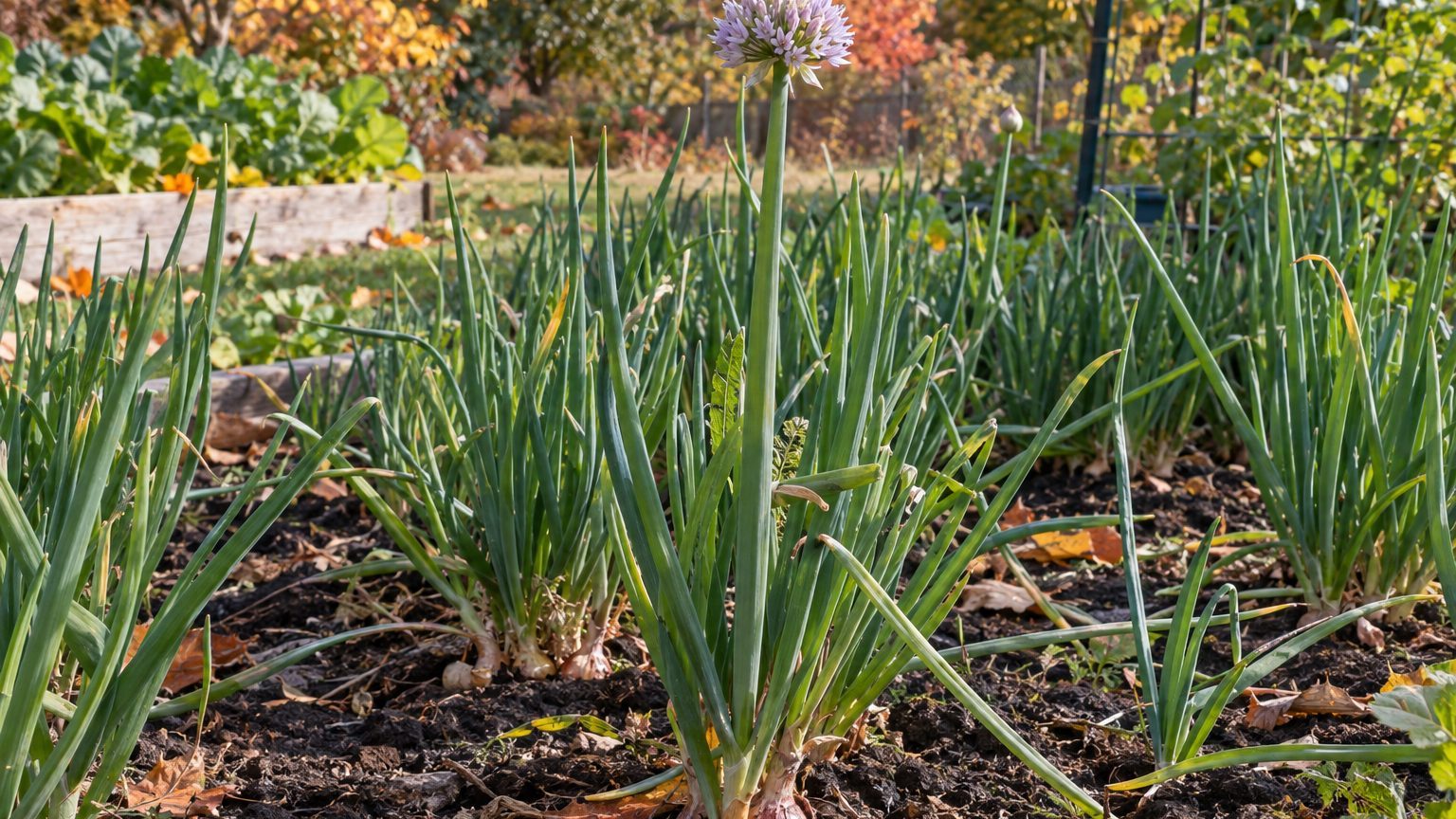

A shallot that sends up a flower stem is bolting, and the short version is this: snap the stalk off at the base, pull the plant if the bulb looks mature enough, and use it first. Bolted shallots rarely store well. The bulb usually sizes up less than its neighbors, and the stalk leaves behind a tough center that invites rot. Nothing in the garden has failed, though. The plant has simply decided it’s time to make seed.
The decision is mostly about temperature, and it’s made earlier than you’d think. Here’s how to read what happened, what to salvage, and how to keep your next planting from doing the same thing.
What bolting looks like, and what triggers it
The first sign is a single thick, round, hollow shoot rising from the center of a clump, taller and stiffer than the surrounding leaves. A tight, pointed bud sits at the tip. Left alone, it opens into a ball of small flowers (lavender to white) a lot like a chive blossom, only larger. In most of the country this happens between late spring and early summer, roughly May through June, depending on when you planted.
Shallots are biennial plants. In their natural cycle they grow a bulb in year one, sit through a cold spell, then flower in year two. Bolting is that second-year program kicking in ahead of schedule. The trigger is a stretch of cold, followed by warming weather and lengthening days. Onion growers have long cited a few weeks of temperatures in the 40s as enough to flip the switch in plants or sets that have reached a certain size. Shallots follow the same logic.
That size detail matters more than most gardeners realize. A plant has to be big enough to “sense” the cold. Larger sets, which carry more stored energy and more developed growing points, are the likeliest to bolt. A small set can sit through the same chilly April and shrug it off. If you’ve ever noticed that your jumbo, most impressive-looking planting stock produced the most flower stalks, that wasn’t a coincidence.
Stress adds to the pressure. Drought after a wet spring, a late frost after warm weather has already pushed growth, or a sudden heat spike can all nudge a borderline plant over the line. A cold snap in April in Minnesota or Michigan, after a warm spell tricked you into planting early, is a classic setup. So is the opposite problem in the South, where sets bought in late winter spent weeks in a chilly garage or fridge before they ever touched soil.
Where your sets spent the winter counts
Storage is the hidden culprit. Sets kept in a refrigerator, an unheated shed, or a cold basement can be vernalized before planting, which means the plant arrives at the garden already primed to flower. Many growers keep planting stock somewhere in the 60s°F instead, dry and airy, until planting time. If you ordered sets that arrived in a cold snap and sat on a porch, that’s worth remembering when you look back at a bolted bed.
What to do when you spot a flower stem
Act quickly, and decide based on how far along the plant is. Look at the bulb, not just the stalk. Brush the soil back from the base and check how big it is.
If the bulb is still small and the leaves are green and actively growing, cut the flower stem off as low as you can with clean shears or snap it by hand. Some growers report that the plant puts a bit more energy into the bulb afterward, though you shouldn’t count on a rescue. The bulb is likely to end up smaller than it would have been, and it may form a hard, woody core where the stalk was trying to emerge.
If the bulb already looks near full size, or the tops have started to yellow, just pull it. There’s no reason to wait. A bolted plant that stays in the ground burns through whatever reserves it has left, and the flowering stalk keeps drawing from the bulb to feed its seed head.
Young scapes are edible, which softens the blow. While the stem is still tender (before the bud swells and the base turns fibrous), you can chop it the way you would chives or garlic scapes. It tastes like a mild shallot with a green edge. Once it toughens, you’ll find the lower portion stringy and not worth the trouble, though the flowers themselves are edible as a garnish.
One honest caution: pulling the stem doesn’t un-bolt the plant. The signal to flower has already been sent, and the plant may try again with a side shoot. Check the clump every few days for a week or two.
Can you still use the bulbs?
Yes, with a shorter shelf life in mind. The problem is the neck. A healthy shallot dries down at the neck, which seals as the leaves die back and keeps moisture and fungi out. A bolted shallot has a thick, hollow stalk running right through that spot, and it doesn’t close up. Water can sit in the hollow, and rot can work its way down into the bulb from the top.
That makes bolted bulbs the ones to use fresh. Kitchen use is the plan: roast them, caramelize a batch, make a vinaigrette, or slice and sauté and freeze the results in small portions. Pickling works well too, because it doesn’t ask the bulb to survive months in a basket. If you’re not sure how a shallot’s flavor compares when you’re cooking in volume, the guide on how a shallot differs from an onion covers that ground.
Cure the keepers anyway, if you have any. Lay the pulled plants in a shaded, airy spot for a couple of weeks. Then check the neck of each bulb by squeezing gently. A firm neck with a dry stalk is fine to store a while. Anything with a soft, damp, or hollow-feeling neck goes to the kitchen counter.
Whether to replant bolted bulbs is a common question. The advice you’ll hear most often is to skip them. Bolted bulbs tend to be smaller and lower in quality, and some growers feel the tendency to flower can repeat in the next generation. The evidence for that is more anecdotal than tested, but there’s a practical argument anyway: you want your replanting stock to be your best, most uniform bulbs, and a bolter is by definition an outlier. It’s also worth knowing that saved sets divide into new bulbs on their own schedule, which is covered in when and how the cluster divides.
Keeping it from happening next year
You can’t control the weather, but you can change the odds. Four moves do most of the work:
- Choose small to medium sets instead of the biggest ones in the bag.
- Store planting stock dry and above 60°F, never in the refrigerator.
- Time planting to your region instead of the first warm weekend.
- Keep the soil evenly moist through spring.
Timing is where geography matters. In the Deep South and much of the Southwest, shallots are generally planted in fall, around October or November, and grow through a mild winter. Farther north (the Upper Midwest, New England, the mountain states), early-spring planting as soon as the soil can be worked is the usual route, and a fall planting needs a thick mulch and a cold-tolerant variety to be worth the gamble. In the Pacific Northwest, where springs can stay cool and damp for weeks, a set that was planted too early can sit through enough chilly nights to trigger bolting even though the air looks mild.
A row cover can buy you a few degrees in a surprise cold snap. It won’t fix a whole season of cool weather, but it can blunt the overnight dips that matter most. Mulch has a double effect: it holds moisture steady, and it moderates soil temperature swings that stress the plants.
Then there’s seed. Shallots grown from true seed, rather than sets, behave differently in their first season. They grow more like an annual onion, and seedlings that never got cold are far less likely to flower in year one. The trade-off is that seed-grown shallots usually produce a single bulb instead of a big cluster, so you lose some of the multiplication that makes sets so appealing. The full picture of what to expect from a planting, from one bulb to a handful, lives in the main guide, Growing Shallots: One Bulb In, a Handful Out.
One more thing before you write off a patch. A few flower stems in a large planting are normal, and plenty of experienced growers lose 5 to 10 percent of a row this way without changing a thing. A row where half the plants bolt is the signal to look at your sets and your timing. Check where the sets were stored, and how big they were, before you blame the variety.
Bolting also isn’t unique to shallots. Onions, leeks, and garlic all do it, and you’ll often see them flower in the same spring. When the whole allium bed bolts together, the weather is almost always the common cause, not anything you did in a particular row.