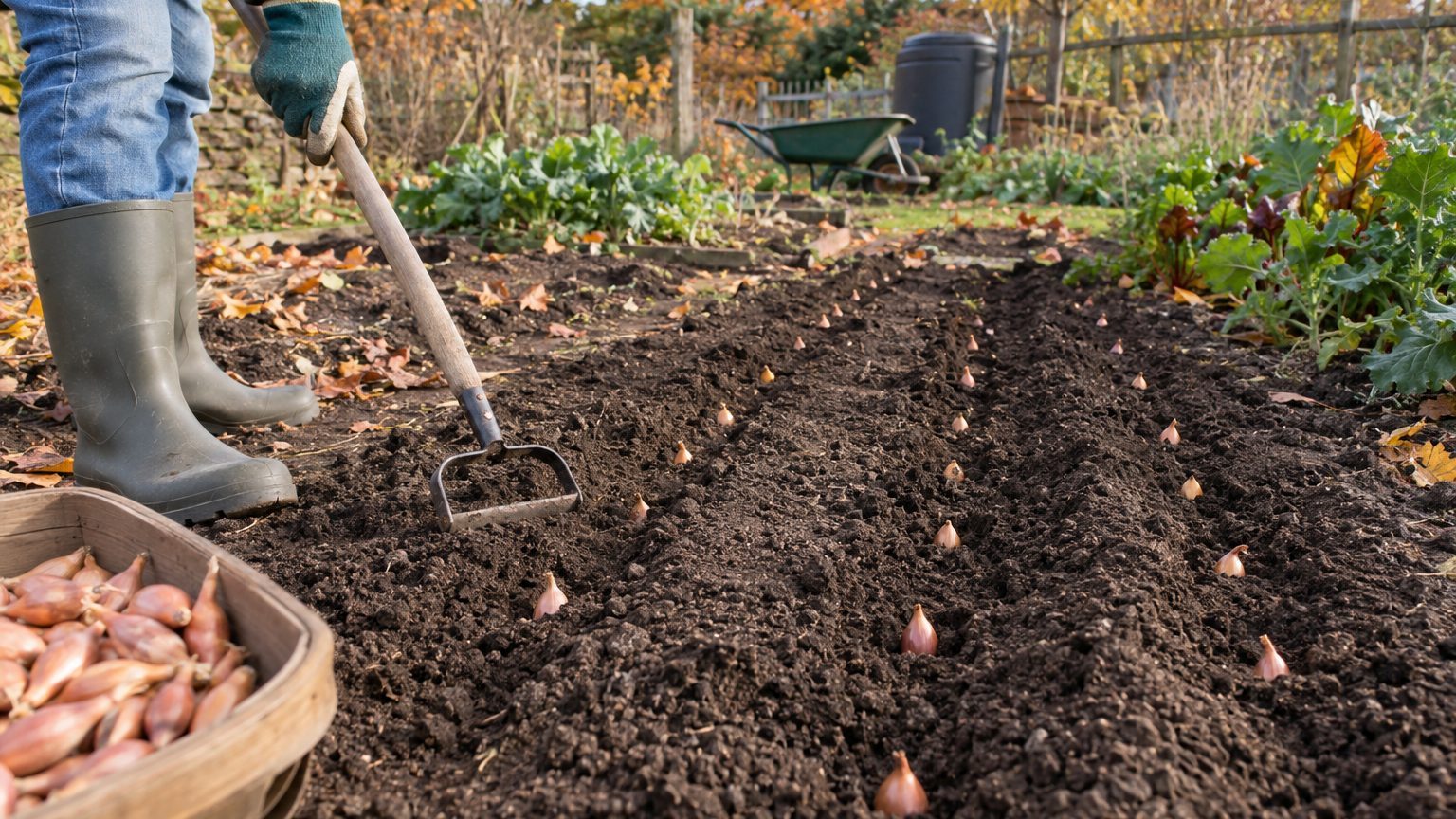

Plant shallot sets about 6 inches apart in rows 12 inches apart, with the pointed tip level with the soil surface or just barely covered. That spacing works for most gardens in most climates. The workable range runs from roughly 4 inches (tighter, smaller bulbs) to 8 inches (looser, larger ones), and where you land inside it depends on set size, soil, and how you want to harvest.
The numbers matter more for shallots than for most bulbs because of what happens underground. A single shallot set doesn’t swell into one bulb. It divides, sending up a ring of new bulbs that typically number somewhere between 3 and 10, all attached at the base. That cluster needs room to expand sideways. Plant it as though it were a single onion, and the neighbors start shoving each other.
What a Cluster Needs Underground
Start with the footprint. A mature shallot cluster, with its bulbs fanned out and its roots feeding in all directions, often spreads 5 to 7 inches across, depending on variety and how many offsets it produced. Set the original bulbs 6 inches apart and the clusters just touch at harvest. Set them 3 inches apart and the clusters merge into a single mat of bulbs that can’t swell properly.
Row spacing has a separate job. Twelve inches between rows leaves a lane for a hoe, a hand cultivator, or just your knees. Shallot roots are shallow and fibrous, so weeds compete hard, and you don’t want to be hacking at weeds inches from a bulb. A stirrup hoe slides through a 12-inch lane with room to spare. Drop to 8 inches and you’ll end up weeding by hand, which is slow work in July.
Here’s the arithmetic for a standard 4 by 8 foot raised bed, which covers 32 square feet. At a 6-inch grid, with 6 inches both ways, you fit 128 sets. If each one averages six bulbs (a reasonable figure for healthy plants in decent soil, though results swing widely), that’s close to 770 shallots from one bed. For comparison, a typical grocery-store shallot weighs well under an ounce, so a bed that size could keep a serious cook supplied for the better part of a year if the bulbs cure and store well. Most households don’t need that many. Plant a 2 by 4 foot patch and you still get over 190 bulbs.
Soil structure feeds into all of this. Bulbs expanding in packed clay have nowhere to go, so they distort or push upward, and spacing can’t fix that. The guide on the soil shallots want covers loosening and amending in detail. In short, a loose, well-drained bed lets clusters spread to the spacing you gave them. In heavy ground, err wider and add compost before you plant.
Tight, Standard, or Wide: Choosing Your Number
Spacing is a trade between bulb size and bulb count. Closer plantings produce more total bulbs per square foot, but each bulb finishes smaller. Wider plantings give each cluster more soil to draw from, and individual bulbs usually size up. Neither approach is wrong. It depends on what you plan to do in the kitchen.
At 4 inches apart (about nine plants per square foot in a grid), expect a heavy crop of small to medium bulbs. That suits cooks who want shallots for pickling, roasting whole, or tossing into pan sauces, where a bulb the size of a large grape is ideal. It also suits small beds. The tradeoff is less airflow, slower drying after rain, and more effort lifting the clusters without bruising neighbors.
At 6 inches (four plants per square foot), you get what most gardeners want: bulbs about the size of a golf ball or slightly smaller, clusters that separate cleanly, and enough breathing room between plants. If you’re unsure, start here.
At 8 inches or more, clusters grow large and bulbs run big, sometimes approaching the size of a small onion. That makes sense in poor or dry soil where plants struggle for resources, or if you want fewer, bigger bulbs for slicing and dicing. You give up yield per square foot, and a wide bed leaves more room for weeds to fill in unless you mulch.
How set size changes the plan
Large sets, those over about an inch across, tend to produce larger clusters with more offsets, so they benefit from the wider end of the range. Small sets, under three-quarters of an inch, make smaller clusters and handle 4 to 5 inches comfortably. Many gardeners sort their bulbs before planting and put the big ones in one block at 7 or 8 inches and the small ones in another at 5. It takes ten minutes and makes harvest more even.
Shallots grown from true seed behave differently. Seed-grown varieties are usually started indoors or direct-sown and then thinned or transplanted, and the plants commonly stand 4 to 6 inches apart. Check the seed packet, because recommendations vary by variety. If you’re still choosing between sets and seed, the overview in growing shallots: one bulb in, a handful out lays out how each route plays out through the season.
Depth, Timing, and the Details That Change Spacing
Planting depth is the quiet partner of spacing. Shallots want to sit high. In spring, push each set into loose soil until the tip is flush with the surface or barely showing. Buried too deep, the bulb struggles to divide and you get long, pale necks instead of plump bulbs. Gardeners who plant too deep often blame their spacing for disappointing results when the real culprit sits an inch lower than it should.
Fall planting changes the picture slightly. In milder regions, roughly USDA zones 7 through 9, including much of the Mid-Atlantic, the Southeast, and the Pacific Northwest, October into November is a common planting window, typically four to six weeks before the ground freezes. Today is early October, so that window is opening in many of those areas. For fall plantings, set the bulbs about an inch deep so winter frost doesn’t heave them out, then cover with 2 to 3 inches of straw or shredded leaves. Frost heaving is real: alternating freeze and thaw can push sets right out of the ground, and shallow-planted sets at tight spacing are especially vulnerable because there’s less soil mass holding them. In colder states such as Minnesota, Wisconsin, or Vermont, spring planting as soon as the soil can be worked is the safer course, usually in April.
Garden layout gives you more options than the single-row default. A few approaches that work well:
- Grid planting in raised beds, 6 inches each way, which maximizes space and makes counting easy.
- Staggered rows, where each plant sits offset from the one in the next row, which gives each cluster slightly more room at the same density.
- Edge planting along the border of a vegetable bed at 6 to 8 inches, which tucks a harvest into otherwise unused space.
Shallots also make a decent border or interplant near carrots and lettuce, since their narrow upright foliage doesn’t shade neighbors much. Keep them out of the same spot where onions, garlic, or leeks grew in recent years, though. Rotating the allium family matters for reasons that go beyond spacing. White rot, a soilborne fungal disease, can persist in the ground for many years and wipes out entire allium beds. Spacing won’t prevent it, since the fungus lives in the soil rather than spreading through leaf contact, but good air movement does help foliage dry out faster and reduces other problems like downy mildew and botrytis leaf blight.
Spotting Spacing Mistakes Before Harvest
Crowding announces itself by midseason. Leaves lean into each other, outer plants flop sideways, and the soil between plants never seems to dry. When you pull a cluster in summer, you may find bulbs that are flattened on one side or squeezed into odd shapes where they pressed against a neighbor. Small bulbs, a lot of them, and a damp canopy all point to planting that was too tight for the conditions.
Too much space has its own tell. Bare soil between clusters turns into a weed nursery. Bulbs may grow very large and thick-necked, which sounds like a win until you realize big shallots with thick necks cure slowly and don’t store as long as medium bulbs with thin, dry necks. If you wanted a yield and got a few oversized bulbs plus a lot of weeding, the spacing was too generous. A thick layer of mulch eases this problem, and a light straw mulch of an inch or two between plants is usually enough.
Watering plays into it too. Shallots have shallow roots and need steady moisture while the bulbs size up, roughly an inch of water per week from rain or irrigation. Dense plantings compete for that moisture, so in a dry stretch the tight patch suffers first. If your summers run hot and dry, as in Texas, Oklahoma, or the interior West, lean toward 6 to 8 inches and mulch heavily. Where rain is regular and soil is rich, 4 to 6 inches usually works fine.
Harvest brings spacing back into focus. Tops yellow and fall over in early to mid summer, usually June through July depending on region and planting date. Loosen the soil beside each cluster with a garden fork set a few inches out, then lift the whole group so you don’t stab the bulbs. Clusters spaced at 6 inches leave enough margin for that fork. At 4 inches you’ll be working between bulbs and risking nicks that shorten storage life. Let the harvested clusters cure in a shaded, airy spot for two to three weeks until the necks are fully dry, then trim and store.
One last practical nuance: hold back your best bulbs, the ones about 1 to 1.5 inches across, for next season’s planting. Those mid-sized bulbs usually give the best balance of cluster size and vigor, and saving them means your spacing plan for next year is already half done.