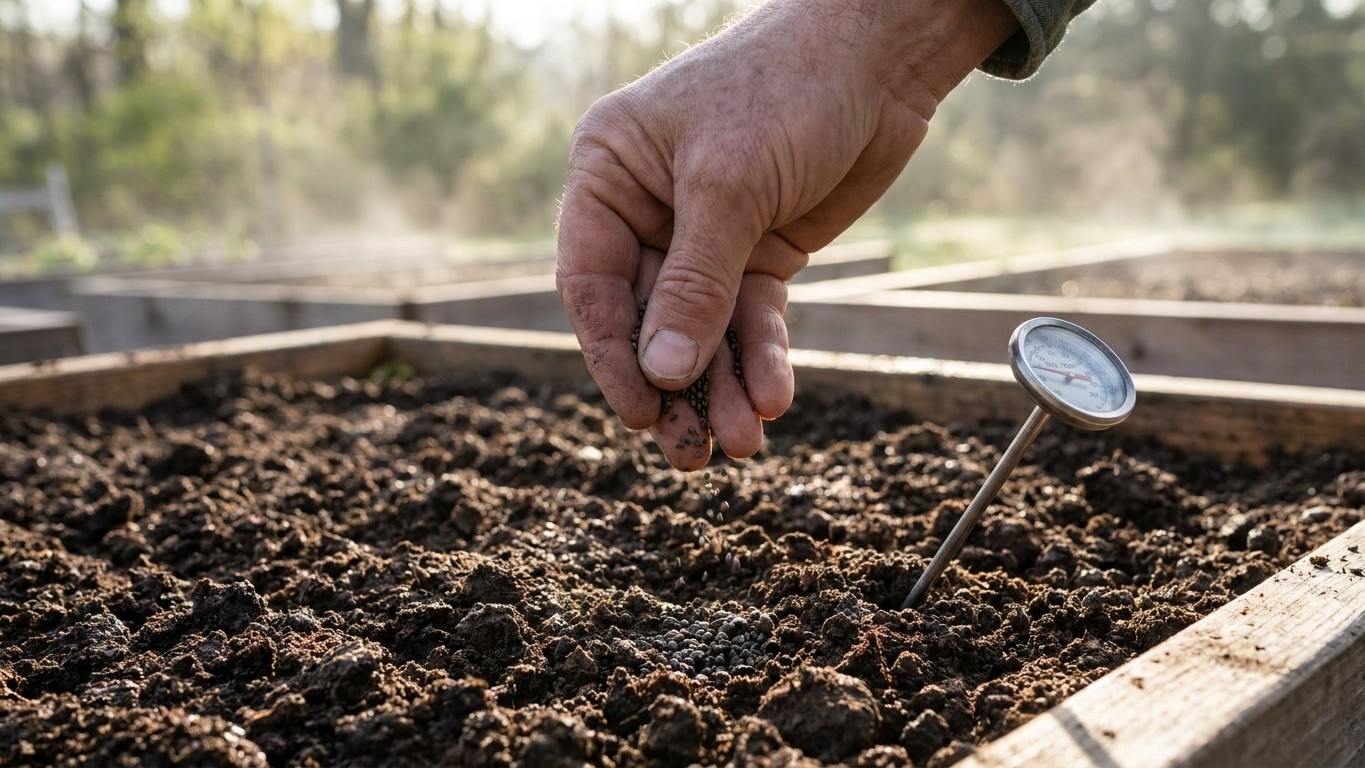

Spinach seed can go into the ground once soil hits 40 degrees F, according to Utah State University Extension. That’s weeks before most vegetables tolerate planting, and it’s why spinach counts as one of the earliest crops in the garden. The upper limit is just as firm: temperatures above 80 F reduce germination, which is the reason a late-summer sowing meant for a fall harvest often just never shows up. The two thresholds bracket a narrow window where spinach seed actually works.
The short answer
Forty degrees is a floor, not a target. Seed sown into soil that’s barely thawed will sit and wait, sometimes for weeks, before conditions turn favorable. Utah State University Extension puts the real sweet spot much higher: seeds germinate best at 55-65 degrees F and require 7-10 days to emerge. So the practical answer to “when do I sow” isn’t really 40 F. It’s whatever point between 40 and 65 lets you get seed in the ground early enough to beat the heat, since that same source warns that temperatures above 80 F reduce seed germination.
That upper number matters more than gardeners usually realize. A cold soil slows spinach down but doesn’t stop it. A hot soil does something closer to switching the seed off. This is why spring plantings, timed while soil is climbing through the 40s and 50s, tend to succeed more reliably than late-summer ones, when soil is often still falling from its peak and can sit well above 80 F for weeks after the air has started to feel like fall.
The spread between 40 and 80 also explains why spinach has a reputation for being finicky in warm climates and nearly foolproof in cool ones. In a region where soil crosses 40 F in late winter and doesn’t touch 80 F until midsummer, there’s a long comfortable stretch to work with. In a region where soil jumps from the 40s to the 80s in a matter of weeks, the window is short and unforgiving, and missing it by even a week or two can mean a crop that never germinates at all.
None of this is about air temperature. Soil temperature is what the seed responds to, and it lags behind air temperature by days, sometimes longer under mulch or in shaded beds. A gardener checking the forecast instead of the dirt is checking the wrong number.
What actually decides it
Heat shuts down germination and growth
Clemson Extension is specific about the numbers: “The optimum soil temperature for spinach seed germination is 70 °F. Soil temperature above 85 °F will inhibit seed germination.” That word, inhibit, matters. The seed isn’t destroyed by hot soil. It’s held in a kind of suspension, unable to sprout until the soil cools back down. That’s the real mechanism behind the mystery fall planting that never comes up: the gardener did nothing wrong, and the seed wasn’t defective. The soil was simply too warm for germination to proceed, and it stayed that way long enough that the gardener gave up checking.
Heat doesn’t only block germination, either. Once plants are established, temperatures above 75 F slow growth, and that same threshold is where leaf quality starts to suffer, with flavor turning bitter well before the plant shows any visible stress. It isn’t a calendar date. It’s a ceiling that shows up whenever soil and air happen to cross it, whether that’s early June in a hot region or late August in a cooler one.
Day length triggers bolting, independent of heat
The second cause is the one most gardeners never suspect. Clemson Extension advises to “plant spinach in early spring to avoid high temperatures and long days, which cause the plants to bolt, or form flower stalks.” Heat is one trigger. Long daylight hours are a separate one, and they can push spinach into bolt even when the weather feels mild. This is the opposite of what happens with onions, where long days signal the bulb to form. In spinach, long days signal the plant to stop making leaves and start making seed.
That distinction matters most for gardeners at higher latitudes, where summer daylight stretches well past 14 hours. A cool, comfortable evening in a far-northern garden can still carry enough daylight to send spinach to seed, which is why timing by the calendar alone, without accounting for day length, leaves gardeners in cooler climates just as exposed to bolting as those baking in summer heat.
How to do it
- Check soil temperature, not the forecast. Sowing can begin once soil reaches 40 degrees F, per Utah State University Extension, though germination will be faster and more even closer to 55-65 degrees F.
- Sow seed 1/2 inch deep, 2-3 weeks before the last frost in the spring. This timing puts germination right in the window before soil climbs toward the 80 F mark that reduces success.
- Wait out the 7-10 day germination period. Seedlings emerging outside that window in cold soil aren’t a failure; they’re just responding to soil that hasn’t yet warmed into the optimal range.
- Thin seedlings, or set transplants, to 3 inches apart in the row, with rows spaced 12 inches apart. Crowded rows compete for light and moisture and tend to bolt sooner.
- For a fall crop, count backward 50 to 75 days from your intended harvest date, then confirm soil has actually cooled before sowing. A calendar date that lands while soil is still above 80 F will not produce a stand, regardless of how well it fits the 50-75 day math.
- Choose a variety suited to your goal. Four names commonly show up in seed catalogs and extension references: Bloomsdale, Melody, Teton, and Olympia. Utah State University Extension names these varieties but publishes no comparative data on days to maturity, bolt resistance, or yield among them, so treat variety choice as a matter of availability rather than documented performance.
What goes wrong
- Seed sown into soil above 80 F never comes up. This is the single most common failure with fall sowings. The fix isn’t more seed or deeper planting; it’s patience. Check soil temperature directly and hold off until it drops back into a range where germination can proceed.
- Plants bolt in early summer despite mild weather. Long daylight hours alone can trigger flowering, especially at higher latitudes. Planting early enough in spring to finish the crop before daylight peaks is the only real defense, since this cause has nothing to do with a hot spell.
- Germination is slow and uneven in cold soil. Soil sitting near the 40 F floor will eventually sprout seed, but slowly and inconsistently. This isn’t a dead crop, just a delayed one; warmer soil in the following days should bring the rest of the stand up.
- Leaves taste bitter even though the plant looks healthy. Once temperatures push past 75 F, quality drops before the plant shows obvious stress. Harvesting earlier, before that threshold is reached, keeps flavor from turning.
- A fall sowing timed by the calendar fails outright. Counting 50 to 75 days back from a target harvest date is only half the equation. If soil is still above 85 F on the planting date, Clemson Extension’s data says germination will be inhibited regardless of how well the date fits the maturity window. Wait for the soil, not the calendar.
Common questions
Can spinach seed survive soil colder than 40 F?
Utah State University Extension identifies 40 F as the point sowing can begin, which functions as a practical floor rather than a guarantee of quick results. Seed sitting in soil below that mark is likely to stall rather than germinate promptly.
Is 80 F a hard cutoff for germination?
No. Utah State University Extension states that temperatures above 80 F reduce germination, and Clemson Extension adds that soil above 85 F will inhibit it. Reduced and inhibited both describe a seed that’s struggling, not one that’s dead. Cooling soil later in the season can still bring a stand up.
Why does spinach bolt even in a mild summer?
Because heat is only one of two triggers. Clemson Extension names long days as the second cause of bolting, independent of temperature. In regions with long summer daylight hours, spinach can bolt even when conditions feel comfortable.
How far apart should fall sowing dates be from the first frost?
The source used on this page gives a range of 50 to 75 days before the desired harvest date, but that math only holds if soil has already cooled below the germination-inhibiting range near 85 F. A date that fits the day count while soil is still hot won’t produce a crop.