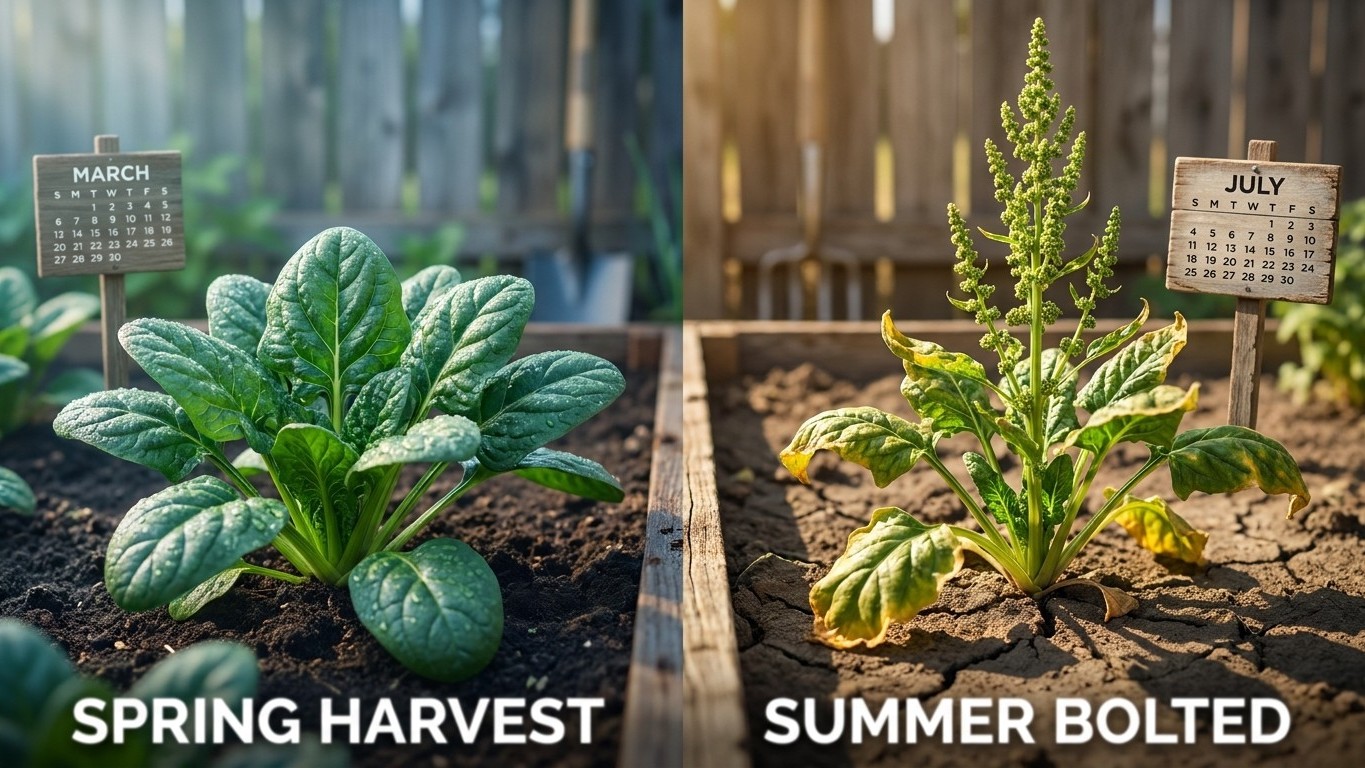

Spinach bolts when days get long and temperatures climb, not on a fixed date on your calendar. Utah State University Extension puts it plainly: spinach flowers, or bolts, “during long days AND warm temperatures in summer.” That single mechanism decides whether you get a full harvest or a handful of bitter leaves, and it explains why the same seed packet performs so differently in April versus June.
The short answer

Spinach is a race against the calendar’s daylight hours, not against heat alone. Utah State University Extension is direct about the trigger: long days combined with warm temperatures push the plant to send up a flower stalk. Once that stalk forms, the leaves turn bitter and the crop is essentially done, no matter how much you water or fertilize afterward, which is why knowing Harvesting Spinach: Leaf by Leaf, or All at Once ahead of time lets you get the most out of the plant before bolting sets in. For a broader look at What Goes Wrong With Spinach, it helps to understand this bolting mechanism alongside the other common issues growers face.
Here’s the part gardeners miss. A mild, cool summer will not rescue a spinach planting if the days are already long. Day length is an environmental signal the plant reads on its own, independent of the thermometer. You can have a string of pleasant 68-degree afternoons and still watch spinach bolt, because the plant is responding to how many hours of light it’s getting, not just how hot those hours feel.
Temperature still matters, just for a different reason. The source states that “spinach grows best when temperatures do not exceed 75 F,” and above that mark the leaves turn bitter. That 75-degree figure does double duty: it’s the ceiling for good growth, and it’s also the threshold where flavor turns, as explained in Why Spinach Turns Bitter: the 75 F Line. It isn’t tied to a specific week or month. In a cool mountain valley, that threshold might not arrive until well into summer. In a low desert basin, it can show up in mid-spring.
So the honest answer to “when will my spinach bolt” is: whenever your local days get long enough, especially if that coincides with a stretch above 75 F. There’s no universal date, because day length shifts by latitude and the 75-degree threshold shifts by regional climate. What stays constant is the mechanism itself, long days plus warmth, and that’s the two-headed enemy every spinach grower is racing against, which is exactly why many gardeners sidestep the problem entirely by choosing the right cultivar in the first place, relying on The Four Spinach Varieties the Extension Names — and Nothing Else and paying close attention to Sowing Spinach and timing The Autumn Spinach Crop to grow as days shorten instead.
This is also why spinach behaves so differently from a crop like onions, where long days are the trigger that tells the plant to start forming a bulb. Same variable, opposite outcome. For spinach, longer light is a signal to stop making leaves and start making seed. Keep that distinction in mind, because carrying the onion logic over to spinach will lead you to expect a benefit that never comes.
What actually decides it
Two separate factors push spinach toward bolting, and they don’t always arrive together. Understanding them as distinct forces, rather than one vague idea of “hot weather,” is what lets you actually plan around them.
Day length
Spinach reads the number of daylight hours through its leaves, and once that count crosses a certain point, the plant shifts from vegetative growth into reproduction. Utah State University Extension names this directly as part of the bolting trigger. This is why a planting that looks lush and stable in early spring can suddenly send up a central stalk within a couple of weeks in early summer, even if the weather hasn’t changed much. The days simply got longer, and the plant responded to that light exposure on its own internal schedule.
Temperature
The second half of the equation is heat. The source sets 75 F as the point above which growth suffers and leaf flavor turns bitter. Warm soil also works against spinach at the other end of the season: temperatures above 80 F reduce seed germination, which is why late-summer sowings for a fall crop often fail if the soil hasn’t cooled yet. Notice that temperature affects spinach at two different stages for two different reasons, poor germination when soil is too warm at sowing time, and bitter leaves when air temperature climbs during growth. Both point to the same practical lesson: cooler conditions favor spinach at every stage, from seed to harvest.
Where these two factors overlap, in the weeks of both long days and rising heat, is where spinach crops are lost fastest. A grower who only watches the thermometer can be caught off guard, because the day-length trigger operates even during a cooler-than-average stretch. Treat both factors as independent risks, not a single “summer problem,” and you’ll read your spinach patch more accurately.
How to do it
- Wait for soil to reach 40 degrees F. Utah State University Extension states spinach seed can be sown once soil hits that mark, which in most regions happens well before the last frost.
- Sow 1/2 inch deep, 2-3 weeks before your last spring frost. This early timing gives the crop as much cool weather as possible before long days and heat arrive.
- Expect germination in 7-10 days if soil sits between 55 and 65 degrees F. This is the sweet spot for emergence; germination drops once soil climbs above 80 F, which matters again later for fall sowing.
- Thin seedlings to 3 inches apart in the row, with rows spaced 12 inches apart. Crowded spinach competes for light and moisture, and thinning early avoids stressing the roots of plants you intend to keep.
- Water 1-2 inches per week. Consistent moisture keeps growth steady and helps the plant tolerate the warm stretch of its cycle before bolting sets in.
- Harvest individual leaves any time before the flower stalk forms, or cut the whole plant to within 2 inches of the soil in one pass. Once that stalk appears, the leaves turn bitter and the window is closed.
- For a fall crop, count backward 50-75 days from the date you want to harvest, and sow when soil temperature has dropped rather than on a fixed date. Since warm soil above 80 F reduces germination, in hot regions this window opens only once soil cools, not according to a calendar.
- Store harvested leaves at 32 F and 95 percent relative humidity, where they’ll keep for 1-2 weeks.
What goes wrong
- Bolting cuts the harvest short. Long days combined with warm temperatures push spinach to flower, and once the stalk forms the leaves turn bitter. The only remedy is timing: sow early enough in spring, or late enough in fall, that the bulk of the leaf-growth period falls before the long-day, warm-weather window arrives.
- Fall seed won’t germinate. If soil is still above 80 F when you sow for autumn, germination drops sharply. The fix isn’t more water or deeper planting, it’s waiting until the soil actually cools, even if that pushes your planting date later than you expected.
- Leaves taste bitter even before an obvious flower stalk appears. Temperatures climbing past 75 F degrade flavor on their own, separate from bolting itself. Harvest promptly once you see sustained heat, rather than waiting for a “perfect” leaf size.
- Aphids build up on the undersides of leaves. Utah State University Extension lists aphids among the common spinach problems. Regular inspection and prompt action at the first sign of colonies keeps damage from spreading through a dense planting.
- Slugs shred young leaves overnight. This is another problem named by the source, and it tends to show up in damp, shaded rows. Checking plants in early morning, when slug damage and the pests themselves are easiest to spot, helps catch an infestation before it takes over the row.
- Flea beetles riddle leaves with small holes. Also named as a recurring spinach problem, flea beetles are most active in warm, dry conditions, which often overlaps with the same stretch that pushes plants toward bolting. Monitoring during that window addresses both issues at once.
Common questions
Can a cool summer stop spinach from bolting?
No. Utah State University Extension identifies long days themselves as one of the two bolting triggers, independent of temperature. Even a mild summer with fewer 75-degree days won’t prevent bolting if daylight hours have already reached the length that signals the plant to flower.
Why won’t my late-summer spinach seed come up?
The soil is likely still too warm. The source notes that temperatures above 80 F reduce germination, which is the most common reason fall sowings fail. Wait for soil to cool rather than sowing on a fixed calendar date.
How do I know when to sow for a fall harvest?
Count backward 50 to 75 days from the date you want to start harvesting, as Utah State University Extension recommends, and adjust that sowing date around when your soil temperature has dropped enough for reliable germination.
Which spinach variety should I plant?
Utah State University Extension names Bloomsdale, Melody, Teton, and Olympia as spinach varieties, without publishing performance data on any of them. Choosing among them comes down to what’s available locally, since the source offers no comparative figures to base a decision on.