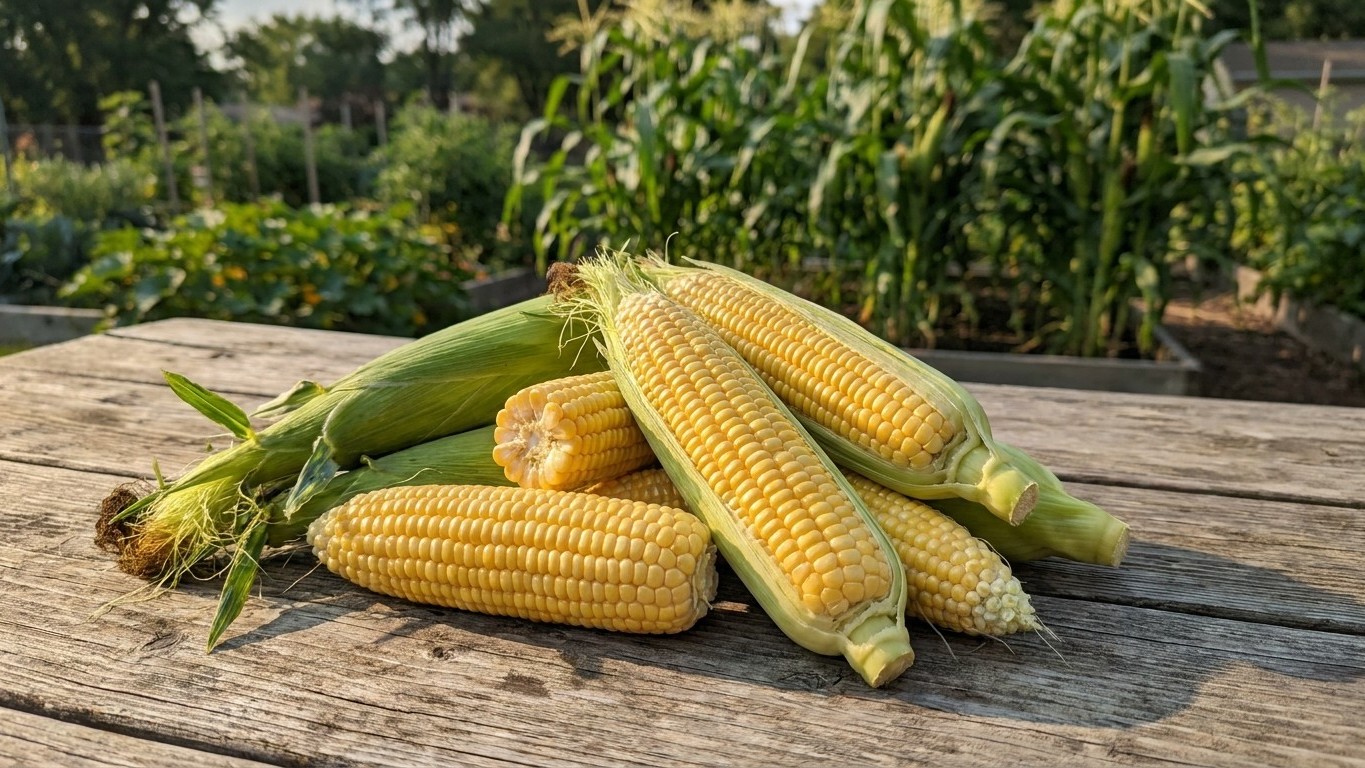

Sugar Buns is a sugary enhanced (se) sweet corn with yellow kernels, recommended by Clemson Cooperative Extension. That genotype makes it sweeter and more tender than standard su corn, and it holds its sugar longer after picking. Unlike supersweet (sh2) varieties, it needs no isolation from other sweet corn in the garden.
Genotype and Kernel Color
The letters after a sweet corn name tell you more than the name itself ever will. Sugar Buns carries the sugary enhanced, or se, genotype, a middle ground between old-fashioned su corn and the supersweet sh2 hybrids that dominate seed catalogs today. Clemson Cooperative Extension lists it specifically for this trait: se corn produces kernels that are sweeter and more tender than standard su varieties, and that sweetness sticks around longer once the ear leaves the stalk.
That staying power matters more than most gardeners realize. Sweetness in corn is really stored sugar, and every genotype converts that sugar to starch at a different pace. Su corn converts fast, which is why grandma’s stories about running from the garden to the pot weren’t exaggeration. Se corn slows that clock down. Sh2 corn slows it down even further, though Sugar Buns doesn’t fall into that category.
Kernel color is the other detail people fixate on, and it’s worth being blunt here: yellow kernels aren’t sweeter or less sweet than white ones. Clemson’s list doesn’t rank colors by flavor, because color is a pigment trait, not a sugar trait. Choosing yellow over white (or a bicolor) is purely a matter of what you like on your plate. The genotype, not the hue, is what decides how sweet an ear tastes and how long that sweetness lasts.
Soil Temperature: When to Plant
Forget the calendar. Sweet corn germination depends on soil temperature, not a date on a seed packet or a regional planting guide. For an se cultivar like Sugar Buns, the threshold is 50 F, measured at a 4-inch depth, before you drop a single seed.
The depth matters because surface soil warms and cools much faster than soil a few inches down. Check the top half-inch on a sunny spring morning and you might see a reading well above 50 F, even though the seed zone underneath is still cold enough to rot a kernel before it sprouts. A simple soil thermometer, pushed down 4 inches and checked in the morning before the sun has had a chance to skew the number, gives a far more honest picture than air temperature or the feel of the dirt in your hand.
This 50 F threshold applies to ordinary sweet corn genotypes, including su and se types like Sugar Buns. Supersweet sh2 varieties are pickier: they need soil at 65 F before they’ll germinate reliably. Mixing up those two thresholds is a common way to lose a planting. If you’re growing Sugar Buns alongside a supersweet variety in the same garden, don’t plant them on the same day just because the calendar says spring has arrived. Test the soil, and plant each type when its own threshold is met.
As for how many days until harvest, no days-to-maturity figure for Sugar Buns is published in the sources behind this guide. That number varies by seed lot and by grower, and your own seed packet will carry the count that applies to the seed in your hand. Treat that printed number, not a generic estimate, as your harvest countdown once the seed is in the ground.
Isolation: Does Sugar Buns Need It?
Here’s where a lot of backyard growers get nervous for no reason. Isolation distance rules exist in sweet corn, but they exist specifically for supersweet sh2 varieties, not for su or se types like Sugar Buns.
Clemson Cooperative Extension is direct about the genotype behind Sugar Buns: it’s sugary enhanced (se), a category that Clemson describes as needing no isolation. That’s a meaningfully different situation than sh2 corn, where cross-pollination from any nearby ordinary sweet corn (su or se varieties included) reduces sweetness in the sh2 ears. The mechanism is pollen drift: wind carries pollen from a neighboring su or se planting onto the silks of an sh2 ear, and the resulting kernels lose the enhanced sugar content that makes sh2 corn worth growing in the first place. Nothing about the ear looks wrong when you pick it. The damage is invisible until you bite into a kernel that should have been candy-sweet and tastes merely ordinary.
Because Sugar Buns is se, not sh2, that whole problem doesn’t apply to it. You can plant it near other sweet corn varieties, su or se, without worrying that cross-pollination will dull its flavor. If you’ve heard advice about keeping sweet corn varieties a certain distance apart, that rule is aimed at protecting supersweet corn from cross-pollination, and it doesn’t govern how you plant Sugar Buns. No specific isolation distance or timing window is published for any genotype in Clemson’s guidance, sh2 included, so don’t go looking for an exact number to plug into your garden plan. The category (sh2 needs isolation, su and se generally don’t) is the operative rule, not a measured distance.
Taste, Texture, and What to Do With the Ears
Sweetness in corn is a race against time, and Clemson Cooperative Extension puts the mechanism plainly: “Sweet corn loses sugar from the kernel rapidly at high temperatures… Sweet corn can be stored under optimal conditions for about five days, but will lose sweetness with each day of storage.” Read that carefully, because “about five days” is a ceiling under ideal conditions, refrigerated, husks on, not a guarantee. Every day that passes, and every degree of extra heat, pulls more sugar out of the kernel and converts it to starch.
This is exactly where genotype earns its keep. Su corn, the old-fashioned type, burns through its sugar fastest, which is why traditional advice said to cook it within hours of picking. Se corn, Sugar Buns’ category, holds its sweetness longer than su, giving you a wider window between garden and table without the flavor collapsing. Sh2 supersweet corn holds longest of the three, which is part of why it’s become so common in grocery stores that need corn to survive days of shipping and shelf time.
That ranking is the practical reason a home gardener picks se corn like Sugar Buns over a plain su variety: you get noticeably better sweetness retention without needing the extra vigilance sh2 corn sometimes demands during germination and isolation planning. Once you’ve picked your ears, keep them cool and use them soon. Refrigerate unhusked ears immediately if you’re not cooking the same day, and treat “about five days” as the outer edge of quality, not a target to aim for. The sooner you eat it, the closer that kernel tastes to the moment it left the stalk.
Common questions
Is Sugar Buns a supersweet (sh2) corn?
No. Sugar Buns is a sugary enhanced (se) genotype, according to Clemson Cooperative Extension. Supersweet sh2 corn is a separate category with its own soil temperature and isolation considerations that don’t apply to Sugar Buns.
Do I need to isolate Sugar Buns from other sweet corn?
No isolation is needed. That rule applies specifically to sh2 supersweet varieties, which lose sweetness if pollinated by ordinary sweet corn nearby. Sugar Buns, as an se type, doesn’t carry that requirement.
What soil temperature does Sugar Buns need to germinate?
Soil at a 4-inch depth should reach 50 F before sowing. That’s the threshold for ordinary sweet corn genotypes like se, not the 65 F threshold that applies to supersweet sh2 varieties.
How long can I store picked ears before the sweetness fades?
Clemson Cooperative Extension notes sweet corn can be stored under optimal conditions for about five days, losing sweetness with each day. As an se variety, Sugar Buns holds its sugar longer than old-fashioned su corn, but that five-day figure is still a maximum, not a target.