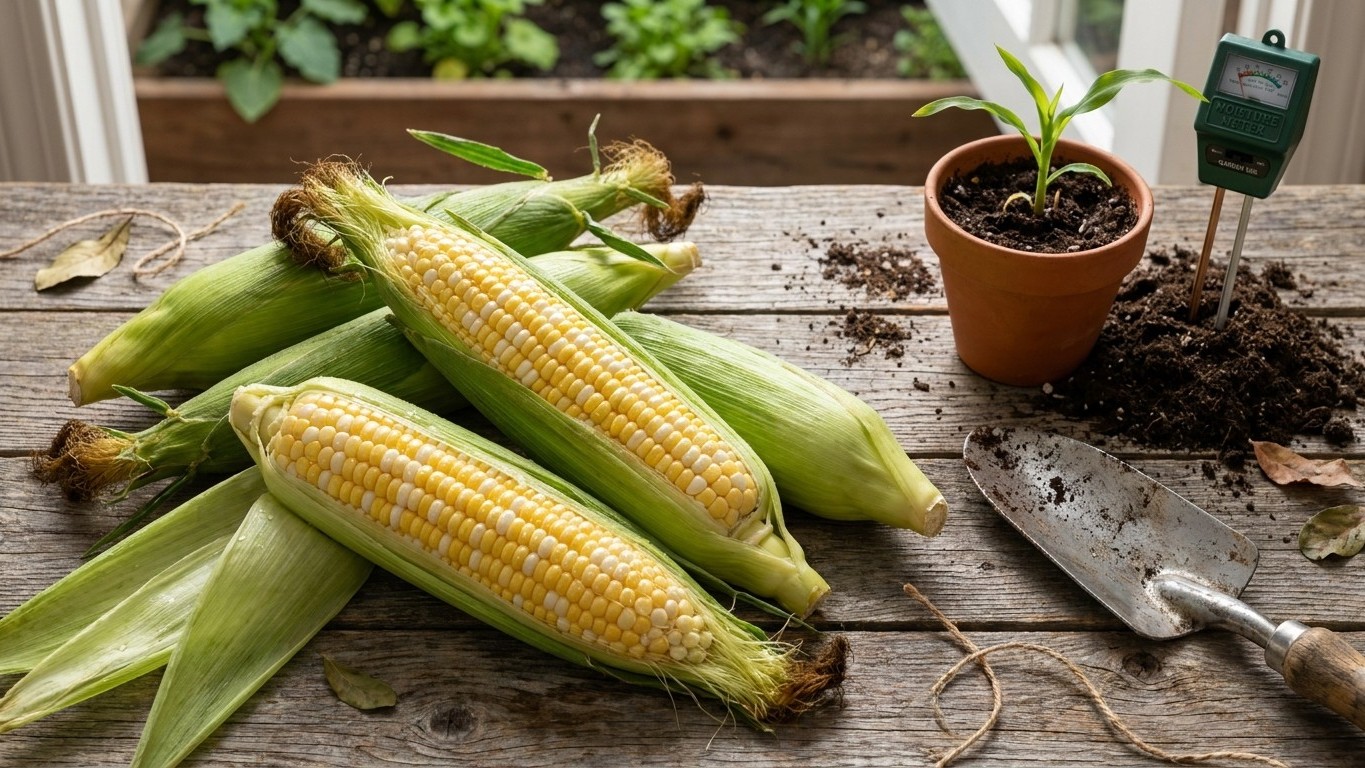

Ambrosia sweet corn is a sugary enhanced (se) bicolor cultivar recommended by Clemson Cooperative Extension. Plant it once soil at the 4-inch depth reaches 50 F, not the 65 F threshold reserved for supersweet types. It needs no isolation from other sweet corn in the garden, and its ears hold their sugar longer than standard su varieties, though Clemson’s own storage window (about five days under optimal conditions) still applies.
Genotype and Kernel Color: What Ambrosia Actually Is
Every sweet corn variety carries a genetic code that determines how much sugar sits in the kernel and how fast that sugar disappears after picking. Ambrosia falls into the sugary enhanced (se) category, a step up from the older sugary (su) types home gardeners grew for decades. Clemson Cooperative Extension recommends Ambrosia because the se gene produces an ear that’s sweeter and more tender than su corn, and one that resists turning starchy between harvest and the pot.
The se designation matters more than any marketing on a seed packet. Sugary corn converts sugar to starch almost immediately once picked, which is why older varieties demanded you run from the row to the boiling water. Sugary enhanced corn slows that conversion. It won’t match a supersweet (sh2) for shelf life, but it closes the gap enough that most home cooks never notice the difference between a same-day ear and one that sat in the crisper overnight.
Ambrosia’s kernels come in bicolor, meaning yellow and white kernels mixed on the same cob. That’s a cosmetic trait, nothing more. Clemson’s variety notes don’t rank bicolor against solid yellow or solid white for flavor, and there’s no agronomic reason to expect one color to taste sweeter than another. Sugar content is a function of the se genotype, not the pigment in the pericarp. Choosing bicolor is a matter of appearance, not a shortcut to a sweeter ear.
When Soil Temperature, Not the Calendar, Says Plant
Sweet corn seed doesn’t germinate on schedule; it germinates on soil temperature, and the number changes depending on genotype. For ordinary sweet corn, the ground at a 4-inch depth needs to hit 50 F before seed goes in. Supersweet (sh2) cultivars want 65 F at that same depth, because their seeds carry less stored energy and rot easily in cold, wet soil.
Ambrosia is sugary enhanced, which places it with the standard sweet corn group rather than the supersweets. That means the 50 F threshold at 4 inches is the number to track, not 65 F. A soil thermometer pushed to that depth, checked in the morning before the sun warms the surface, gives a far more honest reading than trusting a neighbor’s planting date. Surface soil warms and cools fast with air temperature; four inches down is where the seed actually sits, and where germination decisions get made.
Why the 4-Inch Depth Matters More Than the Date
A soil surface can read 60 F on a sunny afternoon while the seed zone, four inches under, is still sitting at 46 F. Plant on the strength of that surface number and the seed can rot in cold, saturated soil before it ever sprouts. That’s the value of the 50 F rule for se corn: it measures the seed’s actual environment, not air temperature or a calendar date.
One number this article won’t give you is days to maturity. No publication attaches a maturity count to the se genotype as a category, and estimating one would be guesswork. Every seed packet lists its own days-to-maturity figure for the specific lot in hand, and that’s the number to plan a harvest around.
Isolation: The Rule Ambrosia Doesn’t Need
Isolation is where sweet corn growing gets confusing, mostly because the rule that matters for one genotype gets misapplied to all of them. Clemson Cooperative Extension is direct about who needs to worry: supersweet (sh2) varieties require isolation from other corn types, because cross-pollination with ordinary sweet corn pollen turns their kernels starchy and tough, with no visible warning until the ear is cooked and eaten.
Ambrosia doesn’t carry that risk. As a sugary enhanced (se) cultivar, it needs no isolation from other sweet corn in the garden. Plant it next to a standard su variety, another se cultivar, or a mixed block of both, and cross-pollination won’t degrade the sweetness the way it would with a supersweet. The isolation warning many gardeners have heard, often repeated as a blanket rule for “sweet corn,” actually belongs to the sh2 category alone.
That distinction saves real garden space. A gardener growing only se and su types can plant multiple varieties in adjoining blocks without staggering plantings or separating rows by a set distance. No specific isolation distance or timing window is published for se corn, because none is needed. The caution belongs to anyone growing sh2 corn near ordinary sweet corn, where pollen drift is the actual threat, and where the damage is invisible until the pot is on the stove.
The Sugar Clock: What “Fresh” Really Means for a Bicolor Ear
Sweetness in corn is a countdown, and Clemson Cooperative Extension puts the mechanism in plain terms: “Sweet corn loses sugar from the kernel rapidly at high temperatures… Sweet corn can be stored under optimal conditions for about five days, but will lose sweetness with each day of storage.” That’s the biology behind the old advice to run from the garden to the pot. Sugar converts to starch inside the kernel, and heat accelerates the process, which is why a shaded cooler beats a hot truck bed even for a short trip home.
Where the se genotype earns its keep is in how that clock runs. Standard sugary (su) corn loses sugar fastest of the three types, which is why older varieties demanded same-day cooking. Sugary enhanced corn, Ambrosia’s category, holds its sugar longer than su, giving a wider window between picking and cooking without the flavor collapsing into starchiness. Supersweet (sh2) corn holds longest of all, which is why commercial growers lean on it for corn that travels long distances to a grocery shelf.
That “about five days” figure from Clemson is a ceiling, not a guarantee, and it assumes optimal storage conditions: cold, humid, and out of direct heat. It doesn’t mean an ear tastes the same on day five as day one. Every day in storage costs some sweetness, even under ideal conditions; the se genotype simply slows that decline compared to su corn rather than stopping it. For a home garden, the practical takeaway is straightforward: refrigerate ears promptly, use them sooner rather than later, and treat that five-day window as the outer edge of acceptable quality rather than a target to aim for.
Common questions
Is Ambrosia a supersweet corn?
No. Ambrosia is sugary enhanced (se), a different genotype from supersweet (sh2). It’s sweeter and holds its sugar longer than older sugary (su) types, but it doesn’t need the isolation or the 65 F soil threshold that supersweet varieties require.
Does bicolor Ambrosia taste sweeter than a yellow or white variety?
Kernel color isn’t a sweetness indicator. Sweetness comes from the se genotype, not from whether the kernels are bicolor, all-yellow, or all-white. Clemson’s variety notes make no claim that any color outperforms another for flavor.
Do I need to plant Ambrosia away from my other sweet corn?
No isolation is needed. That requirement applies specifically to supersweet (sh2) cultivars, whose kernels turn starchy if cross-pollinated by ordinary sweet corn pollen. Ambrosia, as an se variety, can be planted near other sweet corn without that risk.
How long can I keep picked Ambrosia corn before it loses its sweetness?
Clemson Cooperative Extension puts the outer limit at about five days under optimal storage conditions, with sweetness declining each day. As an se variety, Ambrosia holds its sugar longer than standard su corn, but it still loses quality with time, so earlier use is always better than later.