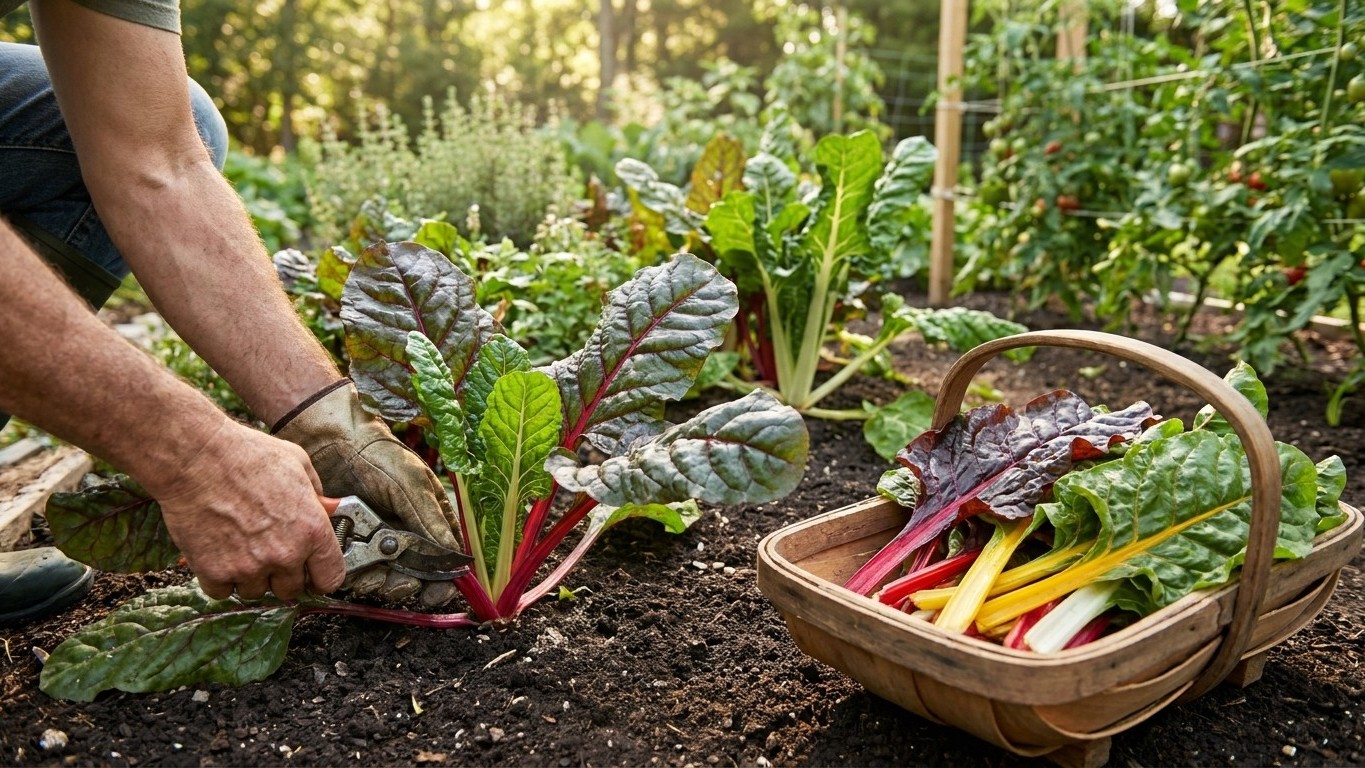

Yes, you can cut Swiss chard almost to the ground and it will keep producing. Unlike lettuce or kale, which get picked leaf by leaf, chard tolerates a full shearing down to two inches above the soil, as long as the growing point stays intact. That single condition decides whether the plant regrows or dies in the row. A 10-foot row can hand you 8 to 12 pounds of leaves and stems over a season, and every part of what you cut is edible, raw or cooked.
The short answer
Utah State University Extension’s fact sheet on Swiss chard in the garden lays out the rule plainly: “Provided the growing point is not damaged, all leaves can be cut off to within 2 inches of the soil.” That detail sets chard apart from nearly everything else in a backyard vegetable bed. Lettuce bolts once you take too much at once. Kale slows down if you strip whole branches. Chard, cut hard, just sends up new leaves from the same crown.
Harvest timing is flexible in a way few greens allow. “Swiss chard can be harvested when the leaves reach full size or any time after they form,” according to the Extension. Gardeners commonly strip the oldest, outer leaves first, letting the younger leaves at the center keep growing, then switch to the full clear-cut method once the plant is established and productive.
What that means for yield: a 10-foot row produces 8 to 12 pounds over a growing season, a return that rivals or beats most other leafy greens grown in the same footprint. Both leaves and stems are edible, raw or cooked, so almost nothing from that cut goes to waste. Stalks can be sliced and sautéed while leaves go into a salad or a pan the same night.
Storage has a similarly hard-edged answer. Refrigerated chard holds for 1 to 2 weeks, per Utah State University Extension, which is long enough to plan a harvest around a weekly rhythm rather than a scramble. Cut what a few dinners need, refrigerate the rest, and go back to the row once new growth reaches a usable size again.
None of this works if the cut goes too deep and takes the crown with it. The growing point, that compact cluster of tissue at the base of the plant, is what regenerates leaves after a hard cut. Damage it and the plant is finished, no matter how healthy the roots below remain. The instruction to stop at “2 inches” isn’t an arbitrary number. It’s the margin that keeps that growing point out of reach of the knife or shears.
What actually decides it

The growing point is the whole mechanism
Every other rule in this fact sheet exists to protect one small structure. The growing point sits low at the base of the plant, below where the leaves are usually cut. As long as it’s undamaged, the plant keeps pushing out new growth after even an aggressive harvest. Cultivation practices that avoid root pruning, and harvest practices that stop two inches above the soil, are both aimed at the same target: leave that point alone.
A narrow temperature window, twice
Chard has two separate heat ceilings, and they don’t apply to the same stage of the plant. Seeds need soil at 40 F just to go in the ground, germinate best between 55 and 75 F, and take 7 to 14 days to emerge. Push past 80 F and germination itself drops off, before the plant has even started growing. Once established, the mature plant has its own limit: growth is best under 75 F, and young plants tolerate temperatures down to 32 F without serious damage. High summer heat later on doesn’t kill chard outright, but it reduces growth, lowers quality, and can push the leaves toward bitter or off-flavors. Chard tastes best when it grows fast and matures before that summer heat arrives.
Watering: frequent and uniform, not deep and infrequent
Chard is watered differently than most of the vegetables in this series. Extension guidance calls for 1 to 2 inches of water per week applied frequently and uniformly, rather than the deep, infrequent soaking recommended for many other crops. The reason is textural, not just a matter of drought stress: moisture fluctuations cause leaves to toughen, slow leaf development, and contribute to off-flavors. Irregular watering doesn’t just stunt the plant, it changes what the leaves taste like on the plate.
Spacing does double duty as weed control
Chard is set at 6 inches between plants in the row, with rows 12 inches apart, the tightest spacing of any leafy green in this series.
| Crop | Spacing between plants |
|---|---|
| Cabbage | 12–18 inches |
| Lettuce | 8–12 inches |
| Swiss chard | 6 inches |
Chard doesn’t compete well with weeds, so that tight spacing isn’t just about maximizing leaves per foot of row. Dense plantings reduce weed pressure directly, and weed control matters most while the plants are still small and establishing. Cultivation should stay shallow to avoid root pruning, which would interrupt the uninterrupted growth the plant needs to stay productive.
How to do it
- Pick a variety or two. Utah State University Extension names four types commonly grown in home gardens: Rhubarb, Bright Lights, Lucullus, and Fordhook Giant. Planting a range of leaf colors makes salads and meals more interesting, and the source gives no maturity dates or ratings to choose between them, so selection comes down to color and personal preference.
- Decide between seed and transplants, and count backward from your last frost-free date. Seeded chard goes into the ground 3 to 4 weeks before that date. Transplants, by contrast, wait until the last frost-free date itself before going out. If starting transplants indoors, count backward roughly 5 to 6 weeks from that same planting date, growing seedlings until they have 4 to 6 mature leaves and a well-developed root system before they leave their containers.
- Check soil temperature before direct seeding. Soil needs to reach at least 40 F. Germination is best between 55 and 75 F and takes 7 to 14 days to show. Above 80 F, germination drops, so seed going into soil that’s already running hot is working against itself.
- Space and thin. Set plants 6 inches apart in rows 12 inches apart. Once seedlings reach 3 to 4 true leaves, thin the stand. Plants pulled at thinning aren’t wasted: with some roots kept intact they can be transplanted elsewhere, or they can simply be eaten.
- Feed once the plants are growing. About 4 weeks after transplanting or thinning, apply 1/4 cup of a 21-0-0 nitrogen fertilizer per 10 feet of row to push rapid leaf growth.
- Water and mulch. Supply 1 to 2 inches of water per week, applied frequently and uniformly rather than in occasional deep soakings. Organic mulch helps cool the soil as temperatures climb, reduces water stress, and controls weeds at the same time.
- Cover for protection when needed. Fabric row covers protect seedlings and transplants from frost, and floating row covers keep flea beetles from reaching young plants.
- Time a fall crop by counting back from the first fall frost. Plant 50 to 75 days before the anticipated maturity date, aiming for maturity roughly 2 to 3 weeks before the first fall frost. Established plants can stay in the garden and tolerate light frosts afterward.
What goes wrong

- Aphids curl the leaves. Crinkled, curled foliage signals an aphid problem. A strong stream of water knocks them off, or use insecticidal soap on established infestations.
- Slugs chew holes in the leaves. This tends to happen where the soil stays consistently moist. Avoid the wet soil conditions that favor slugs in the first place rather than treating the damage after it appears.
- Flea beetles reduce or kill young stands. Seedlings are especially vulnerable. A floating row cover excludes beetles from reaching the plants entirely.
- Disease builds up in the same bed year after year. Chard isn’t especially disease-prone, but rotating its location from year to year still helps control most of the problems that do show up.
- Leaves turn tough and bland. This usually traces back to uneven watering. Moisture fluctuations toughen leaf texture and cause off-flavors, so water needs to be frequent and uniform, not occasional and heavy.
- Leaves turn bitter in midsummer. High heat reduces quality and can push flavor toward bitter or off notes. Planting early enough that the crop matures before summer heat, and mulching to keep soil temperatures down, both help avoid this.
- Weeds overrun young plants. Chard doesn’t compete well with weeds, especially while establishing. Keeping the recommended 6-inch spacing and cultivating shallowly, without pruning roots, keeps weeds from getting ahead of the crop.
- A hard cut kills the plant instead of renewing it. This happens when the cut goes below the growing point. Stop at 2 inches above the soil, never lower, so the crown that regenerates new leaves stays intact.
Common questions
Can Swiss chard really be cut down more than once in a season?
Yes, provided each cut stops at 2 inches above the soil and leaves the growing point undamaged. The plant regenerates from that point repeatedly, which is why gardeners often strip outer leaves for early harvests and reserve the full clear-cut for later in the season.
What’s the real difference between seeding chard and starting transplants?
Timing. Seed goes directly into the ground 3 to 4 weeks before the last frost-free date. Transplants wait until that date itself, after spending roughly 5 to 6 weeks growing indoors until they reach 4 to 6 mature leaves and a solid root system.
How long does harvested chard actually keep?
Refrigerated chard holds for 1 to 2 weeks according to Utah State University Extension, which is enough to spread a single row’s harvest across several meals without racing to use it all at once.
Does chard need constant watering to avoid bitterness?
It needs consistent watering rather than heavy watering. The Extension guidance calls for 1 to 2 inches per week delivered frequently and uniformly. Fluctuating moisture, not simply too little water, is what toughens leaves and pushes flavor toward off notes, and high summer heat compounds the same problem.