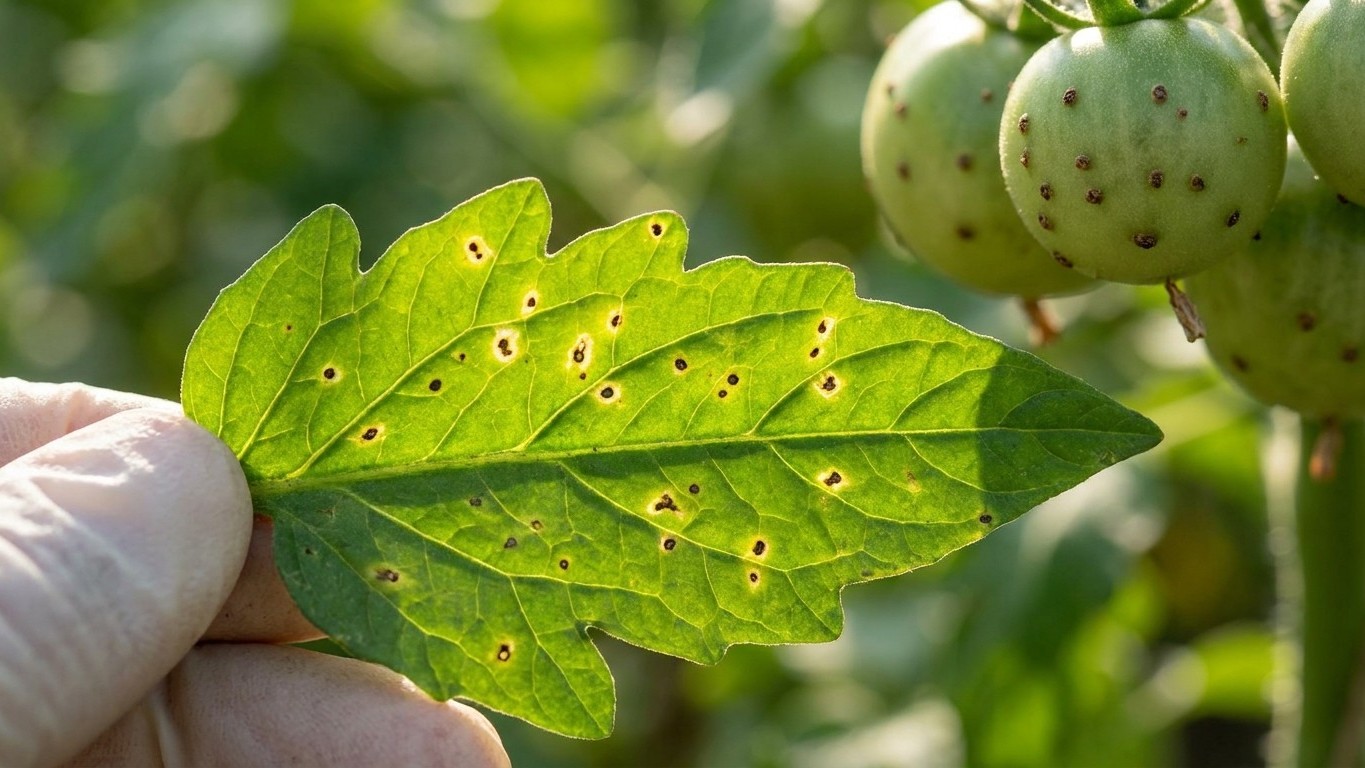

Bacterial speck shows up as pinpoint black lesions, each ringed by a narrow yellow halo, scattered across young leaves and green fruit. It’s a real disease, not a random blemish, but it rarely kills a plant outright. Cool, wet spells push it fast; hot, dry weeks can stall it for good.
What you are looking at

Bacterial speck is not an emergency in the way late blight is, but it does spread quickly once the weather cooperates, often moving through a planting in a matter of days when leaves stay wet overnight. It starts on the youngest growth, upper leaflets and the newest fruit clusters, then works its way down the plant as spores wash onto lower foliage during rain or overhead watering.
Black pinpoint spots with a yellow ring on leaves
The lesions begin as tiny, dark flecks, smaller than a pencil tip, that look almost greasy or water-soaked when you hold the leaf up to light. Each spot is surrounded by a thin, distinct halo of yellow tissue that fades into the healthy green. As the disease advances, individual spots can merge into larger dead patches, and heavily infected leaves yellow all over and drop early.
Raised dark specks on green fruit
On fruit, the same organism produces small, slightly raised, dark brown to black specks, usually no bigger than a pinhead, sometimes with a faint pale halo. They stay superficial, sitting right at the surface rather than sinking into the flesh. Fruit that’s already turned red rarely develops new lesions; the damage is almost always confined to green, immature tomatoes.
Dark streaks on stems and petioles
Stems and leaf petioles can carry narrow, dark, water-soaked streaks, especially where they’ve brushed against wet foliage. These lesions stay superficial and don’t girdle the stem the way a vascular wilt does, so the plant above the streak keeps growing normally rather than collapsing.
What it is not
Three other tomato problems produce spots that get mistaken for bacterial speck almost every season, and mixing them up leads gardeners to either overtreat a minor nuisance or ignore something that needs faster action.
Septoria leaf spot
Septoria lesions are larger and more circular, with a tan or gray center and a dark brown border, and if you look closely at that center you’ll often see tiny black dots (the fungus’s fruiting bodies) embedded right in the dead tissue. Septoria almost never shows the tight yellow halo that defines bacterial speck, and it favors humid, muggy stretches rather than the cool, wet weather speck prefers. Treating septoria like a bacterial problem wastes a copper application that won’t touch the fungus driving it.
Bacterial spot
This one is the closest look-alike, caused by a related bacterium, and on leaves alone the two can be almost impossible to separate by eye. The fruit is where they part ways: bacterial spot lesions grow larger, become raised and scabby, and often develop a sunken, rough crater, while speck lesions stay small, flat, and superficial. Bacterial spot also tends to build up in warm, wet weather, while speck favors cooler conditions, so the calendar can be a useful second clue.
Early blight
Early blight produces much larger lesions on lower, older leaves first, and each one carries visible concentric rings, like a target, inside a brown dead patch. There’s no fine yellow halo hugging a pinpoint black dot the way speck shows it. Early blight also spreads upward from the bottom of the plant over weeks, a slower and more predictable pattern than speck’s quick jump through young growth after a wet night.
Where it comes from and when it strikes
Bacterial speck is caused by Pseudomonas syringae pv. tomato, a bacterium that survives between seasons on infected seed, in crop debris left in the soil, and on volunteer tomato plants that pop up where last year’s crop grew. It can also overwinter on nearby weeds that serve as a quiet reservoir until conditions turn favorable again.
The bacterium arrives on a new planting mainly through contaminated seed or infected transplants bought or started without knowing the source was clean. Once it’s established, splashing water, whether from rain or a garden hose aimed at the foliage, carries it from leaf to leaf and from soil up onto the lowest leaves. Wind-driven rain can move it across a whole row in a single storm, and hands, pruning shears, and stakes that brush wet, infected leaves spread it just as effectively.
What separates speck from most other tomato bacterial diseases is its preference for cool, wet conditions rather than heat. Extended periods of leaf wetness, heavy dew that lingers into midmorning, or a stretch of overcast, drizzly days give the bacteria the time they need to enter leaf pores and multiply. A sudden warm, dry spell usually slows an outbreak fast, which is part of why speck can flare early in the season and then seem to disappear once summer heat sets in.
What to do about it now
There’s no cure once a leaf or fruit lesion has formed, and no product will erase the black specks that are already there. What you can control is whether the disease keeps spreading to healthy tissue, and that comes down to a handful of practical moves done consistently rather than any single treatment.
Start by pulling and destroying the worst-affected leaves and any volunteer tomato plants nearby, rather than composting them, since home compost piles rarely get hot enough to kill the bacteria. Switch from overhead watering to a soaker hose or drip line at the base of the plant, because wet foliage is the single biggest driver of new infections. Stake or cage plants to lift foliage off the ground and thin out crowded stems so air moves through the canopy and leaves dry faster after rain or dew.
A copper-based bactericide, applied before or right at the first sign of spots, can slow the spread on the leaves and fruit that aren’t yet infected, though it won’t reverse existing lesions and resistance in the bacteria population has reduced how reliable copper is in some regions. Mulching under the plants cuts down on soil splashing onto lower leaves, which is one of the main ways the bacteria climb the plant in the first place.
The fruit itself is safe to eat. Speck lesions are cosmetic and superficial; simply cut around the small black spots and use the rest of the tomato as you normally would.
Keeping it out next season
Crop rotation matters here, and it needs to be a real break rather than a token one: avoid planting tomatoes, and closely related crops like peppers and eggplant, in the same bed for at least two to three years, since the bacterium can persist in soil and buried debris that long. Pull volunteer tomato seedlings on sight in rotated beds, because a single volunteer plant can restart the whole cycle.
Seed source matters more for this disease than for most, since contaminated seed is one of the main ways speck gets introduced to a new garden in the first place. Buy from suppliers that test or treat seed, or start from certified disease-free transplants rather than saving seed from a plant that showed any spotting. Some tomato varieties carry a natural resistance gene, often referred to by breeders as the Pto gene, that provides protection against certain strains of the bacterium; check variety descriptions in seed catalogs for language noting resistance to bacterial speck, since this disease doesn’t carry a single, universal letter code the way Verticillium or Fusarium resistance does on seed packets.
Sanitize stakes, cages, and pruning tools between seasons, since dried bacterial residue on wood or metal can reintroduce the disease to clean transplants. Space plants generously and prune lower leaves and suckers to keep air moving through the canopy, and lay down mulch at transplanting time so splashing rain can’t carry soilborne bacteria up onto new foliage.
Common questions
Will bacterial speck kill my tomato plant?
Rarely on its own. It weakens plants by reducing leaf area and can lower yield in a bad year, but it doesn’t girdle stems or cause the sudden wilting and collapse that vascular diseases do.
Can I still can or freeze tomatoes with speck marks on them?
Yes, once you’ve cut away the small surface lesions. The rest of the fruit is unaffected and safe to process normally.
Does rain make bacterial speck worse?
Yes, particularly cool rain followed by overcast, humid days that keep leaves wet for hours. Splashing water is the main way the bacteria move from plant to plant.
Is bacterial speck the same thing as bacterial spot?
No, though they’re closely related and often confused. The clearest difference shows up on the fruit, where speck stays small and flat while spot lesions grow larger, raised, and scabby.