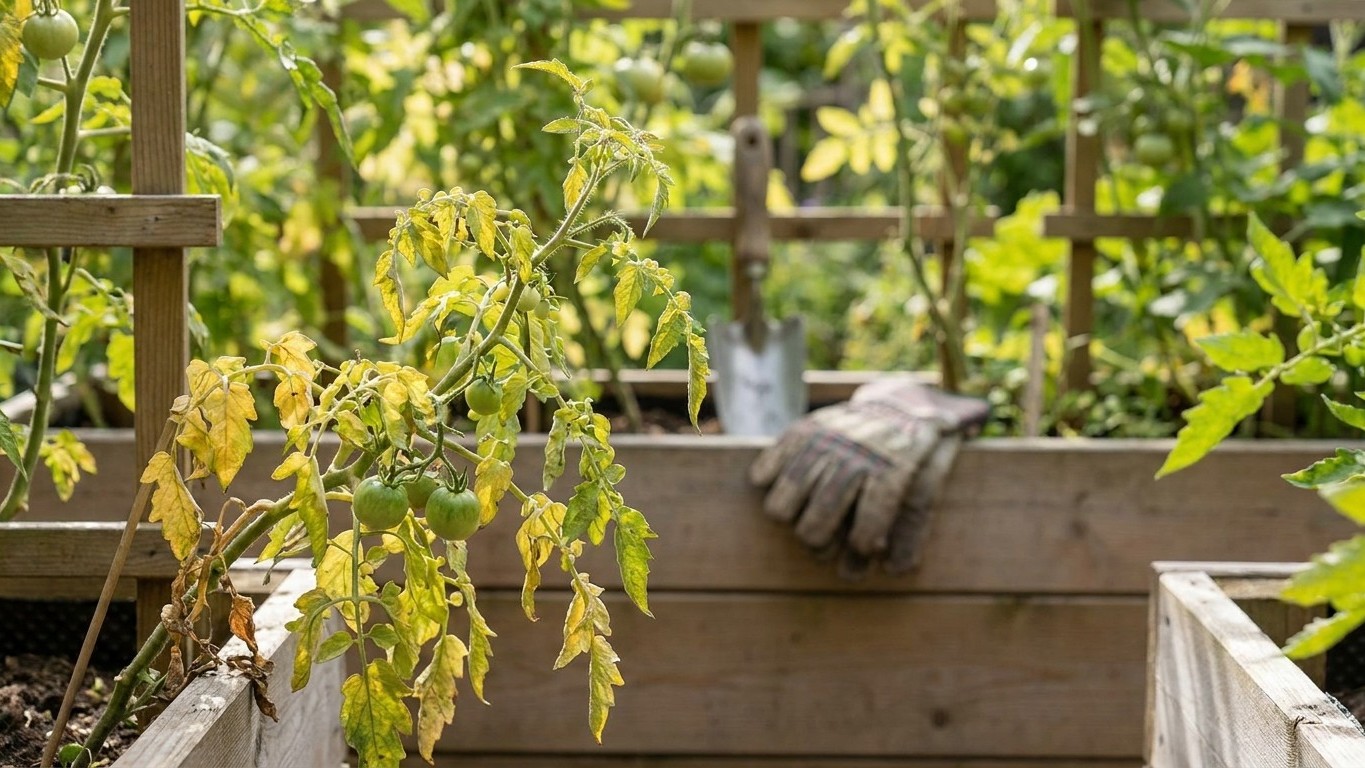

Yellow leaves on a tomato plant usually mean one of three things: the plant is recycling nitrogen from old leaves into new growth, a fungal disease has taken hold, or watering has been inconsistent enough to stress the roots. It is not automatically serious. Bottom leaves turning yellow slowly on an otherwise healthy, fruiting plant is normal aging. Yellowing that spreads fast, comes with spots, or shows up on one side of the plant only is not. Check the lowest leaves first, then look for spots, rings, or wilting before you treat anything.
What you are looking at

Start by locating exactly where the yellow is. Normal age-related yellowing begins on the oldest leaves at the base of the plant and creeps upward slowly over weeks. The leaf usually goes uniformly pale yellow, sometimes with a slight give before it drops on its own. That pattern, on a plant that is otherwise green, upright, and setting fruit, is not a crisis.
Disease-driven yellowing looks different. Early blight and Septoria leaf spot both start with small brown or tan spots, often ringed with yellow, on lower and mid-level leaves. The yellow spreads outward from the spot rather than starting at the leaf tip or margin. Leaves affected this way often curl or shrivel before they drop, and the spotting is visible even on leaves that are still mostly green.
Vascular wilts (Fusarium and Verticillium) tend to show up asymmetrically: yellowing on one branch or one side of the plant while the rest looks fine, sometimes with wilting during the heat of the day that recovers overnight. Interveinal yellowing, where the veins stay dark green but the tissue between them pales, is a different pattern again and points toward a magnesium or iron shortage rather than nitrogen or disease.
Do not confuse any of this with blossom end rot, which shows up as a sunken, leathery patch on the fruit itself, not the foliage. If the fruit is affected and the leaves are not, that is a separate issue covered in detail on our page about blossom end rot and why calcium is rarely the real problem. Spider mite damage can also mimic nutrient yellowing: check the underside of a yellowing leaf for fine webbing or tiny moving specks before assuming it is nutritional.
What actually causes it
Nitrogen is a mobile nutrient inside the plant. When the supply in the soil runs short, the tomato plant pulls nitrogen out of its oldest leaves and ships it to new growth and developing fruit, because keeping the newest leaves productive matters more to the plant than keeping the oldest ones green. That is why bottom-up yellowing is the default pattern for a plant that is simply hungry or has outgrown its feeding schedule, not a sign of disease.
The common assumption is that any yellow leaf means the plant needs fertilizer. That is often wrong. Overwatering and poor drainage suffocate roots and produce the exact same bottom-up yellow leaf, because a root system that cannot breathe cannot take up nitrogen even if plenty is present in the soil. Underwatering does something similar by concentrating salts around the root zone. In both cases, adding fertilizer does nothing, because the nutrient was never the bottleneck. The uptake was.
Fungal diseases are a separate mechanism entirely. Early blight (caused by the fungus Alternaria solani) and Septoria leaf spot both kill leaf tissue directly with fungal lesions, and the yellowing you see is the plant’s dying response around each infection site, not a nutrient signal at all. Vascular wilts go further: the fungus physically clogs the plant’s water-conducting tissue, so the yellowing and wilting you see is a plumbing failure, not a feeding one.
| Cause | Where it starts | Appearance | Other clues |
|---|---|---|---|
| Nitrogen mobility (normal aging or mild deficiency) | Oldest, lowest leaves | Uniform pale yellow | Plant otherwise vigorous, new growth stays green |
| Overwatering or poor drainage | Lower leaves, whole plant over time | Yellow, sometimes slightly wilted despite wet soil | Soil stays wet days after watering |
| Early blight or Septoria leaf spot | Lower and mid leaves | Brown or tan spots ringed in yellow | Spots visible before yellowing spreads |
| Fusarium or Verticillium wilt | One side or one branch | Yellow with daytime wilting | Cut a stem: browning inside the vascular ring |
| Magnesium or iron shortage | Newer leaves (iron) or older leaves (magnesium) | Green veins, yellow tissue between them | No spots, no wilting |
What to do now

Leaves that have already turned yellow will not turn back green. That tissue is either being deliberately abandoned by the plant or already damaged by fungus, so the goal now is stopping further spread, not reviving what is gone. Remove and discard badly spotted or fully yellow leaves, cutting rather than tearing to avoid stripping healthy tissue with it. Do not compost diseased leaves if you suspect early blight or Septoria, since the fungus survives in plant debris.
Do not strip more than roughly a third of the plant’s foliage at once even if a lot of it looks bad. The remaining leaves are doing all the photosynthesis that ripens the fruit already on the vine, and a plant stripped bare will struggle to finish what it has set. If the cause was disease and it caught the plant early, the trusses that are already sizing up can usually still ripen normally; if fruit development stalls anyway, our page on why tomatoes stop ripening covers the heat and stress factors that slow that process separately from foliage disease.
If it is a wilt disease
There is no cure for Fusarium or Verticillium wilt once a plant is infected. Pull severely affected plants to protect neighboring ones, and do not replant tomatoes, peppers, or eggplant in that same soil the following year without addressing the pathogen, since both fungi persist in soil for years.
If it is nitrogen or watering
Adjust the watering schedule to reach consistent, even moisture rather than alternating soggy and bone-dry, and consider a balanced, nitrogen-containing feed timed to when new growth resumes. Improvement usually shows up in new leaves within one to two weeks, not in the leaves already yellowed.
What does not work
Crushed eggshells scattered around the base are a slow-release calcium source at best, and yellow leaves are almost never a calcium problem to begin with. Calcium moves through the plant via water flow to whichever tissue is transpiring fastest, which is usually the leaves, not the fruit, so a shortage typically shows up as blossom end rot on the fruit rather than yellow foliage. Foliar calcium sprays fail for the same reason from the other direction: calcium sprayed on a leaf does not translocate to where the plant actually needs it, so spraying leaves does nothing for either yellowing or fruit-end rot.
Adding lime to soil that already has adequate calcium does not help and can actively hurt, because it raises soil pH and can lock out iron and manganese, producing the exact interveinal yellowing you were trying to prevent. Test soil before adding any amendment rather than assuming a deficiency.
Overwatering “just in case” the plant looks stressed is one of the most common overcorrections, and it worsens root suffocation if drainage was already the problem. Likewise, reaching for a broad-spectrum fungicide before confirming which disease, or whether it is a disease at all, wastes product and time on a plant that may simply need better drainage or a nitrogen top-up. Treating the wrong cause delays treating the right one.
Preventing it next time
The single change that prevents the most yellow-leaf trouble is consistent, even watering from the start of the season, delivered at the soil level rather than overhead. Uneven watering stresses roots, invites fungal spores to splash up from soil onto lower leaves, and is a factor behind the fruit-splitting problems covered on our page about why tomatoes crack and split, so getting the watering routine right solves more than one problem at once.
- Mulch under plants to stop soil-borne fungal spores splashing onto lower leaves during watering or rain.
- Space plants for airflow so foliage dries quickly after wet weather, since damp, still air is what lets Septoria and early blight spread.
- Rotate tomatoes, peppers, and eggplant out of the same bed for a few years where wilt disease has appeared before.
- Feed on a schedule rather than reactively, so nitrogen never runs short enough to trigger heavy bottom-up yellowing.
- Remove lower leaves that touch the soil early in the season as a preventive habit, not just once disease shows up.
If yellowing has been a recurring problem in the same bed, choosing disease-resistant cultivars is worth doing before you plant rather than treating after the fact. That decision belongs earlier in the season, alongside the other groundwork covered in our guide to growing tomatoes, since soil preparation and spacing decided at planting time influence how much disease pressure the plant faces all summer.
Common questions
Should I remove all the yellow leaves right now?
Remove the ones that are fully yellow or visibly spotted, but leave partially green leaves in place since they are still contributing to photosynthesis. Stripping too much foliage at once stresses the plant further and can expose fruit to sunscald.
Can yellow leaves spread to other plants?
Age-related or nutrient yellowing cannot spread, it is not contagious. Fungal causes like early blight and Septoria leaf spot can spread to nearby plants via wind, rain splash, or tools, so sanitize pruners between plants if disease is suspected.
Is it normal for the very bottom leaves to turn yellow every year?
Yes. Even healthy, well-fed tomato plants shed their oldest lower leaves as the season progresses, since those leaves are the least efficient and the plant reallocates their resources to new growth. Only worry if the yellowing accelerates up the plant or spreads faster than a leaf or two a week.
My tomato leaves are yellow but the plant still has flowers and fruit. Is that a bad sign?
Not necessarily. A plant can carry mild nitrogen-driven yellowing on its lower leaves while continuing to flower and set fruit normally, especially later in the season. Watch the fruit and new growth rather than the old leaves for the real read on plant health.