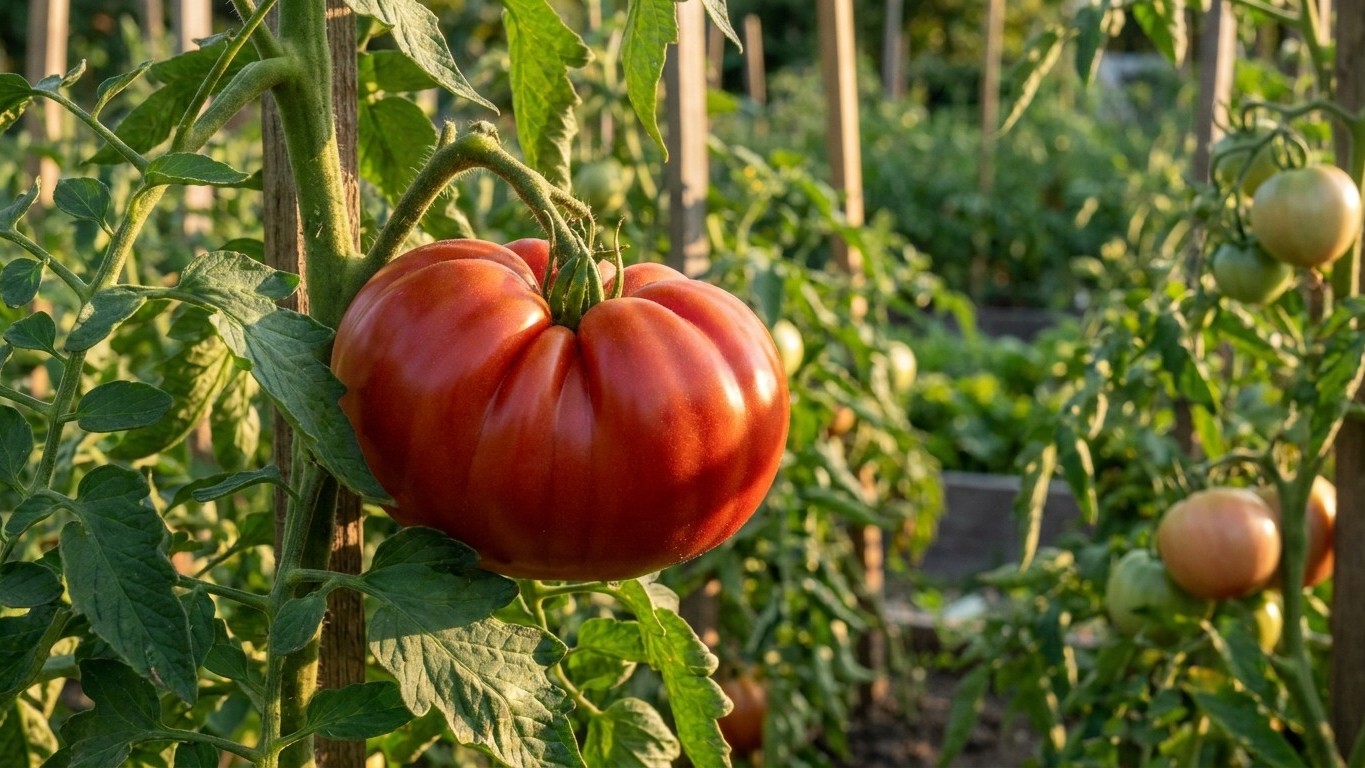

A beefsteak red tomato reaches full size and full flavor in about 90 days counted from transplant, not from seed, which means where you live decides whether it ripens at all before frost. Indeterminate, large-fruited, and built for slicing rather than canning, it rewards a long warm season and punishes a short one. The rest comes down to arithmetic you can do for your own backyard.
What Brandywine actually is
This is a large-fruited, indeterminate beefsteak, red-skinned, producing fruit that runs 14 to 24 ounces apiece, well into the range where one slice covers a sandwich bun. The flesh is dense and meaty rather than juicy, which is exactly the texture beefsteak growers are chasing when they pass over smaller, wetter slicing types.
Days to maturity is listed at 90 days, and that figure is counted from transplant, not from the date you start seed indoors. Add the four to eight weeks most gardeners spend raising seedlings under lights before that clock even starts, and the real distance from seed tray to first ripe fruit runs well past four months. Catalogue tags that just say “90 days” without stating the basis invite people to count from sowing and come up short at harvest, so it is worth repeating: the basis here is transplant into the garden, once soil and air are already warm enough to stop the plant from sulking.
Being indeterminate changes the planning, not just the plant’s height. It keeps growing and setting fruit until frost cuts it down, rather than ripening in one flush and quitting. That means it needs a tall stake or a sturdy cage from the start, because a plant that never stops growing will sprawl and rot its fruit on the ground if it isn’t held up. It also means the harvest is stretched over weeks rather than delivered all at once, which suits its role in the kitchen: this is a late-season slicer, meant to feed the tail end of summer eating rather than a single big canning day.
Where it ripens in time, and where it is a gamble
The question that actually matters isn’t “can I grow this tomato,” it’s “do I have enough season left after the plant goes in the ground.” That number comes from three subtractions done in order. Start with your area’s frost-free window, the stretch between the last frost in spring and the first frost in fall. Subtract roughly two weeks, because tomato transplants sulk or stall if they go into soil that hasn’t warmed past the mid-50s, so most gardeners hold seedlings back that long even after the calendar says frost has passed. Subtract the 90 days to maturity. Whatever is left over is the picking window, the number of days you actually get to harvest fruit before the vines get cut down by cold again.
A frost-free window of around 180 days, common across much of the mid-South and the warmer parts of the mid-Atlantic, leaves roughly two weeks of picking after subtracting the two-week soil-warming delay and the 90-day clock. That is a workable margin, not a generous one: a cool, cloudy stretch in late summer that pushes ripening back by even a week can eat most of it. A window closer to 200 to 220 days, typical of the Gulf Coast, the lower Southeast, and coastal California, gives this variety real breathing room, often a full six to eight weeks of harvest before the season ends.
At the other end, gardeners working with a frost-free window under about 140 days, which describes much of the Upper Midwest, the northern Great Plains, and inland New England, are running the arithmetic close to zero or into negative numbers on paper. That doesn’t mean the plant is impossible there; it means the margin has to be manufactured rather than assumed, through black plastic mulch to warm soil faster, row cover to push the effective transplant date earlier, or starting seed indoors slightly ahead of the usual schedule so a slightly larger transplant goes out the moment soil temperature allows. None of those tricks change the 90-day clock, but they can shave a week or two off the front end, which is often the difference between a real harvest and a frost cutting the vines down while fruit is still green on them.
Specific published frost-date figures for named weather stations aren’t part of the data behind this page, so treat the ranges above as the kind of regional pattern you’d confirm against your own local frost dates before betting a season on this variety.
The two ways a season goes wrong
A long frost-free window on paper doesn’t guarantee a good tomato season, and this is where a lot of gardeners get surprised. In the north, even a stretch of 150 or 160 frost-free days can run short on accumulated warmth if the summer itself stays cool, because tomatoes don’t just need time, they need heat during that time. Fruit set specifically depends on nighttime temperatures staying above 50F; when nights drop below that, even briefly during an early or late cool snap, blossoms drop instead of setting fruit, and the plant simply marks time until warmth returns.
In the south, the opposite failure shows up in the middle of summer rather than at the edges. Once daytime temperatures push past roughly 86F for a sustained stretch, tomato pollen becomes sterile and blossoms stop setting fruit no matter how healthy the plant looks. That’s why growers in hot climates plan around two shorter windows, a spring crop that finishes before the worst heat arrives and a fall crop planted once temperatures ease back down, rather than expecting one unbroken season from spring to frost.
For a 90-day beefsteak, the northern limit is usually the sharper threat. A variety this slow to mature is already using most of a short season just reaching maturity, so any stretch of cool nights near transplant time or late in the season eats directly into a margin that was thin to begin with. Southern growers have more room to lose a few weeks in the summer slump and still fit both a spring and a fall crop around it.
What it resists, and what it does not
The published resistances for this variety are Nematodes and Fusarium Wilt, and that is the complete list; no other disease resistance is stated in the catalogue data behind this page. Both are listed simply as resistances rather than graded into “high” versus “intermediate” tiers, which matters because that distinction changes what a gardener should expect. Where a catalogue does draw that line elsewhere, intermediate resistance means the plant slows an infection and produces a usable crop despite it, not that the disease never takes hold. Calling that “resistant” without the qualifier oversells the protection.
What isn’t on the list matters just as much as what is. There is no stated resistance to Verticillium Wilt, no stated resistance to early blight, and no stated resistance to late blight, the disease that can take down a planting in a matter of days under cool, wet conditions. Growers in regions where blight pressure runs high, the humid Southeast and much of the Eastern Seaboard in particular, should treat this variety as unprotected against foliar disease and plan accordingly: good airflow through wide spacing, drip irrigation instead of overhead watering, and pruning the lower leaves as the plant grows are the actual defenses here, because the genetics aren’t offering any backup.
Nematode and Fusarium resistance are worth having regardless, especially for gardeners reusing the same tomato bed year after year, since both organisms build up in soil over repeated plantings of susceptible varieties. But it’s worth being plain about the boundary: this variety is protected against two specific problems and exposed to several common ones, and no amount of good technique substitutes for resistance genetics that simply aren’t present.
Growing it without the usual mistakes
Because this is an indeterminate plant that keeps growing until frost, the support has to be built for the long haul from day one, not upgraded halfway through the season. A tomato cage sized for a compact determinate variety will be outgrown by midsummer; a stake driven six to eight feet into the ground, or a tall sturdy cage built for a full-size indeterminate vine, is the realistic starting point. Spacing needs to account for a plant that will keep spreading laterally all season, not just for the seedling going in the ground.
The mistake this variety’s timing specifically invites is treating late fruit set as a problem to fix with more fertilizer. Because the 90-day clock already pushes the first ripe fruit toward late summer, gardeners get impatient in July and push nitrogen, which produces more foliage and delays fruiting further rather than speeding it up. The better move once flowering begins is to ease off nitrogen and let the plant put its energy into fruit rather than vine.
Feeding should scale back, not stop outright, once the first fruit clusters are set and sizing up; heavy feeding late in the season tends to buy leaf growth at the expense of the ripening fruit the plant is already carrying. Because harvest is stretched over several weeks rather than delivered in one flush, the practical plan is to keep picking as fruit ripens rather than waiting for a single big harvest day, since an indeterminate plant left unpicked simply keeps producing more than one basket can hold at once. And because the fruit itself is large and heavy, individual trusses often need their own tie or sling to keep the weight from snapping a branch before the tomato is fully ripe.
Common questions
Is 90 days to maturity counted from seed or from transplant?
From transplant. The clock starts the day the seedling goes into the garden, not the day seed goes into a tray, so gardeners need to add their own indoor seed-starting time on top of the 90 days when planning a harvest date.
Does this variety need a cage, or is a stake enough?
Either works as long as it’s built for a full-size indeterminate vine that keeps growing all season. A short cage meant for a compact bush variety will be outgrown and won’t support the weight of large 14- to 24-ounce fruit.
Why do the flowers drop instead of setting fruit in midsummer?
Two different temperature problems can cause this. In cooler climates, nights below 50F stop fruit set. In hot climates, sustained daytime heat above roughly 86F makes pollen sterile, which is why southern growers often split the season into a spring crop and a fall crop.
Is this variety protected against blight?
No. The published resistances cover only Nematodes and Fusarium Wilt. There is no stated resistance to early blight, late blight, or Verticillium Wilt, so good spacing, airflow, and drip watering are the real defense against foliar disease.