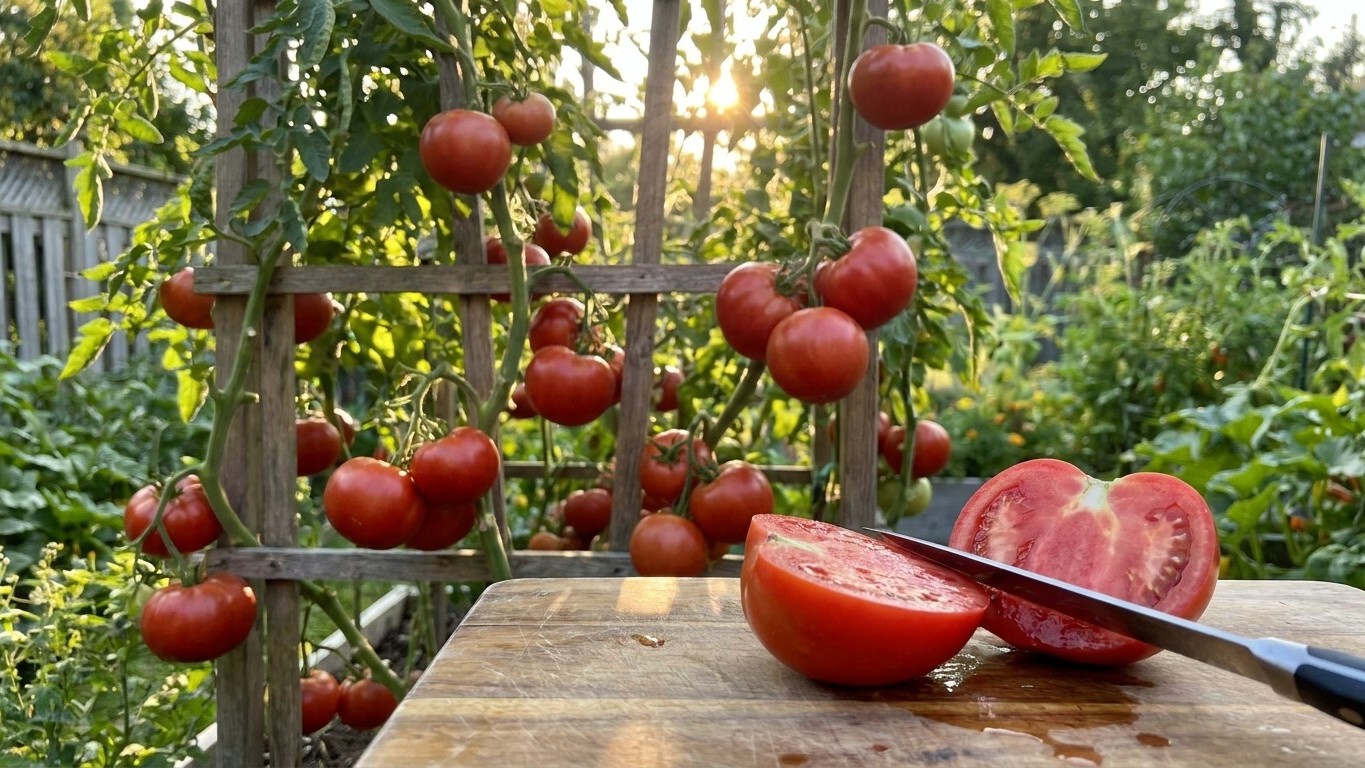

Big Boy is a hybrid slicing tomato built for the sandwich, not the sauce pot: an indeterminate vine that keeps producing until frost, carrying large, meaty red fruit that holds its shape in a thick-cut slice. Catalogue data puts it at 78 days to maturity from transplant, with cracking listed as a resisted trait. Whether that timeline actually fits your growing season is the part worth working out before you buy the seedling.
What Big Boy actually is
Three facts decide whether Big Boy belongs in a given garden. First, the growth habit: it’s indeterminate, meaning the vine doesn’t stop at a set height or a single flush of fruit. It keeps climbing and setting new flowers as long as conditions allow, right up until frost cuts it down. That habit dictates the second fact, which is support. An indeterminate vine this vigorous needs a tall stake or cage from the start, not the short tomato cage sold for compact patio varieties.
Third is the maturity figure itself: 78 days, and that count starts from transplant into the garden, not from the day you sowed the seed indoors. Confusing the two is a common way gardeners misjudge their harvest window, since seed-to-transplant time (typically five to seven weeks for tomatoes) adds weeks the catalogue figure doesn’t include.
The fruit itself is what earns Big Boy its reputation. It’s large, sized for a sandwich rather than a snack, red-skinned, and described as meaty rather than juicy. That density matters in the kitchen: a wet, juicy tomato soaks through bread; a meaty one cuts into a thick slice that stays put. This is a raw, fresh-eating tomato built for the BLT and the burger, not a paste or canning variety. Nothing about its published profile suggests it’s meant for sauce.
Where it ripens in time, and where it is a gamble
The math that decides whether Big Boy fits your garden is simple to lay out and worth doing on paper before you plant. Start with your local frost-free window, the stretch between your average last spring frost and first fall frost. Subtract roughly two weeks, because soil needs to warm before a transplant will actually grow rather than sit stalled in cold ground. From what’s left, subtract the 78 days to maturity. Whatever remains is your margin: the cushion of extra days you have for a slow spring, a cool stretch in July, or a late frost that arrives early.
In a region with a long, generous frost-free season, that margin is wide. Gulf Coast and lower Southeast gardens, much of California’s Central Valley, and the warmer parts of the Southwest desert typically have frost-free stretches well past the 100 days that Big Boy strictly needs once soil-warming time is subtracted. A gardener there can transplant with real breathing room, and even recover from a rough start.
The calculation tightens fast as you move north. Gardens in the Upper Midwest, northern New England, and the Mountain West often have frost-free seasons compressed into three or four months. Run the same subtraction there and the margin can shrink to a couple of weeks, or vanish. That doesn’t make Big Boy impossible in a short-season garden, but it removes the safety net: a delayed transplant, a cool June, or an early autumn cold snap can mean the difference between a full harvest and a vine full of green fruit at frost.
This page doesn’t carry sourced frost-date figures for specific weather stations, so treat the regional descriptions above as a starting point, not a substitute for your own numbers. Every county extension office publishes local average frost dates, and plugging those into the same subtraction (frost-free window, minus two weeks, minus 78) gives you a margin specific to your address rather than to a region. If that number comes out negative or close to zero, starting seedlings indoors earlier or choosing a shorter-season variety alongside Big Boy is the more reliable move.
The two ways a season goes wrong
A frost-free window wide enough on paper doesn’t guarantee a good crop, because two separate limits sit outside what a frost date can show. In northern gardens, the problem is accumulated warmth, not just the count of frost-free days. A season can technically run long enough on the calendar while still being too cool, night after night, for the plant to set fruit efficiently. Tomatoes generally stop setting new fruit once nighttime temperatures drop below 50F, regardless of how many frost-free days remain on the books.
In southern and hot-summer gardens, the opposite failure shows up. Once daytime temperatures climb past roughly 86F for stretches, tomato pollen becomes sterile and flowers drop without setting fruit at all. This is why growers in hot climates commonly split the year into a spring crop and a fall crop rather than expecting one continuous harvest through the peak of summer; the middle of the season is effectively dead time for fruit set, even though the vine keeps growing.
For a mid-season variety like Big Boy, at 78 days, the heat limit is usually the tighter constraint. A vine transplanted early enough to mature before summer’s hottest weeks can do well, but one that hits its flowering stretch right as daytime highs cross into the high 80s and beyond will simply stall, fruitless, until temperatures ease. Gardeners in hot-summer regions get more out of this variety by timing transplant to finish the bulk of fruit set before that heat window closes, and by treating a second, later planting as the way to reclaim the fall.
What it resists, and what it does not
Big Boy’s published resistance profile is short and specific: it’s listed as resistant to cracking, the splitting that happens when fruit swells faster than its skin after uneven watering or a heavy rain following a dry spell. That’s a real, practical advantage for a variety with large, meaty fruit, since size and juiciness swings are exactly what triggers cracking in less resistant types.
Resistance to cracking is not immunity to it. It means the fruit tolerates the stress of irregular moisture better than an unresistant variety, not that it’s guaranteed crack-free regardless of how it’s watered. Wild swings between drought and soaking will still test that resistance.
What matters just as much is what’s absent from the list. The catalogue data for this variety names cracking resistance and nothing else, which means none of the standard soil-disease resistance codes, Verticillium wilt, Fusarium wilt, or nematodes, are documented for Big Boy. In practical terms, if a garden bed has a history of any of those problems, this variety offers no built-in protection against them. Crop rotation, and choosing resistant varieties elsewhere in that same bed, does the work that Big Boy’s own resistance package doesn’t.
Growing it without the usual mistakes
Because Big Boy is indeterminate, the growing plan has to look different from a determinate variety that sets one flush and finishes. There’s no single harvest to plan around; instead, the vine needs ongoing management for months. A tall stake, five to six feet or more, or a heavy-duty cage set at planting time, keeps the vine from collapsing under its own fruit load later in the season, when retrofitting support is far harder than installing it early.
Suckering, removing the small shoots that grow between the main stem and side branches, keeps an indeterminate vine like this one from turning into an unmanageable tangle. Skipping it doesn’t kill the plant, but it does mean more foliage competing for the same energy that could go into fruit size, and it makes the fruit harder to find and pick.
Feeding should track the 78-day maturity window rather than run flat through the season. Nitrogen-heavy fertilizer works well early to build the vine, but continuing it once fruit is set and sizing pushes the plant toward more leafy growth at the expense of ripening speed. Backing off nitrogen once the first fruit reaches full size, and switching to a lower-nitrogen feed, directs the plant’s energy toward finishing what’s already on the vine rather than starting more it won’t have season left to ripen.
Consistent watering matters more with this variety than the cracking-resistant label might suggest. That resistance buys tolerance, not indifference; a vine that goes dry for a week and then gets soaked is still asking its skin to stretch faster than it’s built for. Even watering, especially as fruit approaches full size, is what actually puts that resistance to work.
Common questions
Is Big Boy tomato determinate or indeterminate?
It’s indeterminate. The vine keeps growing and setting fruit until frost stops it, rather than reaching a set height and finishing in one flush.
How many days does Big Boy tomato take to ripen?
78 days, counted from the day of transplant into the garden rather than from seed-sowing.
Is Big Boy tomato good for sauce?
No. It’s built as a sandwich slicer, meaty rather than juicy, meant to be sliced thick and eaten raw rather than cooked down.
Does Big Boy tomato resist diseases other than cracking?
The published resistance covers cracking only. No resistance to Verticillium wilt, Fusarium wilt, or nematodes is listed, so gardens with a history of those problems get no built-in protection from this variety.