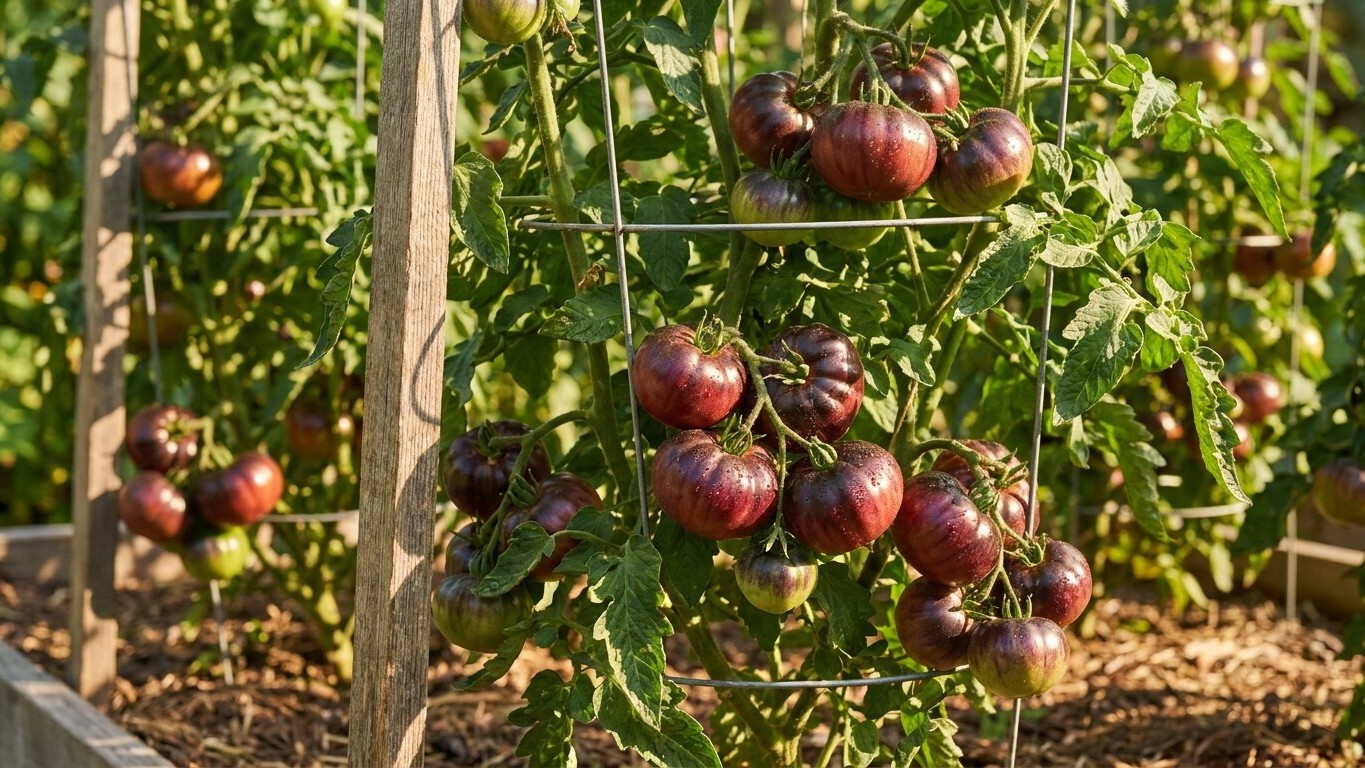

Black Prince is a black heirloom slicing tomato on an indeterminate vine, and it reaches harvest in about 74 days from transplant. That single number, paired with its sprawling growth habit and the fact that no disease resistance is published for it, decides whether it belongs in a given garden. Short-season gardeners need to run the frost math before they buy seed, and everyone needs a tall cage or a stake in the ground before the vine takes off.
What Brandywine actually is
Black Prince is an heirloom, not a hybrid, and it grows on an indeterminate vine, meaning it keeps growing and setting fruit until frost finally stops it. That habit rules out treating it like a compact patio plant. The vine needs a tall cage or a sturdy stake driven in at transplant time, not bolted on later once the stems have already sprawled across the bed.
The maturity figure attached to this variety is 74 days, and that count starts at transplant, not at the day the seed goes into a starter tray. Anyone comparing catalog numbers across varieties needs to make sure they’re comparing the same starting line, since a seed-to-harvest count and a transplant-to-harvest count can differ by several weeks.
The fruit is black-skinned and grown for slicing, with flavor described in seed catalogs as worthy of a chef’s table. A single plant typically produces 25 to 40 pounds of fruit over a season, which for a mid-size heirloom slicer means a steady, rolling harvest rather than one big flush, a pattern that lines up with its indeterminate habit and its need for continuous support as the season runs on.
Where it ripens in time, and where it is a gamble
Whether 74 days is generous or tight depends entirely on how long a garden’s frost-free window runs, and that window varies enormously across the country. The arithmetic is simple enough to do on the back of an envelope: take the number of frost-free days between the average last spring frost and the average first fall frost, subtract roughly two weeks because tomato roots don’t grow well in cold soil and transplants usually wait until the ground has warmed, then subtract the variety’s days to maturity. What’s left over is the picking window, the number of days the plant actually spends loaded with ripe fruit before the season closes back down.
In much of the northern Plains and the interior Mountain West, growing seasons often run closer to 110 to 130 frost-free days. Take a garden with a 120-day window: subtract the two-week soil-warming wait and the 74-day clock, and there’s only about a month left to actually harvest before frost returns. That’s workable, but it leaves little room for a cool, wet spring that delays transplanting or a stretch of overcast weather that slows fruit set.
Move into the mid-Atlantic, the Ohio Valley, or the Pacific Northwest’s warmer valleys, where frost-free seasons commonly stretch to 160 to 180 days, and the same math leaves two to three months of harvest, plenty of cushion for a slow start or a second round of side shoots to catch up. In the Deep South and along the Gulf Coast, where frost-free stretches can run 220 days or more, 74 days is almost a non-issue for timing; the constraint there isn’t season length at all, it’s the summer heat covered in the next section.
None of these regional figures are precision numbers for any single garden. A local frost date can shift by a week or more from one year to the next, and elevation, urban heat, and nearby water all nudge it further. The exercise is meant to be redone with a gardener’s own average frost dates, not borrowed wholesale from a neighboring county.
The two ways a season goes wrong
A long frost-free window on paper doesn’t guarantee a good tomato season, because two limits sit inside that window that a frost date alone can’t show. The first is accumulated warmth. A region can have a technically long frost-free period and still deliver cool nights that stall fruit set, since tomato flowers won’t reliably pollinate once nighttime temperatures drop below 50°F. A garden at higher elevation or near a large lake can have plenty of frost-free days on the calendar and still lose weeks of productive fruiting to chilly nights.
The second limit runs the opposite direction. Once daytime temperatures climb above roughly 86°F, tomato pollen turns sterile and blossoms drop without setting fruit. That’s why growers in hot climates plan around two crops rather than one continuous season, an early spring planting that finishes before the worst heat and a second planting timed to fruit as temperatures ease in fall, rather than expecting a single vine to produce straight through July and August.
For Black Prince, with its relatively brisk 74-day clock, the cold-night limit matters more in the short-season parts of the country than the heat limit does further south. A grower in the northern Plains needs to worry about whether nights stay above 50°F long enough for the plant to set its full run of fruit, while a grower in the Deep South has enough spare season length to sidestep the summer sterility window entirely by timing a spring crop to wrap up before the heat peaks, and starting a second one once it breaks.
What it resists, and what it does not
No disease resistance is published for Black Prince. That’s a meaningful gap worth stating plainly rather than glossing over: many modern hybrid tomatoes carry catalog codes for resistance to Fusarium wilt, Verticillium wilt, or root-knot nematodes, and Black Prince carries none of them. That doesn’t mean the plant is unusually fragile, heirlooms as a category are frequently sold without resistance ratings, but it does mean a gardener can’t lean on genetics to get through a season in soil with a known wilt problem.
Practically, that shifts the disease-prevention work onto the gardener rather than the seed. Crop rotation, meaning not planting tomatoes, peppers, eggplant, or potatoes in the same bed for at least a few years running, does more here than it would for a resistant hybrid. Gardeners working a bed with a history of wilt disease sometimes graft heirloom varieties like this one onto disease-resistant rootstock, which keeps the fruit and flavor of the heirloom top growth while borrowing resistance from the roots.
Good airflow and drip irrigation instead of overhead watering also matter more when there’s no built-in resistance to fall back on, since wet foliage is what lets fungal spores establish in the first place. None of this is unique to Black Prince, but it carries more weight for a variety with no published resistance than it would for one bred specifically to shrug off common wilts.
Growing it without the usual mistakes
Because Black Prince is indeterminate, the support plan has to be built for a full season, not a one-time setup. A short tomato cage bought for a determinate patio variety won’t hold this vine past midsummer. A tall cage or a stake driven in at transplant, with the plant tied up as it grows, is the baseline; spacing needs to allow for a plant that will still be reaching upward and outward in late summer, not just at planting time.
Feeding follows the same logic as the growth habit. Because the vine keeps setting new fruit until frost, it also keeps drawing on soil nutrients longer than a determinate variety does. A steady, moderate feeding schedule through midsummer works better than a single early dose, though nitrogen should be eased off once the plant is fruiting heavily, since too much pushes leafy growth at the expense of the tomatoes themselves.
The mistake its timing invites is treating 74 days as the whole story and stopping the countdown there. Because that figure starts at transplant, a gardener who starts seed indoors, waits for a slow spring, and transplants two weeks later than planned has quietly pushed the harvest date back by the same two weeks, without changing the catalog number at all. Tracking the actual transplant date, not the packet’s days-to-maturity figure, is what keeps the frost math in the earlier section honest.
Common questions
Is Black Prince a hybrid or an heirloom?
It’s an heirloom, grown from open-pollinated seed rather than bred as a hybrid, which is also why no disease-resistance codes are published for it.
Does Black Prince need a cage or a stake?
Yes, and a tall one. It’s an indeterminate variety, so the vine keeps growing and fruiting until frost, and a short cage meant for a compact plant won’t contain it by midsummer.
How many tomatoes does one Black Prince plant produce?
Catalog figures put a single plant’s yield at 25 to 40 pounds of fruit over a season, spread out over time rather than arriving all at once, in keeping with its indeterminate growth pattern.
Is Black Prince resistant to common tomato diseases?
No resistance is published for this variety, so gardeners should rely on crop rotation, airflow, and site selection rather than assuming any built-in protection against wilts or nematodes.