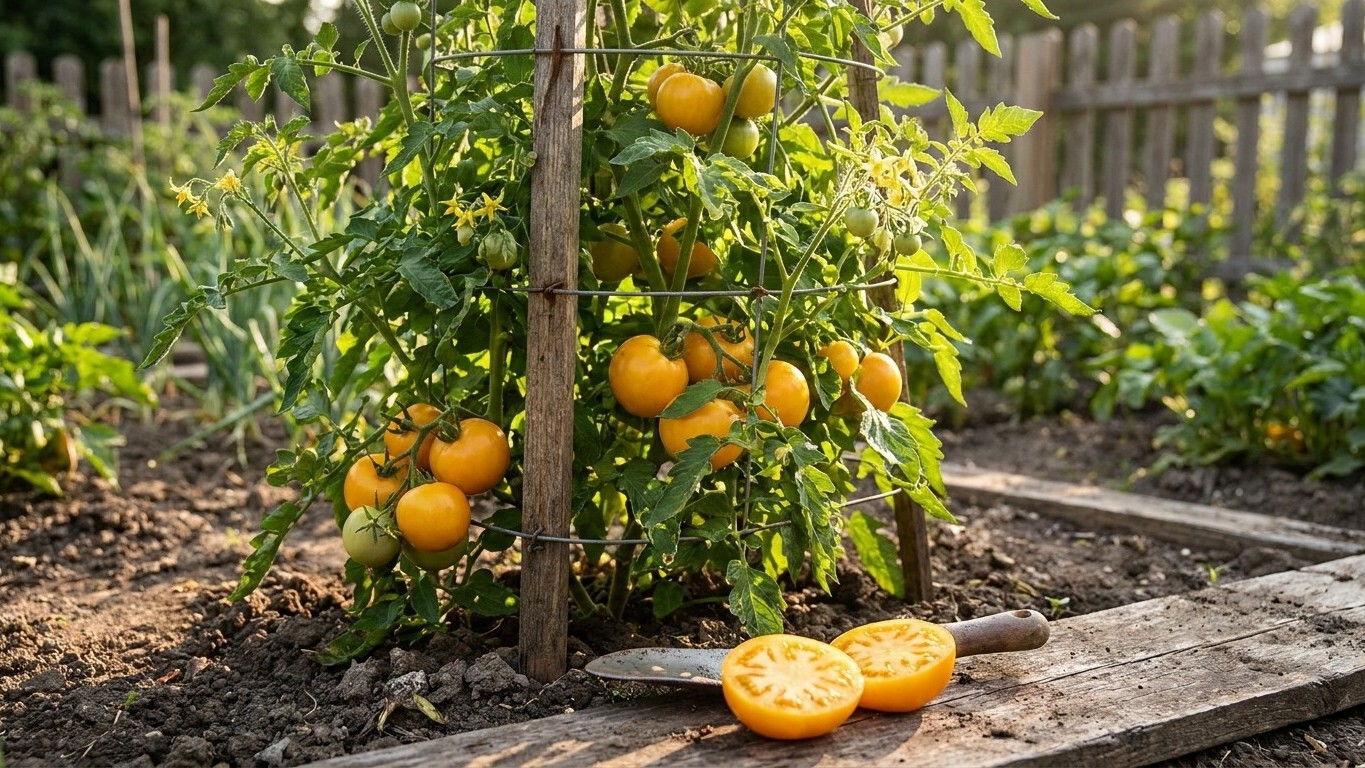

A blush tomato ripens golden rather than red, reaches harvest about 70 days after transplant, and keeps producing on a sprawling indeterminate vine until frost shuts it down. That timeline decides almost everything else: when you can safely set it out, how much cage or stake you need, and whether your growing season leaves room for a full run of fruit before cold weather ends it.
What Brandywine actually is

This is a specialty tomato, not a slicing workhorse bred for uniform size or shipping. The fruit comes in golden, with what the catalogue simply calls a complex flavor rather than a straightforward sweet or acidic profile. That single descriptor matters more than it sounds: it signals a tomato meant for eating fresh, not for canning by the bushel. The listed use is salads and snacking, which fits a fruit that’s better appreciated sliced or halved than cooked down.
The habit is indeterminate. The vine does not stop at a set height and produce one flush of fruit; it keeps growing and setting new blossoms until frost kills it. That means a tall cage or a sturdy stake isn’t optional, it’s the difference between a productive plant and a collapsed tangle by August. Sprawling indeterminate vines left unsupported also put fruit in contact with soil, which invites rot and slugs.
Days to maturity is listed at 70, and that figure is counted from transplant, not from the day you sowed seed indoors. Growers who count from germination routinely end up two to three weeks off, which throws every frost calculation in the next section out of alignment. Anchor the count to the day the seedling goes into the ground, and everything downstream, from bloom to first ripe fruit, lines up with the catalogue number.
Where it ripens in time, and where it is a gamble
Seventy days is a mid-length season for a tomato, long enough that timing actually matters, short enough that most gardens with a real summer can fit it in. The arithmetic is simple and worth doing by hand rather than trusting a planting app. Start with your area’s frost-free window, the stretch between the average last spring frost and the average first fall frost. Subtract roughly two weeks, because soil needs to warm before a transplant will actually grow rather than sit and sulk. Then subtract the 70 days to maturity. Whatever number is left is your margin, the cushion of extra days you have to actually pick a harvest before cold ends the season, not just watch the first fruit turn color the day frost arrives.
A gardener working with a long, warm frost-free window, the kind found through much of the lower South, the Gulf Coast, and coastal California, typically clears that arithmetic with weeks to spare. Set transplants out once nights are reliably warm, and the 70-day clock finishes with enough runway left to pick multiple waves of fruit before any autumn chill shows up. In those regions the limiting factor usually isn’t frost at all, it’s the summer heat problem covered in the next section.
The math gets tighter in the Upper Midwest, the interior Northeast, and mountain gardens at higher elevation, where frost-free windows commonly run in the range of 90 to 110 days. Run the subtraction: 100 days of frost-free window, minus two weeks for soil warm-up, minus 70 days to maturity, leaves roughly a two-week harvest margin. That’s workable, but it leaves no slack for a cold, wet spring that delays transplanting, or a stretch of overcast days that slows fruit set. Gardeners in genuinely short-season pockets, above 6,000 feet in the Rockies or in northern New England’s colder valleys, may find the frost-free window barely clears the 70-day requirement once the soil-warming weeks are subtracted, which turns this into a variety to start a week or two early under cover rather than direct-set on the calendar date.
No specific frost dates for named weather stations are published in this brief, so treat the numbers above as the method, not a substitute for checking your own local average frost dates. The arithmetic is what travels from garden to garden; the local dates are what you plug into it.
The two ways a season goes wrong
A frost-free window long enough on paper doesn’t guarantee a good crop. Two limits sit underneath that number and neither shows up on a frost date table.
In cooler regions, accumulated warmth can run short even inside a technically adequate frost-free window. Tomatoes don’t grow on a calendar, they grow on heat, and a summer with a string of cool, cloudy weeks can stall a plant that’s supposedly had “enough days.” On top of that, fruit set itself fails once nighttime temperatures drop below 50°F: blossoms may open, but pollen won’t transfer properly, and flowers drop without setting fruit. A far-north garden hitting cool nights in early September, even with weeks left before frost, can watch late blossoms fail for exactly this reason.
In hot regions, the opposite failure applies. Once daytime temperatures climb above roughly 86°F, pollen turns sterile and blossoms stop setting fruit, effectively pausing production through the hottest stretch of summer. This is why growers in the Deep South and desert Southwest typically run two separate tomato crops, a spring planting that finishes before the worst heat and a fall planting timed to mature after it cools back down, rather than one continuous harvest.
For a 70-day variety, the cold-side risk matters more in northern gardens where the season is already tight, while the heat-side risk matters more in the South, where the long frost-free window looks generous but hides a dead middle. Either way, the 70-day figure only tells you the plant can physically finish; it says nothing about whether the weather in between will let it.
What it resists, and what it does not
The catalogue lists no published disease resistances for this variety. That’s a plain fact, not an oversight worth reading past: it means there’s no coded protection against verticillium wilt, fusarium wilt, or the nematode and tobacco mosaic resistances that show up as letter codes (V, F, N, T) on many hybrid tomato tags. Specialty and heirloom-style tomatoes bred primarily for flavor and color often trade away that built-in resistance, and this one is no exception.
Practically, that shifts the disease-prevention work entirely onto the grower rather than the genetics. Crop rotation matters more here than it would for a resistant hybrid: avoid planting this tomato in soil that grew tomatoes, peppers, eggplant, or potatoes the previous year or two, since those crops share susceptibility to the same soil-borne fungi. Mulching to keep soil from splashing onto lower leaves, watering at the base rather than overhead, and spacing plants for airflow all do real work when there’s no genetic backstop.
It’s worth being direct about what “no published resistance” doesn’t mean. It doesn’t mean the plant is unusually fragile compared to every other tomato; it means claims of resistance simply aren’t made for it, so none should be assumed. A grower who plants it expecting fusarium protection because “most tomatoes have some” is setting up a preventable disappointment. Treat it as a variety that needs standard sanitation and rotation discipline, not one that can skip those steps.
Growing it without the usual mistakes
The indeterminate habit is the detail that shapes every decision here, because it behaves nothing like a determinate tomato that sets one flush and finishes. A determinate variety can get by on a short cage; this one needs a tall stake, at minimum 5 to 6 feet, or a heavy-duty cage built for a vine that keeps climbing past midsummer. Skimping on support early, when the plant looks small and manageable, is the most common mistake with indeterminate tomatoes: by the time the vine is heavy with fruit in late summer, retrofitting a taller stake means fighting through a mass of foliage and risking broken stems.
Spacing needs to account for that same sprawling growth. Crowding indeterminate plants close together traps humidity in the canopy, which, given the lack of published disease resistance, is exactly the condition to avoid. Give each plant real room, and prune selectively to keep airflow moving through the center of the vine rather than letting it become a solid wall of leaves.
Because this variety keeps flowering and fruiting until frost, feeding needs to continue longer than it would for a determinate type that’s done by midsummer. Cut back on nitrogen once the plant is fruiting heavily, since excess nitrogen late in the season pushes leafy growth at the expense of fruit, but continue a balanced feeding program through the season rather than stopping after the first harvest the way a gardener might with an early determinate variety.
The specific timing mistake this variety invites is treating the 70-day figure as a finish line rather than a starting gate. Because the vine is indeterminate, the first ripe fruit at day 70 is the beginning of a harvest that should continue for weeks, not the end of the season’s work. Gardeners who stop supporting, feeding, or picking after that first wave lose most of the crop the plant is actually capable of producing.
Common questions
Can I count the 70 days from when I start seeds indoors instead of transplanting?
No. The 70-day figure is measured from transplant into the garden, not from germination. Counting from seed-starting will make the plant appear weeks behind where it actually is.
Does this tomato need a cage, or will a short stake work?
Because it’s indeterminate and keeps growing until frost, a tall stake of at least 5 to 6 feet or a heavy-duty cage is needed. Short cages meant for determinate varieties won’t hold up once the vine is loaded with fruit later in the season.
Is it resistant to common tomato diseases like fusarium or verticillium wilt?
No resistances are published for this variety. That means rotation, mulching, and base-level watering matter more here than they would for a hybrid bred with disease-resistance codes.
Why would fruit stop setting even though the season isn’t over yet?
Fruit set fails outside a fairly narrow temperature band: nights below 50°F prevent proper pollination, and days above roughly 86°F make pollen sterile. Either extreme can pause production even with weeks left before frost.