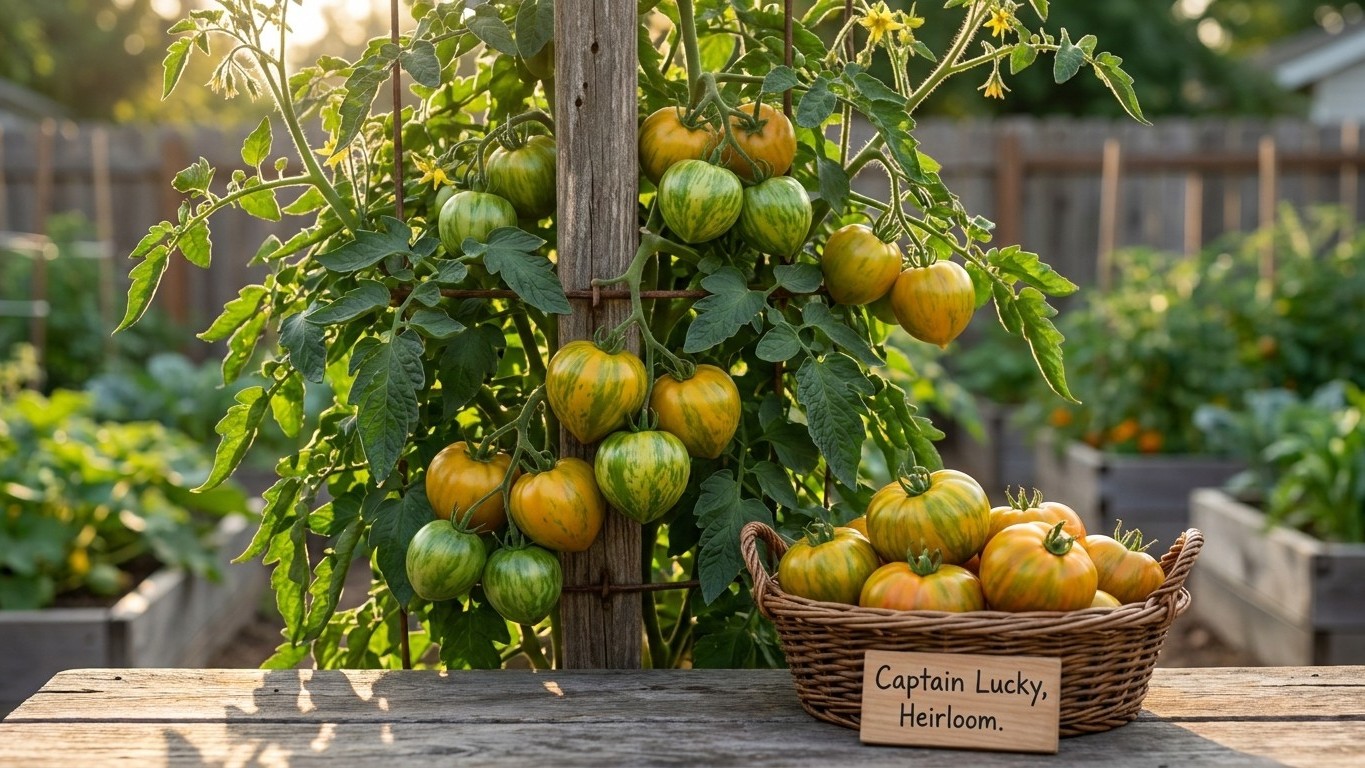

Captain Lucky is a specialty bicolor slicing tomato that needs 75 days from transplant to first ripe fruit, and because it’s indeterminate, it keeps setting new fruit clusters right up until frost instead of stopping after one flush. That combination means the real question isn’t just “does it ripen,” but how many weeks of picking a given garden can squeeze out before the season closes.
What Brandywine actually is
Captain Lucky is classed as a specialty tomato, which in catalogue terms usually signals a fruit bred for looks and flavor over shipping toughness or uniform size. It’s indeterminate, meaning the vine doesn’t stop growing at a set height the way a determinate variety does. It keeps climbing, branching, and flowering through the summer, which is why it needs a tall cage or a stake rather than the low ring-style supports that work fine for compact bush tomatoes.
The fruit runs 10 to 16 ounces, described as an heirloom-like green bicolor with incredible flavor, a two-toned skin pattern that reads as a marbled green-and-gold or green-and-red streak depending on the individual fruit. That fruit size puts it solidly in slicing-tomato territory, not a cherry or paste type, so gardeners are growing this for sandwiches and salads, not for canning by the bushel.
Days to maturity is listed at 75, and that figure is counted from the day the transplant goes into the garden bed, not from the day the seed was started indoors. That distinction matters more than it sounds like it should. A gardener who starts seed six weeks before their last frost and transplants right on schedule is looking at 75 days after that transplant date before the first fruit ripens, meaning the seed-to-harvest calendar runs well past 75 days when the indoor weeks are added in.
Where it ripens in time, and where it is a gamble
The arithmetic that decides whether Captain Lucky works in a given yard is simple to lay out, even without knowing the exact frost dates for one specific address. Start with the frost-free window, the stretch between the average last spring frost and the average first fall frost. Subtract roughly two weeks from the front end, because tomato transplants shouldn’t go into soil that hasn’t warmed up yet, cold soil stalls root growth and can set a plant back by weeks it never fully recovers. From what’s left, subtract the 75 days to maturity. Whatever remains is the picking window, the stretch of weeks an indeterminate plant like this one gets to keep producing before frost shuts it down.
In the coldest gardening zones, that math gets tight. A short-season spot in northern Minnesota or interior Maine typically works with a frost-free season in the neighborhood of 100 to 120 days. Take out two weeks for soil warm-up and 75 days for maturity, and the picking window shrinks to something like one to four weeks, a real harvest but not a long one, and a late spring or an early fall cold snap can eat into it fast.
Move into the broad middle of the country, places like Iowa, Ohio, or Pennsylvania, and the frost-free season typically stretches to something like 150 to 180 days. Run the same subtraction and the picking window opens up to roughly eight to thirteen weeks, enough time for an indeterminate plant to hit its stride and produce several waves of fruit.
Farther south and in milder coastal climates, the constraint on the calendar mostly disappears. A Virginia Piedmont or Tennessee garden, with a frost-free season closer to 190 to 210 days, ends up with something like fourteen to seventeen weeks of picking. Gulf Coast, coastal California, and South Texas gardens, where the frost-free season commonly runs 220 days or more, effectively have no frost problem to plan around at all.
| Region example | Typical frost-free season | Picking window after soil warm-up and 75-day maturity |
|---|---|---|
| Northern Minnesota, interior Maine | ~100-120 days | ~1-4 weeks |
| Iowa, Ohio, Pennsylvania | ~150-180 days | ~8-13 weeks |
| Virginia Piedmont, Tennessee | ~190-210 days | ~14-17 weeks |
| Gulf Coast, coastal California, South Texas | ~220+ days | 18+ weeks, essentially season-long |
A gardener anywhere in between can run the same subtraction with their own local last and first frost averages, which most county extension offices publish, to get a personal number instead of a regional guess.
The two ways a season goes wrong
A long frost-free window on paper doesn’t guarantee a good crop, because two other limits sit underneath the frost dates and a calendar alone won’t show either one. The first is accumulated warmth. Even in a zone with a technically long frost-free season, cool nights can slow a tomato plant’s internal clock so much that it never catches up to its listed maturity date. Tomatoes specifically stop setting fruit when nighttime temperatures drop below 50F, regardless of how many frost-free days remain on the calendar, so a string of cool nights in a marginal northern garden can cost real weeks even without a frost anywhere in sight.
The second limit runs the opposite direction. Once daytime temperatures climb above roughly 86F, tomato pollen goes sterile and flowers drop without setting fruit at all. This is why gardeners in the Deep South and similar hot-summer regions typically plan around two separate crops, a spring planting that finishes before the worst heat and a second, fall planting that picks back up once temperatures ease, rather than expecting one tomato plant to produce straight through July and August.
For Captain Lucky specifically, the 75-day maturity works in the grower’s favor on the heat side. A plant that reaches first fruit in 75 days can often be transplanted early enough to get a real harvest in before the sterile-pollen window closes, then, because it’s indeterminate rather than a one-and-done determinate, it has a chance to resume setting fruit once nights cool back down in early fall. The cold-nights limit matters more in the north, where a mid-length maturity like this one still needs those nighttime lows to stay above 50F consistently through the picking window, or the season effectively ends early no matter what the frost date says.
What it resists, and what it does not
No disease resistance codes are published for Captain Lucky. That’s worth stating plainly rather than glossing over, because a lot of gardeners assume a modern hybrid or specialty variety carries some built-in defense against the usual tomato diseases, and here that assumption doesn’t hold. With nothing published, the practical move is to treat the plant as susceptible to the diseases that hit any unprotected tomato: early blight, late blight, fusarium wilt, and verticillium wilt among them.
That doesn’t mean the variety is fragile, only that it isn’t getting any help from genetics on this front. The defense has to come from cultural practice instead. Rotating tomatoes out of the same bed for two to three years cuts down on soil-borne fungal spores building up. Mulching under the plants keeps rain and irrigation water from splashing soil-borne pathogens up onto lower leaves, which is one of the most common ways early blight gets started. Pruning the lowest leaves once the plant is established, and spacing plants far enough apart for air to move through the foliage, both cut down on the humid, still conditions that let fungal diseases spread from leaf to leaf.
None of this is unique advice, but it matters more here than it would on a variety carrying intermediate or high resistance ratings, because there’s no genetic backstop if the cultural practices slip.
Growing it without the usual mistakes
The habit drives most of the practical decisions here. Because Captain Lucky is indeterminate, it needs support built for a plant that keeps growing all season rather than stopping at a fixed height, a standard tomato cage sized for a compact bush variety will be outgrown by midsummer. A tall, sturdy cage, five to six feet, or a single stake with regular tying as the vine climbs, gives the plant somewhere to go instead of sprawling and tangling on the ground, where fruit rots faster and disease spreads more easily.
Feeding schedule follows from the same habit. A determinate tomato that ripens in one flush can be fed on a simple front-loaded schedule and largely left alone once fruit sets. An indeterminate variety producing new flowers and fruit clusters continuously needs steadier feeding through the season, though it’s worth easing off nitrogen a few weeks before the first expected frost, since a plant pushed hard on nitrogen late in the season puts energy into new leafy growth instead of ripening the fruit it already has, right when that fruit needs the plant’s attention most.
The mistake this variety’s timing invites most often is rushing the transplant. Because 75 days already feels like a long wait, especially in shorter-season gardens, it’s tempting to get plants in the ground as early as possible. But transplanting into soil that hasn’t warmed stalls root development, and that early setback doesn’t just delay the harvest by a few days, it compounds. An indeterminate plant depends on getting to full size and vigor as early as possible to make the most of its long fruiting window; a stunted start shrinks that window on both ends.
Common questions
Is Captain Lucky a hybrid or an heirloom?
It’s marketed as a specialty variety with an heirloom-like flavor profile, but no published resistance codes typically accompany a stabilized heirloom line the way they do many modern hybrids, and none are listed here either way. Gardeners should treat the flavor description as the selling point, not a claim about its breeding lineage.
How tall does the plant get?
No specific height is published for this variety, but its indeterminate habit means it keeps growing until frost stops it, which is why a tall cage or stake, rather than a short ring support, is the right call from planting day.
Can it be grown in a container?
Indeterminate varieties generally need a large container, at least 15 to 20 gallons, and a tall support system to do well in a pot, since the same continuous growth habit that demands staking in the ground doesn’t shrink just because the roots are confined.
Why did my plants stop setting fruit in midsummer?
If nighttime lows are dipping below 50F, or daytime highs are consistently running above 86F, the plant’s pollen either isn’t viable or fertilization is being disrupted, and fruit set will pause until temperatures move back into the workable range, a pattern this variety shares with tomatoes generally rather than something specific to its own genetics.