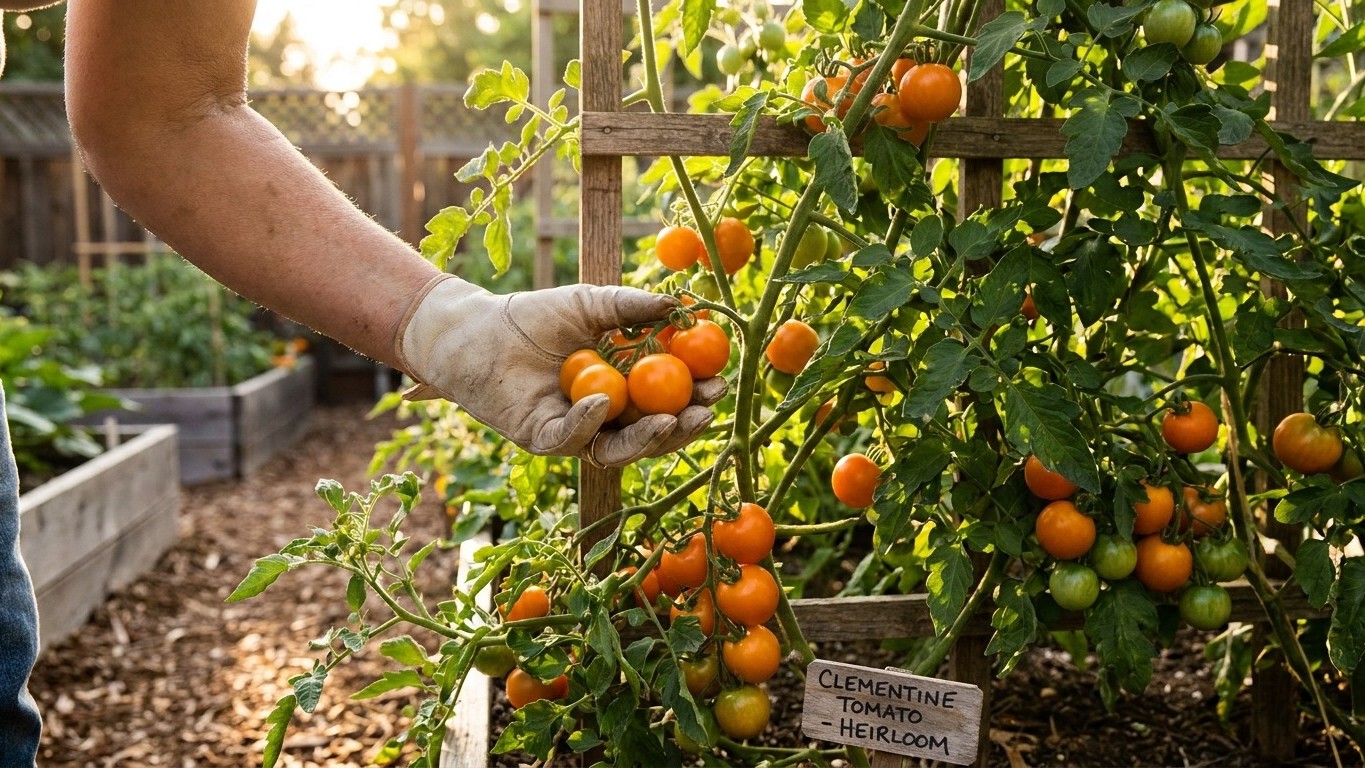

The Clementine tomato is a compact, indeterminate cocktail variety that produces 2-ounce orange fruit with a sweet-tart flavor, best suited for salads and snacking. Counted from transplant, it reaches maturity in 68 days, which puts it in the early-to-mid range for cocktail tomatoes and gives most of the country a workable window, provided the plant gets a stake or cage tall enough to keep it fed through a long summer.
What Brandywine actually is

Before any planting math makes sense, the basics need to be straight. Clementine is a cocktail-type tomato, meaning its fruit sits between a cherry and a full slicer, here landing at 2 ounces apiece, with orange skin and a flavor described plainly as sweet-tart with high yields. That combination makes it a garden-to-bowl tomato rather than a canning or sauce variety: it is built for salads and for eating standing at the counter, not for a stockpot.
The habit matters as much as the fruit. Clementine is indeterminate, which means the vine does not stop at a set height or a single flush of fruit. It keeps growing, flowering, and setting tomatoes until frost cuts it down, and that single fact drives most of the support and feeding decisions later in this page.
The maturity figure is 68 days, and the basis matters more than the number. That count starts from transplant, the day a started seedling goes into the garden bed, not from the day the seed was sown indoors. Gardeners who count from seeding will consistently think their plant is behind schedule when it is not. This 68-day, transplant-based figure is the one published on the variety’s catalogue listing, and it is the number every planting calculation on this page runs from.
Where it ripens in time, and where it is a gamble
Sixty-eight days is a short season by tomato standards, but the number by itself does not tell a gardener whether Clementine will finish before frost. The useful calculation is the frost-free window at a given location, minus roughly two weeks for the soil to warm enough to safely set out a tomato seedling, minus the 68 days to first ripe fruit. What is left over is the actual picking season, and that leftover number is the one that separates a comfortable garden from a race against the calendar.
Run the arithmetic in general terms and the pattern becomes clear. A garden with a frost-free window of around 180 days, typical of much of the Mid-Atlantic, the mid-South, and the Pacific Northwest’s milder valleys, loses about 14 days to soil warm-up and another 68 to maturity, leaving close to 100 days of harvest. That is a wide margin: a late spring, a cool stretch in June, or a slightly delayed transplant date barely dents the outcome, because there is so much slack left in the season.
A garden with a frost-free window closer to 130 days, the kind of range common across the northern tier of states and higher-elevation regions, tells a different story. Subtract the same two weeks for soil warming and the same 68 days to maturity, and the cushion drops to roughly 48 days. That is still enough time to get a real harvest from an early-maturing variety like this one, but it removes the room for error. A cold, wet spring that delays transplanting by even a week can shave a meaningful chunk off that remaining window, and a grower in that situation gains real insurance by starting seedlings a little earlier indoors, using a wall-of-water or row cover to push the transplant date up, or choosing black plastic mulch to warm the soil faster.
At the far end of the country, short-season gardens with frost-free windows under 100 days, found in parts of the northern Rockies, the upper Great Lakes, and high-elevation mountain valleys, leave little room even for a 68-day variety once soil warm-up is subtracted. That does not make Clementine impossible in those regions, but it does mean every trick that buys warmth and time, cold frames, cloches, black plastic, transplants started under lights well ahead of the outdoor date, moves from optional to necessary. In these places, the margin math is the whole ballgame, and a gardener who skips it is gambling on a mild fall to bail out a late start.
Reference frost dates specific to a given county are not part of the figures published for this variety here, so the numbers above are meant as a method to apply locally rather than a lookup table. Any gardener can pull their own area’s average frost-free window from local extension resources and run the same subtraction.
The two ways a season goes wrong
A long frost-free window looks reassuring on paper, but two limits sit underneath it that a simple calendar count never shows. The first is accumulated warmth. Some regions post a long stretch of frost-free days that still run cool, especially in coastal or high-elevation areas, and tomatoes do not care how many days sit between the last and first frost if the nights in between stay chilly. Fruit set stalls when nighttime temperatures drop below 50F, because pollen viability falls off sharply in cold air. A grower with a generous 150-day window at a cool coastal site can still watch a Clementine plant flower for weeks without setting fruit, simply because the nights never warm up enough.
The second limit sits at the opposite end of the thermometer. Once daytime temperatures push above roughly 86F, tomato pollen turns sterile and blossoms drop instead of setting fruit. This is the reason growers across the Deep South, the desert Southwest, and much of Texas plan around two separate cropping windows rather than one continuous season: a spring crop that finishes before the worst of summer heat arrives, and a second planting in late summer that ripens as temperatures ease in fall. The middle of summer, in those regions, is effectively dead time for fruit set even though the plants themselves survive the heat just fine.
For a 68-day variety like Clementine, the heat ceiling matters more than the cold floor in most of the country. Its short maturity window means a spring-planted crop in hot-summer regions has a real shot at finishing, or getting well underway, before the pollen-sterile stretch of July and August arrives, and a second planting timed for late summer can pick up fruit set again once nights cool. In cooler northern gardens, the 50F threshold is the one to watch instead, since a short, cool growing season is the more likely obstacle there than excess heat.
What it resists, and what it does not
The published resistances for Clementine are specific, and the distinction between grades matters more than gardeners often assume. This variety carries High resistance to Verticillium Wilt and High resistance to Fusarium Wilt race 1. Those are the only two resistances listed on the catalogue data for this variety, and no others should be assumed.
High resistance is a strong result: it means the plant is bred to fend off substantial pressure from these two soil-borne fungal diseases, both of which can otherwise persist in garden soil for years and wilt a susceptible tomato plant from the roots up. That is meaningfully different from Intermediate resistance, a grade this variety does not carry for either disease, but one that shows up often enough on other tomato varieties to be worth explaining. Intermediate resistance means a plant slows a disease’s progress and often produces a usable crop under moderate pressure, but it does not stop the pathogen the way High resistance does. Reading “Intermediate” as “resistant” on any variety’s tag is a common way to lose a crop unexpectedly.
What Clementine’s tag does not list matters just as much as what it does. No resistance is published here for the many other pressures a tomato patch can face: early blight, late blight, Septoria leaf spot, root-knot nematodes, or Fusarium race 2 and 3. That does not mean the plant is defenseless against them, but it does mean growers should not treat this variety as broadly disease-proof. Crop rotation, mulching to limit soil splash onto foliage, and routine scouting for leaf spot remain worthwhile practices regardless of the two resistances this plant does carry.
Growing it without the usual mistakes
Because Clementine is indeterminate, the support plan has to be built for the whole season, not just the first flush. A short tomato cage that works fine for a determinate bush variety will get outgrown fast here; a tall stake, at least 6 feet, or a heavy-duty cage of similar height, keeps the vine manageable as it keeps adding growth and fruit clusters through summer and into fall. Spacing should give each plant real air circulation, since a vine that keeps producing new leaves all season also keeps producing new foliage that can trap humidity if plants are crowded.
Feeding follows the same indeterminate logic. A determinate tomato that ripens in one concentrated flush can be fed heavily early and then largely left alone as it finishes. Clementine, still setting new flowers and fruit clusters in August and September, benefits from a lighter, steadier feeding approach through the season rather than one big early dose, tapering off nitrogen as the plant matures so growth doesn’t outrun fruiting.
The mistake its 68-day timing invites is impatience at the other end of the calendar: gardeners see an early-finishing variety and assume the plant is done once the first heavy flush ripens. It isn’t. An indeterminate vine at this maturity keeps setting fruit for months if the season allows it, so the real payoff of Clementine’s short days-to-maturity is an early start to a long harvest, not a short one. Pruning suckers lightly through the season, rather than letting the vine sprawl unchecked, keeps that long harvest manageable instead of turning into a tangled mass by late summer.
Common questions
Is Clementine a determinate or indeterminate tomato?
Indeterminate. The vine keeps growing and setting fruit until frost, which is why it needs a tall stake or cage rather than a short cage built for a bush-type plant.
How many days does Clementine take to ripen?
68 days, counted from the date of transplant into the garden, not from the day the seed was started indoors.
Does Clementine resist tomato diseases?
It carries High resistance to Verticillium Wilt and High resistance to Fusarium Wilt race 1. No other disease resistances are published for this variety, so common issues like early blight or Septoria leaf spot still need standard prevention.
What is Clementine tomato best used for?
Its 2-ounce orange fruit and sweet-tart flavor make it best suited for salads and snacking, in line with its cocktail-type size rather than sauce or canning uses.