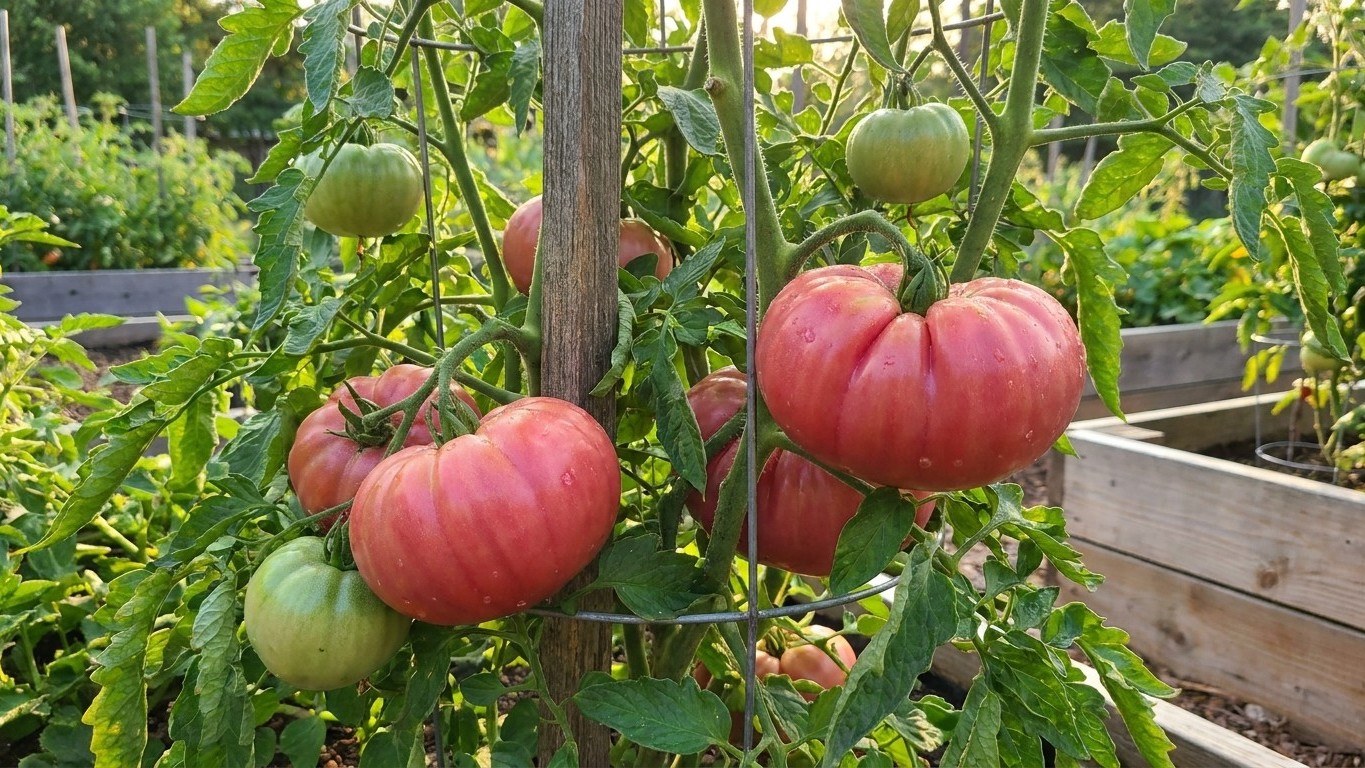

Damsel is a pink, indeterminate beefsteak-type tomato that needs about 73 days from transplant to first ripe fruit, a tall stake or cage to support vines that keep climbing until frost, and a spot in the garden where the season runs long enough to let that vine produce more than one or two fruit before cold weather shuts it down.
What Brandywine actually is
Damsel belongs to the specialty tomato category, the group bred for flavor and size rather than shelf life or shipping toughness. Its habit is indeterminate, which matters more than most catalog descriptions let on: the vine does not stop at a set height and ripen its fruit in one flush. It keeps growing, flowering, and setting new tomatoes right up until frost kills it, which is why it needs a tall cage or a sturdy stake rather than the short cage sold for patio varieties.
Fruit is large, pink, and globe-shaped. According to the variety’s published catalogue listing, the flesh is described as bursting with juicy flavor, an intricate blend of sweet and acidic, the kind of tomato meant for slicing rather than canning or sauce.
The number that matters most for planning is 73 days to maturity, and that figure is counted from transplant, not from the day the seed goes into starter mix. A gardener who starts seed indoors in early spring, waits six to eight weeks for a plantable seedling, then sets it in the ground, starts the 73-day clock on transplant day, not before. Confusing the two bases is the single most common way home gardeners misjudge whether a tomato will finish before frost.
Where it ripens in time, and where it is a gamble
The arithmetic for any tomato variety is the same three-step subtraction, and it works whether you garden in a river valley in Ohio or a raised bed in Arizona. Start with your local frost-free window, the stretch between the average date of last spring frost and the average date of first fall frost. Subtract roughly two weeks from the front end, because tomato transplants go into the ground after the soil has warmed, not on the exact day frost risk ends. What remains is the real growing window available to the plant. Subtract the variety’s days to maturity, in this case 73, and what is left over is the margin: the number of days the vine has to keep producing fruit after that first ripe tomato comes in.
This page does not have a published, station-by-station frost date table to plug into that formula for specific cities, so the honest move is to hand the reader the method rather than a number that was not verified for this piece. The Cooperative Extension office in any county publishes local frost-date averages, and so does the National Centers for Environmental Information, both free to check before committing to a variety. Run your own zip code through that math before you buy the seedling.
What can be said with confidence from the 73-day figure alone: a frost-free window on the shorter side, the kind found in much of the northern tier of states, leaves little room after 73 days for the extended harvest an indeterminate vine is built to deliver. A grower there might get a handful of ripe Damsel tomatoes before the season ends, not the rolling harvest the plant is capable of producing. A longer frost-free window, common through the mid-Atlantic, the South, and much of the West Coast, gives the vine weeks or months of margin after that first fruit ripens, which is exactly the situation an indeterminate variety rewards.
The practical takeaway is not that Damsel fails in short-season climates. Plenty of northern gardeners grow 70-plus-day tomatoes successfully by starting seed early indoors and using row cover or wall-of-water protection to push the transplant date earlier than the raw frost average would allow. But without that extra push, a short window and a 73-day variety leave little slack for the delays that always show up: a cool spring, a late transplant, a stretch of cloudy weather that slows ripening.
The two ways a season goes wrong
A frost date table tells you when the season starts and ends. It says nothing about whether the days in between actually behave like tomato-growing weather, and that gap causes more disappointment than frost itself.
In northern climates, the frost-free window can look adequate on paper while the accumulated warmth inside it falls short. Tomatoes need consistently warm nights to set fruit, and when nighttime temperatures drop below 50°F, pollen becomes sluggish and flowers drop without setting. A cool early summer or a chilly stretch in September can cost a northern grower weeks of productive time that the calendar suggests they had.
In hot southern climates, the opposite failure shows up. Once daytime temperatures climb above roughly 86°F, tomato pollen turns sterile and blossoms fail to set fruit even though the plant looks healthy and keeps flowering. This is why growers in the Deep South and the desert Southwest typically plan around two harvest windows rather than one long season: a spring crop that finishes before the worst heat arrives, and a second planting timed to fruit as temperatures cool in early fall.
For Damsel specifically, the northern cold-night threshold is the more pressing concern. At 73 days to maturity, this variety already sits in the moderate range, not early enough to squeeze a full harvest into a short window with room to spare. Combined with an indeterminate habit that depends on a long stretch of productive weeks to pay off, a northern grower loses more by running short on warm nights than a southern grower loses to a few weeks of summer sterility, since the South’s longer overall season leaves room to plant around the heat.
What it resists, and what it does not
Damsel carries three resistances listed at the high level: nematodes, late blight, and verticillium wilt. All three are graded high in the published catalogue data, with no intermediate ratings mixed in for this variety, which is worth stating plainly because the two grades are not interchangeable. High resistance means the plant strongly suppresses the pathogen and rarely shows serious damage under normal pressure. Intermediate resistance, seen on many other varieties, only slows disease progress and reduces severity, it does not prevent infection. Damsel’s three resistances all sit in the stronger category, which is good news for gardeners dealing with root-knot nematodes in sandy soil or verticillium wilt in older vegetable beds.
What the published data does not list matters just as much. There is no resistance noted for early blight, septoria leaf spot, fusarium wilt, or tobacco mosaic virus, four problems that show up regularly in home gardens across the country. A high rating against late blight does not protect a Damsel plant from early blight, a different fungus entirely despite the similar name, and gardeners who assume broad blight protection based on one resistance often get caught off guard by leaf spot working its way up the plant in midsummer.
None of these ratings amount to immunity. High resistance reduces the odds and severity of infection under typical pressure, it does not guarantee a disease-free season, especially where humidity stays high for extended stretches or where the same tomato bed has hosted susceptible plants for several years running.
Growing it without the usual mistakes
Because Damsel is indeterminate, the support structure needs to go in at planting time, not after the vine has already sprawled. A tall cage, at least five to six feet, or a single stake driven deep and tied as the plant grows, keeps the vine upright through a full season of continuous growth. Gardeners who use the shorter cages sold for determinate patio tomatoes usually end up watching the vine flop over the top by midsummer, which invites fruit rot where tomatoes touch the soil.
Spacing matters more here than on a compact determinate variety. An indeterminate vine this vigorous benefits from at least 24 to 36 inches between plants, giving air enough room to move through the foliage, which helps offset the lack of listed resistance to early blight and septoria leaf spot.
Feeding should taper off once the first fruit sets rather than continuing at full strength all season. Heavy nitrogen late in the year pushes leafy growth at the expense of ripening fruit, and because this vine keeps producing new flowers until frost, there is a temptation to keep feeding it as if more fertilizer means more tomatoes. Past a certain point it just delays ripening on fruit that is already competing with fall weather.
The mistake this variety’s timing invites most often is planting it too late and expecting the same rolling harvest a shorter-season tomato would give. At 73 days, Damsel needs an early, healthy transplant and full seasonal commitment to its support structure, not a casual midsummer planting meant to fill a gap in the bed.
Common questions
Is Damsel tomato determinate or indeterminate?
Indeterminate. The vine continues growing and setting fruit until frost, which is why it needs a tall stake or cage rather than a short determinate cage.
How many days does Damsel tomato take to ripen?
About 73 days, counted from the date of transplant into the garden, not from the date seed was started indoors.
What diseases does Damsel tomato resist?
Published catalogue data lists high resistance to nematodes, late blight, and verticillium wilt. No resistance is listed for early blight, septoria leaf spot, fusarium wilt, or tobacco mosaic virus.
Can Damsel tomato be grown in a short-season climate?
Yes, but with less margin. At 73 days to maturity on an indeterminate vine, a short frost-free window leaves little room for the extended harvest this variety is built to produce, so an early transplant and season-extending tools like row cover make a meaningful difference.