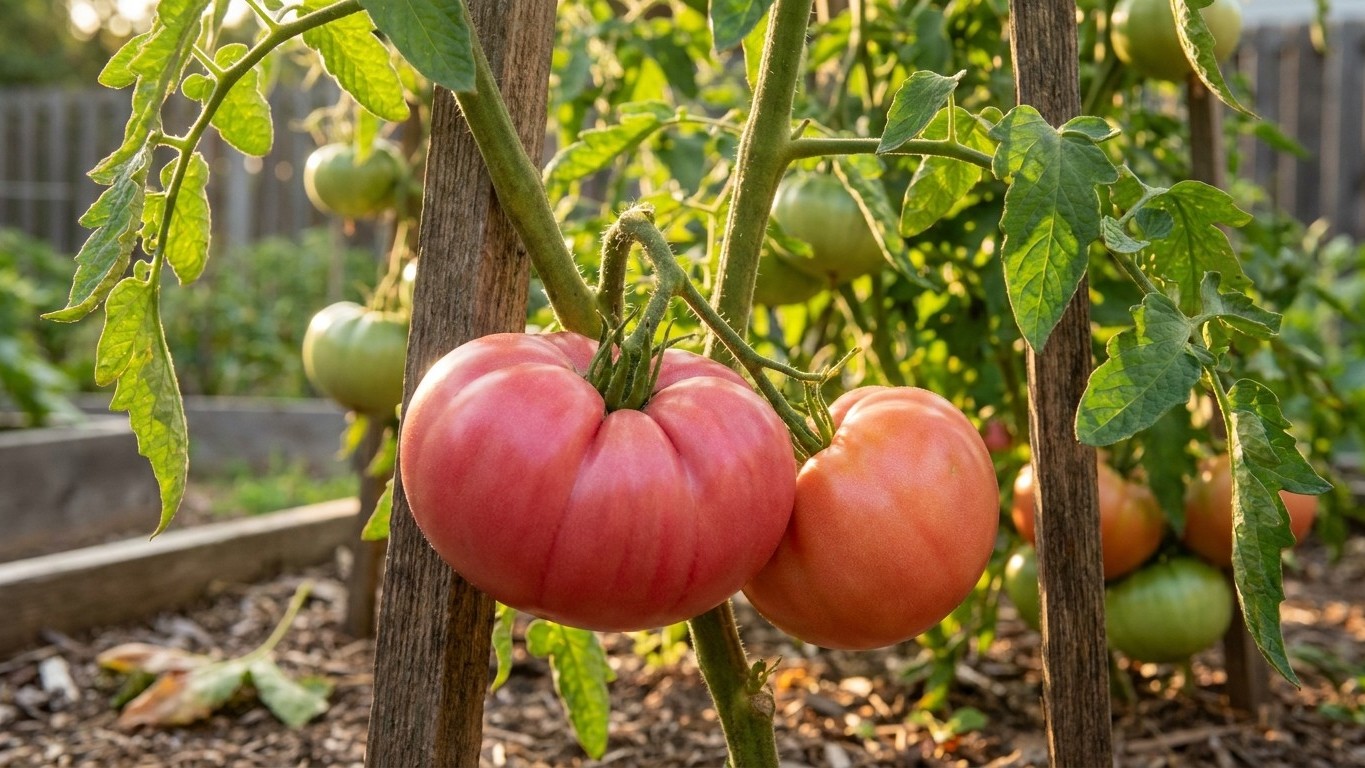

The Enroza tomato is a pink beefsteak that needs 75 days from transplant to first ripe fruit, and whether that number works in your favor depends entirely on where you garden. In short-season regions it can finish with room to spare only if you get plants in the ground on time; in long, warm-summer regions the bigger risk is heat stalling pollination mid-season, not frost cutting the season short.
What Brandywine actually is
Enroza is an indeterminate pink beefsteak, which means the vine keeps growing and setting fruit until frost stops it rather than ripening in one flush and quitting. That habit decides how you build the garden around it: a tall cage or a sturdy stake, not the short wire hoop that works for a compact bush variety, and enough spacing that the vine can be tied up as it climbs through the season.
The published figure is 75 days to maturity, and that count starts at transplant, not at the day you sowed seed indoors. If you started seed eight weeks before your last frost, add those eight weeks to the 75 days when you’re penciling out a calendar; skip that step and you’ll underestimate the season by nearly two months.
Fruit runs 6 to 8 ounces, sized for slicing rather than canning or sauce, and the flesh is described as strong-flavored and balanced on a plant that carries a high yield across the season. That combination, big slicing fruit on a heavy-bearing indeterminate vine, is the whole reason the support and spacing questions matter more here than they would for a smaller-fruited, more restrained variety.
Where it ripens in time, and where it is a gamble
The math a gardener actually needs is simple, even if nobody writes it out plainly: take your area’s frost-free window, subtract roughly two weeks for the soil to warm enough that a transplant won’t just sit there sulking, then subtract the 75 days to maturity. What’s left over is your margin for picking a full crop of ripe fruit before the vine has to stop.
Run that arithmetic in a region with a long, mild season, coastal areas in the warmer USDA hardiness zones where frost is rare or absent for most of the year, and 75 days barely registers as a constraint. Transplant whenever the soil is workable, and the vine has months of margin to keep producing beefsteaks well past that first ripe fruit.
Run the same arithmetic in a short-season region, the colder end of the hardiness map where the frost-free window can be closer to four months than seven, and the picture tightens fast. Subtract two weeks for soil warm-up and 75 days for maturity from a four-month window and you’re left with only a few weeks of harvest before frost risk returns. That’s still workable, but it removes any slack for a late spring, a rainy stretch that delays transplanting, or a plant that runs a week behind schedule because of a cool snap right after it goes in the ground.
The practical takeaway isn’t that Enroza is impossible anywhere with a real winter. It’s that in short-season areas, every trick that buys the plant an earlier, warmer start, black plastic mulch to warm soil faster, a cold frame or wall-of-water device around young transplants, starting seed on the early side of the recommended window, directly converts into more weeks of picking later on. In longer, milder regions none of that hustle is necessary, and the limiting factor becomes something else entirely: heat, which is the subject of the next section.
The two ways a season goes wrong
A frost-date table only tells half the story, because a long frost-free window doesn’t guarantee a productive one. In cooler climates, accumulated warmth can run short even when the calendar window looks generous, and tomato flowers simply won’t set fruit once nighttime temperatures drop below 50°F. A vine can sit there blooming for weeks in a cool, cloudy stretch and produce nothing to show for it, frost or no frost.
In hot regions the opposite failure shows up in midsummer. Once daytime highs push past roughly 86°F, tomato pollen goes sterile and flowers abort instead of setting fruit. That’s the reason growers in the Deep South and the hot interior Southwest plan around a spring crop that finishes before the worst heat and a second, autumn crop planted to mature after it breaks, rather than expecting one unbroken harvest from May through October.
For a 75-day variety like Enroza, the cold-night limit matters more in short-season northern gardens, where a late cool spell right after transplanting can stall the first flush of blooms and eat into an already tight window. The heat-sterility limit matters more in the hot South and Southwest, where the plant will likely finish its spring crop before the worst heat arrives, but a gardener chasing a second flush of fruit late in the vine’s life needs to time that push for after the mid-summer heat breaks, not during it.
What it resists, and what it does not
Published disease ratings for this variety show high resistance to Tomato Mosaic Virus, Fusarium Wilt races 1 and 2, Tomato Apex Necrosis Virus, Fusarium Crown and Root Rot, and Leaf Molds A through E. Against Gray Leaf Spot, the rating drops to intermediate, and that distinction is worth taking seriously: intermediate resistance means the plant slows the disease’s progress and typically shows milder symptoms, not that it won’t get infected at all. A grower who treats “intermediate” as equivalent to “high” and skips the sanitation basics, crop rotation, removing lower leaves that stay wet, avoiding overhead watering late in the day, can still lose foliage to Gray Leaf Spot in a wet season.
Just as important is what isn’t on that list. No resistance is published here for common pressures like Early Blight, Late Blight, Septoria Leaf Spot, or Verticillium Wilt, so gardeners in regions where those diseases are routine shouldn’t assume the plant has any built-in protection against them. That gap doesn’t make Enroza a poor choice; it just means the usual preventive habits, mulching to stop soil splash, staking to keep the indeterminate vine off the ground, and watching the lower leaves early in the season, carry more of the disease-prevention load than they would on a variety bred with broader blight resistance.
Growing it without the usual mistakes
Because Enroza is indeterminate, the support has to be built for a plant that’s still climbing and fruiting in September, not for one that finishes in a single flush. A tomato cage sized for a determinate bush will be outgrown by midsummer; a 6 to 7-foot stake or a tall, heavy-gauge cage set at planting time, with ties added every week or two as the vine extends, keeps the fruit off the ground and the foliage open enough to dry after rain.
Spacing matters more here than on a compact variety too. Crowding an indeterminate beefsteak reduces airflow around the lower leaves right where Gray Leaf Spot and other foliar problems get started, so give each plant the room its catalog spacing recommends rather than squeezing in an extra row.
Feeding follows the vine’s habit rather than a flat schedule: keep nitrogen moderate once the first fruit sets, since an indeterminate plant pushed too hard with nitrogen late in the season puts energy into more vine instead of ripening the beefsteaks already on it. The timing mistake specific to a 75-day variety is starting too late and then trying to compensate with fertilizer; by the time a grower notices the plant running behind, the fix isn’t more feed, it’s earlier transplanting the following year, or season-extension steps like plastic mulch and row cover the same year to recover the lost weeks.
Because the plant keeps setting fruit until frost, the last practical task of the season is deciding when to stop letting new flowers set. A few weeks before your expected frost date, pinching off new blossoms redirects the plant’s energy into ripening the fruit already on the vine rather than starting beefsteaks that won’t have time to mature.
Common questions
How many days does Enroza actually need before I can pick a ripe tomato?
75 days from the day you transplant it into the garden, not from the day you started seed indoors. Add your indoor start time on top of that when planning your calendar.
Is Enroza a good choice for a short growing season?
It can work, but the margin is tighter. Subtract about two weeks for soil warm-up and 75 days for maturity from your area’s frost-free window; whatever’s left is your realistic picking time, and gardeners in short-season regions should use every trick available (mulch, early starts, season-extension covers) to protect that margin.
Does Enroza resist blight?
No blight resistance is listed in the published data. The variety carries high resistance to several viruses and fusarium diseases, and intermediate resistance to Gray Leaf Spot, but Early Blight and Late Blight aren’t on the resistance list, so standard prevention (mulching, staking, avoiding wet foliage) still matters.
Does the vine need a cage or a stake?
Because it’s indeterminate and keeps growing until frost, it needs a tall stake or a heavy-duty cage, not the short cage sized for a compact determinate variety. Plan for a support at least 6 to 7 feet tall.