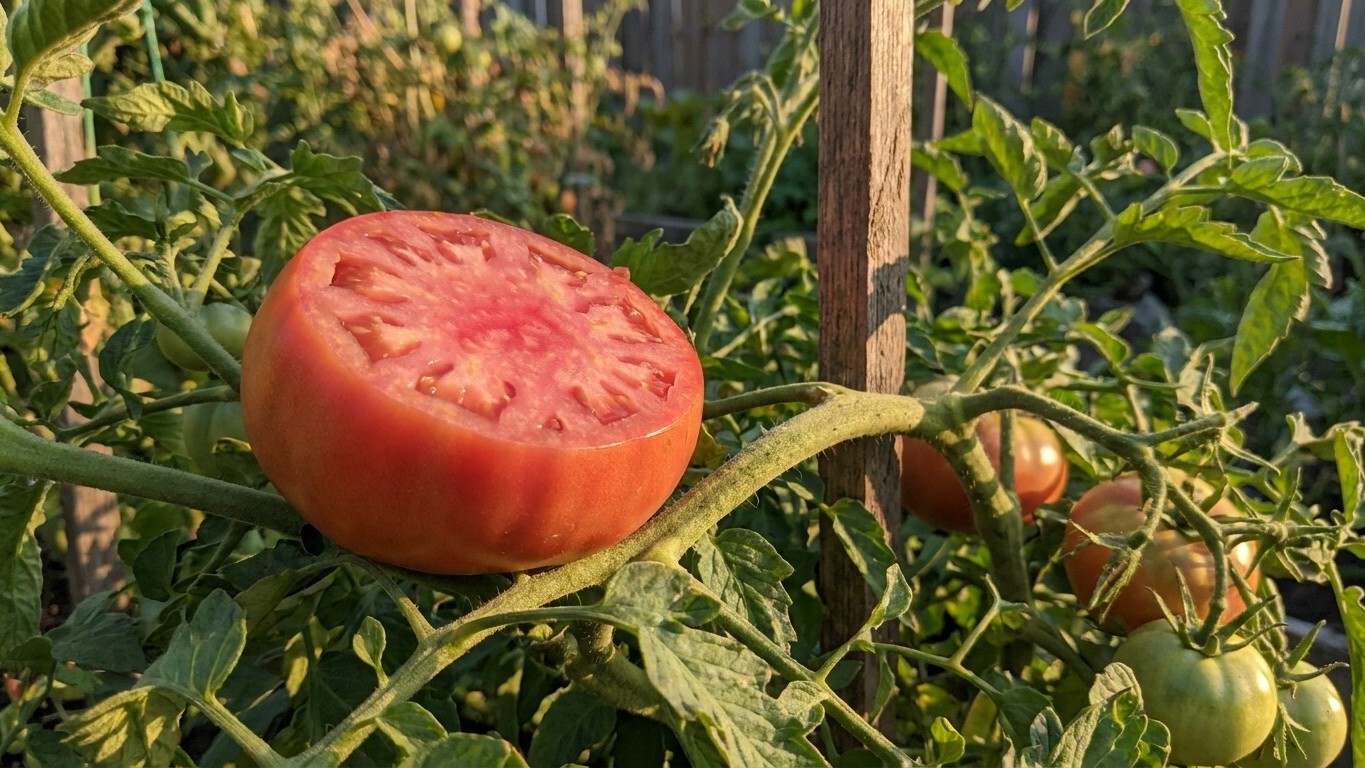

German Johnson is an heirloom slicer built for flavor over volume, and it needs 75 to 80 days from transplant to ripen, longer in cooler soil. Plant it where summer nights stay warm enough for fruit set, expect fewer tomatoes than most catalog varieties, and don’t count on any built-in disease protection. It rewards patience with a big, meaty, low-seed slicer, not a heavy basket.
What German Johnson actually is

German Johnson is a heirloom slicing tomato, indeterminate, growing 48 to 60 inches tall. That habit means the vine keeps climbing and setting new fruit clusters until frost kills it, which is why it needs a tall cage or a sturdy stake rather than a short tomato ring meant for a compact plant. Space it at least 3 feet from its neighbors so the sprawling vine has room to fill out without shading itself.
The fruit is the reason to grow it: big pink-red slicers, sandwich-sized, running 3/4 to 1 1/2 pounds, with very few seeds. That low seed count isn’t just a curiosity, it’s why the flesh stays dense and meaty rather than watery, which is also why this same slicer holds up well when canned, not just eaten fresh off the counter.
Days to maturity from transplant runs 75 to 80. Plan around the later figure. A gardener who counts on 75 days and gets 80 is looking at a harvest that arrives a week late, and in a marginal climate a week is the difference between a full crop and one caught by frost.
One detail matters at the seed rack: two strains are sold under the German Johnson name, regular leaf and potato leaf. The regular-leaf strain is the earlier and more productive of the two. If yield is already a concern with this variety, and it is, buying the wrong strain makes it worse.
Where it ripens in time, and where it is a gamble
The math a gardener needs isn’t complicated, but it has to be done in the right order. Start with the frost-free window at your location, the number of days between the average last spring frost and the average first fall frost. Subtract about two weeks, because tomato soil needs to warm before a transplant will even start growing instead of sitting still. Subtract 80 days, the later end of German Johnson’s maturity range, since that’s the figure worth planning around. Whatever is left is the actual picking window, the stretch of time the plant has to ripen fruit before cold shuts it down.
This page doesn’t carry a station-by-station frost-date table, so the numbers above are meant to be run with your own local frost dates, not borrowed from someone else’s garden. What can be said without inventing a figure is this: German Johnson was bred around North Carolina, which points to a variety suited to life in humidity rather than to a short, cool season. That’s the useful clue when sizing up a garden against this tomato, more than any single city’s frost date.
A gardener in a region with a long, humid growing season, the kind found through much of the Southeast and the mid-Atlantic, has room to run the arithmetic above and still land with weeks of harvest to spare. The soil warms early, the frost-free window stretches long, and an 80-day tomato clears its maturity date with margin left over for picking.
A gardener in the Upper Midwest or northern New England is working with a tighter frost-free window from the start, and an 80-day variety eats a much bigger share of it. Run the subtraction with your own last-frost and first-frost dates before committing a full row to this variety in a short-season garden. If the arithmetic comes out negative or barely positive, that’s the signal to start seed indoors earlier, choose the regular-leaf strain for its earlier finish, or accept that German Johnson will be a race against the calendar rather than a relaxed crop.
The Deep South sits in an odd middle ground. The frost-free window is long enough that maturity date is rarely the problem, but as the next section covers, a long season isn’t automatically a productive one there either.
The two ways a season goes wrong
A frost table only tells half the story, and the two failures it can’t show are opposites of each other. In the north, a frost-free window can look adequate on paper while still falling short in practice, because what actually ripens fruit is accumulated warmth, not just the count of frost-free days. Tomato flowers won’t set fruit at all when nighttime temperatures drop below 50F, so a string of cool nights early or late in the season quietly erases days from the usable window even though no frost has touched the plant.
In the south, the failure runs the other direction. Above roughly 86F, tomato pollen turns sterile, and flowers drop without setting fruit. That’s why growers in hot climates plan around two separate crops, a spring planting that finishes before the worst heat and an autumn planting timed to flower after it breaks, rather than expecting one plant to bear steadily from June through September.
For German Johnson specifically, the cold-side risk matters more, because its maturity date already runs long at 75 to 80 days. A short northern season doesn’t just risk frost at the finish line, it risks a stretch of sub-50F nights stalling fruit set somewhere in the middle, which pushes the harvest later still. The heat-side sterility affects it too in the Deep South, but its indeterminate habit gives it an advantage there: since it isn’t a one-flush plant, a spring-set vine can stall through the hottest weeks and resume setting fruit once nights cool back down, without needing to be replanted the way a determinate variety would.
What it resists, and what it does not
Published resistances for German Johnson: none claimed. This is a straight heirloom, and it carries no VFN code, no listed protection against Fusarium wilt, Verticillium wilt, or root-knot nematodes. That’s worth stating plainly rather than glossing over, because a gardener who assumes an old, well-known variety must have some built-in defense is setting themselves up for a surprise.
The practical risk sits right next to the reason this variety is grown in the first place. It was bred for life in humid climates, and humidity is exactly the condition that favors the fungal and bacterial diseases tomatoes commonly face, early blight, late blight, and bacterial spot among them. Tolerating humid heat and resisting the diseases that humidity encourages are two different traits, and German Johnson has been selected for the first without any documented claim to the second.
That gap means the usual cultural defenses matter more here, not less: airflow around the plant, watering at the base rather than overhead, and mulching to keep soil-borne spores from splashing onto lower leaves. None of that is unique to this variety, but skipping it costs more with a tomato that has no genetic backstop to fall back on.
Growing it without the usual mistakes
Because German Johnson is indeterminate, it needs a different plan from a determinate tomato that sets one flush and finishes. A determinate variety can be staked lightly and left alone once it’s fruiting, since the plant stops growing taller around the time it starts ripening. German Johnson keeps growing new stem and setting new flower clusters all season, which means the cage or stake has to be tall enough for a plant reaching 48 to 60 inches, and the support needs to go in at planting time, not after the vine has already sprawled.
Spacing of at least 3 feet isn’t a suggestion to save room, it’s what keeps a vine this size from shading its own lower fruit and slowing the ripening it’s already stretching to finish on time.
Feeding is where the timing of this variety matters most. Because it’s already on the low end for fruit count, heavy nitrogen late in the season is a costly mistake: it pushes the plant into more leaf and stem growth right when energy should be going into finishing the fruit already set. Ease off nitrogen once the first clusters are sizing up, and let the plant put its effort into ripening rather than expanding.
The honest number to plan around is yield, not disease or timing. In an Alabama trial garden, under a long season and good conditions, German Johnson averaged 40 fruits per plant, and that’s a best-case trial figure, not a guarantee for a home garden with an average summer. This variety sets fewer tomatoes than most others on the market. A gardener choosing by the pound, wanting to fill a freezer or a canning shelf from a couple of plants, is better served by a heavier-yielding variety. A gardener choosing by the bite, wanting a big, meaty, low-seed slicer for a sandwich, is exactly who this tomato was bred for.
Common questions
Is German Johnson the same as Mortgage Lifter?
No. They’re separate heirloom varieties, both pink-red slicers from the same general era and region, but they’re distinct strains with their own seed lines. Confusing the two at purchase is a common mistake since both are large pink heirloom slicers with similar reputations.
How many German Johnson plants should I grow for a family?
Given the trial figure of 40 fruits per plant under ideal conditions, and the fact that a home garden will typically run lower, plan on more plants than you would for a heavier-yielding hybrid if you want a steady supply of slicers through the season.
Should I choose regular leaf or potato leaf German Johnson?
The regular-leaf strain is the earlier and more productive of the two. If your season is on the tight side or yield is already a concern, that’s the strain to look for at purchase.
Does German Johnson work for canning as well as slicing?
Yes. The very low seed count that makes it a clean, meaty slicer for sandwiches also means less watery pulp to cook down, which is why the same fruit that’s prized fresh also holds up well when canned.