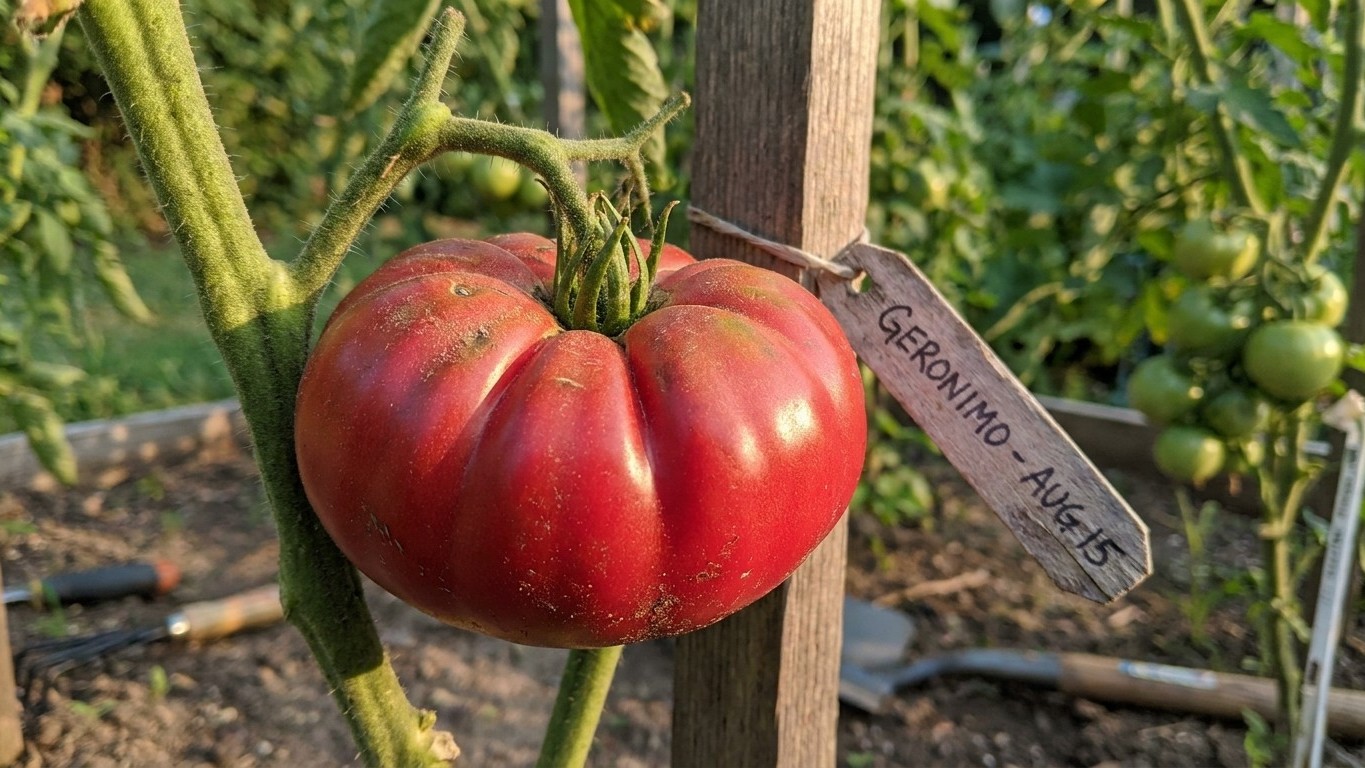

Geronimo is a beefsteak slicer built for gardeners who want a big, meaty tomato without gambling on the earliest possible harvest. It reaches 78 days to maturity counted from transplant, produces indeterminate vines that keep cropping until frost, and yields fruit in the 8-10 oz range with good flavor and some tolerance to mildew. Plant it once your soil has warmed and your frost-free window comfortably clears that 78-day mark.
What Geronimo actually is

Three facts decide whether Geronimo belongs in a given garden. First, it’s a beefsteak, the large-fruited, flattish type grown for thick slices rather than canning or salads. Second, its habit is indeterminate: the vine doesn’t stop at a set height or fruit in one flush, it keeps growing and setting new trusses right up until frost kills it, which means it needs a tall cage or a sturdy stake for the whole season, not a quick round of staking in June. Third, the fruit itself runs 8-10 oz per tomato, described in the published variety data as having good flavor and mildew tolerance, and it’s grown specifically for slicing rather than sauce or paste work.
The maturity figure matters more than most gardeners realize. Geronimo is listed at 78 days to maturity from transplant, not from the day you sow seed indoors. That distinction adds several weeks to the real timeline once you count the seed-starting period, and it’s the number every planting decision in this article works from. A catalogue that quietly measures from sowing instead of transplant can make a variety look two or three weeks faster than it actually performs in the ground, so treat the transplant basis as the fixed starting point for any date math you do yourself.
Where it ripens in time, and where it is a gamble
The math a gardener needs is simple in structure even if the numbers vary by location: take your local frost-free window, subtract roughly two weeks for the soil to warm enough to set transplants without stalling them, then subtract the 78 days Geronimo needs to mature. Whatever remains is your cushion, the number of extra days you have to actually pick a full crop before autumn frost ends the season.
This page doesn’t carry a set of named cities with their specific frost-free windows and reference-station figures, so it won’t invent them here. What can be said reliably is how the arithmetic behaves at the edges. In a region with a long, reliably warm frost-free season, say one running well past 150 days, the two-week soil-warming deduction and the 78-day maturity requirement still leave a comfortable stretch of weeks for harvest, plenty of room for a beefsteak that keeps fruiting until frost. In a region where the frost-free window runs closer to 100 days, the same subtraction leaves very little slack: two weeks for soil warming plus 78 days to first ripe fruit can eat nearly the entire season, leaving only a short harvest window before frost returns.
The practical move for any reader is to pull their own frost-free window, either from a local extension office or a weather-station record for their area, and run that subtraction themselves rather than relying on a national average. A gardener in a short-season region who does this arithmetic honestly may find Geronimo workable only with transplants started early indoors and set out the moment the soil is reliably warm, with row cover on hand in case of a late spring cold snap. A gardener in a long-season region has far less to worry about and can treat the 78-day figure as a comfortable mid-season target rather than a tight deadline.
The two ways a season goes wrong
A frost table only tells you when the growing window opens and closes. It says nothing about two other limits that can ruin a Geronimo crop even inside a technically long enough season.
The first is cold nights in spring or early summer. Tomato flowers fail to set fruit when nighttime temperatures drop below 50F, regardless of how warm the days get. A region can post a generous frost-free window on paper and still deliver a string of chilly nights right when Geronimo’s first trusses are trying to set, stalling the plant for weeks even though no frost ever touched it.
The second is heat in the other direction. Once daytime temperatures push past roughly 86F, tomato pollen becomes sterile and flowers drop without setting fruit. This is why gardeners in hot southern climates typically plan around two shorter cropping windows, a spring harvest before the worst heat arrives and a second push in early autumn as temperatures ease, rather than expecting one uninterrupted season of production. For a variety like Geronimo, with a mid-length 78-day maturity, the heat limit matters more in the Deep South and desert Southwest, where the plant can finish its early fruit set before summer’s peak but then stall through the hottest weeks. The cold-night limit matters more in northern and high-elevation gardens, where a slow, chilly start can push first ripe fruit dangerously close to the fall frost date even when the calendar window looked adequate.
What it resists, and what it does not
Geronimo carries a published set of disease resistances, and the grades matter as much as the list itself. It has high resistance to Verticillium Wilt, high resistance to Tobacco Mosaic Virus, high resistance to Fusarium Wilt races 1 and 2, and high resistance to Leaf Molds A through E. Against Powdery Mildew, the rating is only intermediate.
That distinction between intermediate and high is worth taking seriously rather than glossing over. High resistance means the plant is bred to largely fend off that specific pathogen. Intermediate resistance means something narrower: the plant slows the disease’s development and often shows milder symptoms, but it does not stop an infection from taking hold under the right conditions. A gardener who treats “intermediate” as a green light to ignore airflow and humidity around the plant is setting up disappointment; powdery mildew can still establish on Geronimo, just less aggressively than on a variety with no resistance rating at all.
Just as important is what isn’t on this list. No resistance to early blight, late blight, or bacterial diseases is published for Geronimo here, and none should be assumed. A tomato with strong ratings against wilts and leaf mold can still be vulnerable to blight pressure in a wet season, so crop rotation, mulching to limit soil splash, and reasonable plant spacing for airflow remain part of the job regardless of what the resistance chart shows.
Growing it without the usual mistakes
Because Geronimo is indeterminate, the biggest planning mistake is under-building the support structure. A determinate tomato that ripens in one flush can get by with a modest cage, but Geronimo keeps adding height and new fruiting trusses until frost stops it. That calls for a tall stake, driven deep, or a heavy-gauge cage built for a full-season vine, set in place at transplant time rather than added later once the plant is already sprawling.
Spacing needs to account for that same long season of growth. Crowding an indeterminate beefsteak early in the year looks fine in June and becomes a tangled, poorly ventilated mess by August, which is exactly the kind of dense, humid canopy that gives powdery mildew room to work despite the variety’s intermediate resistance. Give each plant enough room to keep air moving through the foliage all season, not just at planting.
Feeding should track the plant’s continuous fruiting pattern rather than stop after the first flush. Because Geronimo keeps setting new trusses, a steady, moderate feeding schedule through midsummer supports the later fruit better than one heavy feeding at transplant followed by nothing. Ease off nitrogen as the season winds down and cooler nights approach, since pushing new vegetative growth late in the year diverts energy from ripening the fruit that’s already on the vine, the fruit that actually needs to mature before frost closes out the season for good.
Common questions
How many days does Geronimo take to ripen after transplanting?
78 days from transplant to maturity, based on the published variety figure. That count starts once seedlings go into the ground, not from the day seed is sown indoors.
Is Geronimo resistant to blight?
No blight resistance is listed for this variety. Its published resistances cover Powdery Mildew (intermediate), Verticillium Wilt, Tobacco Mosaic Virus, Fusarium Wilt races 1 and 2, and Leaf Molds A-E, all rated high except powdery mildew. Early and late blight aren’t part of that list, so normal precautions like rotation and mulching still apply.
Does Geronimo need a cage or a stake?
Yes. It’s an indeterminate vine that keeps growing and fruiting until frost, so it needs a tall cage or a stake set up at transplant time rather than a light support added later in the season.
What size and type of fruit does Geronimo produce?
It’s a beefsteak tomato with fruit running 8-10 oz, grown for slicing, with good flavor and some mildew tolerance according to the published variety data.