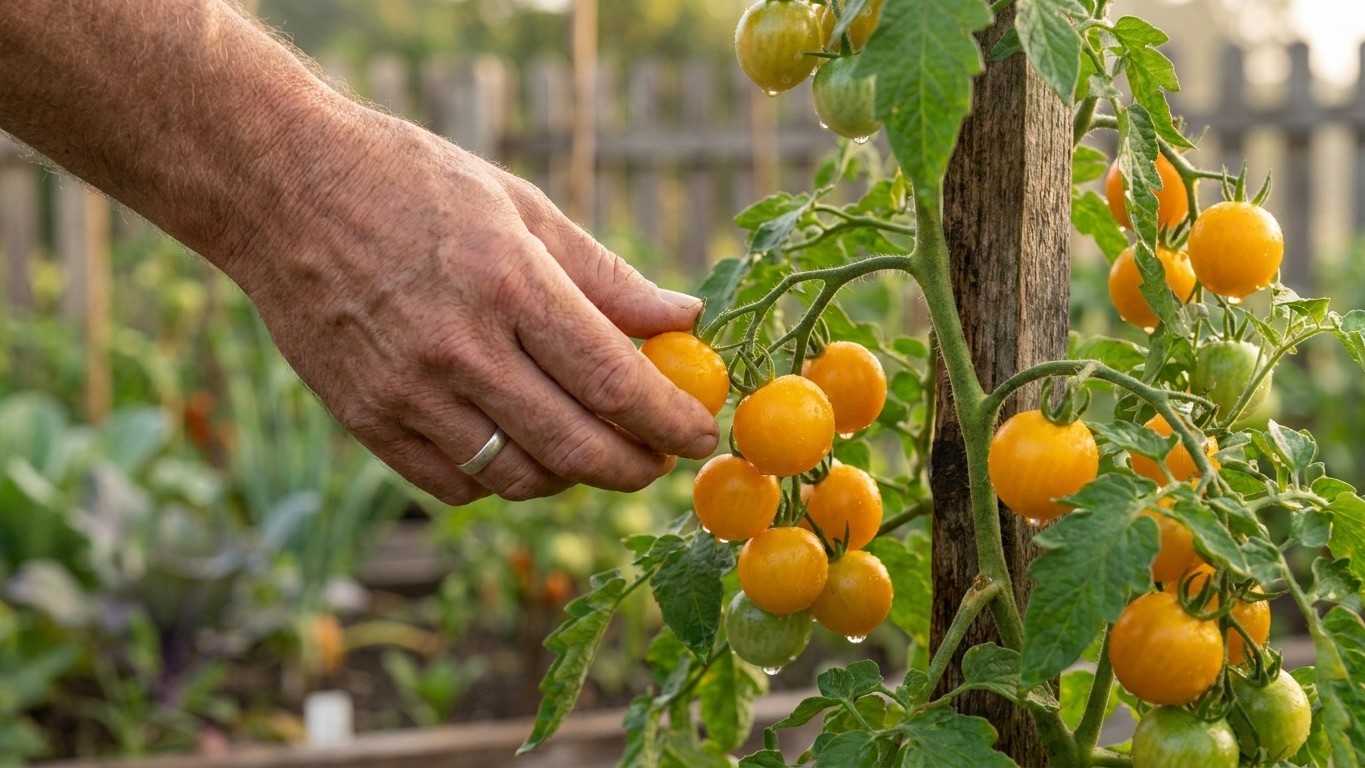

Gold Nugget is a determinate cherry tomato that ripens in about 56 days from transplant, one of the earliest cherries a home garden can grow, and its short, non-stop harvest window makes it a good match for gardens with a tight frost-free season rather than a long, sprawling summer.
What Brandywine actually is

Gold Nugget is a golden cherry tomato with a determinate growth habit, meaning the plant grows to a set size, sets its fruit over a compressed period, and then tapers off rather than producing new flushes all season. That habit changes how you stake it: a determinate cherry does fine in a cage or a short stake, since it won’t keep climbing and adding weight for months the way an indeterminate vine will.
The catalogue figure for days to maturity is 56, and that count starts from transplant, not from the day you sow seed indoors. That distinction matters because seed-starting typically adds another four to six weeks before a seedling is ready to go in the ground, so the 56-day clock only starts once the plant is actually sitting in garden soil.
The fruit itself is small, round, and golden, sized and shaped for eating out of hand rather than slicing. It’s the kind of tomato you snack on standing in the garden or toss whole into a salad, not one you’d cut for a sandwich. Flavor-wise, Gold Nugget is described as reaching an unusually rich, sweet flavor once mature, and it’s consistently among the first tomatoes of any type to ripen in a mixed garden bed. For a gardener choosing what to plant first in spring, that early ripening combined with a determinate habit means a shorter commitment: you get a concentrated harvest, then the plant is largely done, freeing up the space and the stake for something else.
Where it ripens in time, and where it is a gamble
The question that actually matters for this tomato isn’t “can I grow it,” it’s “does my frost-free window leave room for the plant to finish.” That’s arithmetic anyone can do with their own local frost dates, even without a table of named cities in front of them.
Start with the frost-free window: the number of days between the average last spring frost and the average first fall frost in your area. Subtract roughly two weeks, because tomato transplants shouldn’t go into the ground until the soil has warmed past the point where a cold snap can stunt or kill them, even if the calendar says frost risk has passed. What’s left is your effective growing window. Subtract the 56 days Gold Nugget needs to reach first ripe fruit, and whatever remains is your harvest period, the stretch of time you actually get to pick cherries before the season closes back down.
Short-season gardens
In much of the northern tier, gardeners work with frost-free windows in the range of 100 to 130 days. Run the math: even at the shorter end, subtracting two weeks for soil warm-up and 56 days for maturity still leaves a real harvest window, often four to six weeks of picking before frost returns. That’s a comfortable margin for a 56-day tomato, and it’s exactly why fast cherries like this one are the standard recommendation for gardeners in Maine, Minnesota, or similar short-season states rather than a 90-day slicing tomato that eats up nearly the whole season just reaching first ripe fruit.
Long-season gardens
In the Gulf Coast states, the Southeast, and much of the Southwest, frost-free windows stretch past 200 days, sometimes approaching year-round in the mildest zones. Here the math isn’t a squeeze at all. A 56-day tomato finishes so early relative to the available season that gardeners in these regions often plant a spring crop, let it finish, then plant a second round for fall, treating Gold Nugget’s short cycle as an asset rather than a constraint. The gamble in long-season territory isn’t frost. It’s heat, which the next section covers directly.
Wherever you garden, the honest way to use this variety is to pull your own county’s average last and first frost dates, do the subtraction, and see what’s left. No single number from a distant reference station will match your actual soil and microclimate exactly, but the arithmetic itself doesn’t change.
The two ways a season goes wrong
A long frost-free window on paper doesn’t guarantee a good tomato season, and a short one doesn’t automatically doom it. Two separate limits sit underneath the frost dates, and neither shows up on a simple calendar.
In cooler northern gardens, the problem isn’t frost timing, it’s accumulated warmth. Tomatoes need a run of genuinely warm nights to set fruit reliably, and when nighttime temperatures drop below 50 degrees Fahrenheit, pollen doesn’t function well and blossoms drop without setting fruit. A garden can have a technically long frost-free window and still deliver cool, damp nights through much of that window, especially at higher elevations or near large bodies of water, which quietly shortens the real fruit-setting period even though the frost dates look generous.
In hot southern and interior gardens, the opposite failure shows up in midsummer. Once daytime highs push above roughly 86 degrees Fahrenheit, tomato pollen becomes sterile and flowers stop setting fruit even though the plant looks healthy and keeps flowering. This is why southern growers so often run two distinct crops, a spring planting that finishes before the worst heat and a fall planting that goes in once temperatures ease, rather than expecting one tomato plant to produce continuously from May through September.
For a 56-day variety like Gold Nugget, the cold-night limit matters more than the heat limit in most gardens. Because it finishes so early, it has a real shot at avoiding the worst of a hot midsummer stretch in the South, ripening its main flush before peak heat sets in. In cooler regions, though, a run of chilly nights right after transplant can stall those first 56 days regardless of how much frost-free time is left on the calendar, so timing the transplant to actual soil and night temperatures matters more than the calendar date alone.
What it resists, and what it does not
Published catalogue information for Gold Nugget lists no disease resistance codes. That’s worth stating plainly rather than glossing over, because it’s easy to assume every modern tomato variety carries at least some built-in defense against common problems like verticillium wilt, fusarium wilt, or nematodes. This one doesn’t carry any published resistance claim.
That absence has practical consequences. Without resistance to soil-borne diseases like fusarium or verticillium wilt, Gold Nugget depends entirely on garden practice for protection: crop rotation, healthy soil, and avoiding planting tomatoes in the same bed year after year where those pathogens can build up. A resistant variety can tolerate some level of disease pressure in the soil and still produce; an unresistant one has no such buffer, so a bed with a history of tomato problems is a real risk for this variety specifically, not just a general caution.
It’s also worth being precise about what “no published resistance” means versus what a partial resistance rating would mean on another variety. Where a catalogue lists a variety as having intermediate resistance to a disease, that’s not immunity, it means the plant can slow the disease’s progress and often still produce a usable crop despite some infection. Gold Nugget doesn’t even have that intermediate buffer on record. For gardeners in regions with known pressure from wilts or nematodes, that argues for extra attention to rotation and soil health rather than assuming the plant will shrug off a problem the way a resistant hybrid might.
Growing it without the usual mistakes
Because Gold Nugget is determinate, the support and feeding plan should look different from what you’d do for a sprawling indeterminate cherry that keeps growing and fruiting until frost. A determinate plant reaches a set size and then puts most of its energy into ripening the fruit it’s already set, so a simple tomato cage or a single sturdy stake is usually enough, there’s no need to build a tall trellis system meant for a vine that will keep climbing for months.
Feeding follows the same logic. Once a determinate variety sets its main flush of fruit, heavy additional nitrogen doesn’t extend the harvest the way it might on an indeterminate plant still producing new growth. Continuing to push high-nitrogen fertilizer late in the season on Gold Nugget mostly encourages leafy growth at the expense of ripening the fruit already on the vine, so easing off nitrogen once fruit set is well underway, and leaning on phosphorus and potassium instead, supports ripening rather than working against it.
The mistake this variety’s timing invites most often is planting it too early to chase that fast 56-day clock, only to have cool nights stall fruit set anyway, which erases the head start the variety was supposed to provide. It’s also worth planning for the harvest to arrive in a concentrated burst rather than trickling in over weeks: because it’s determinate, expect a heavy flush of ripe cherries over a relatively short stretch, then a rapid decline, rather than the slow, steady trickle typical of indeterminate cherry types. Planning ahead for that glut, whether that means succession planting a second variety to follow it or simply being ready to use a lot of cherry tomatoes at once, gets more value out of the plant than treating it like a season-long producer.
Common questions
Is Gold Nugget determinate or indeterminate?
Determinate. It grows to a set size, sets its crop over a relatively short window, and then production tapers off, rather than continuing to grow and fruit until frost the way an indeterminate variety does.
How many days does Gold Nugget take to ripen?
About 56 days, counted from the day the seedling is transplanted into the garden, not from the day the seed is sown indoors.
Does Gold Nugget have disease resistance?
No disease resistance is published for this variety. Gardeners in beds with a history of soil-borne tomato diseases should lean on crop rotation and soil health rather than expect built-in protection.
What is Gold Nugget best used for in the kitchen?
It’s a snacking and salad tomato: small, round, golden fruit meant to be eaten fresh rather than sliced or cooked down.