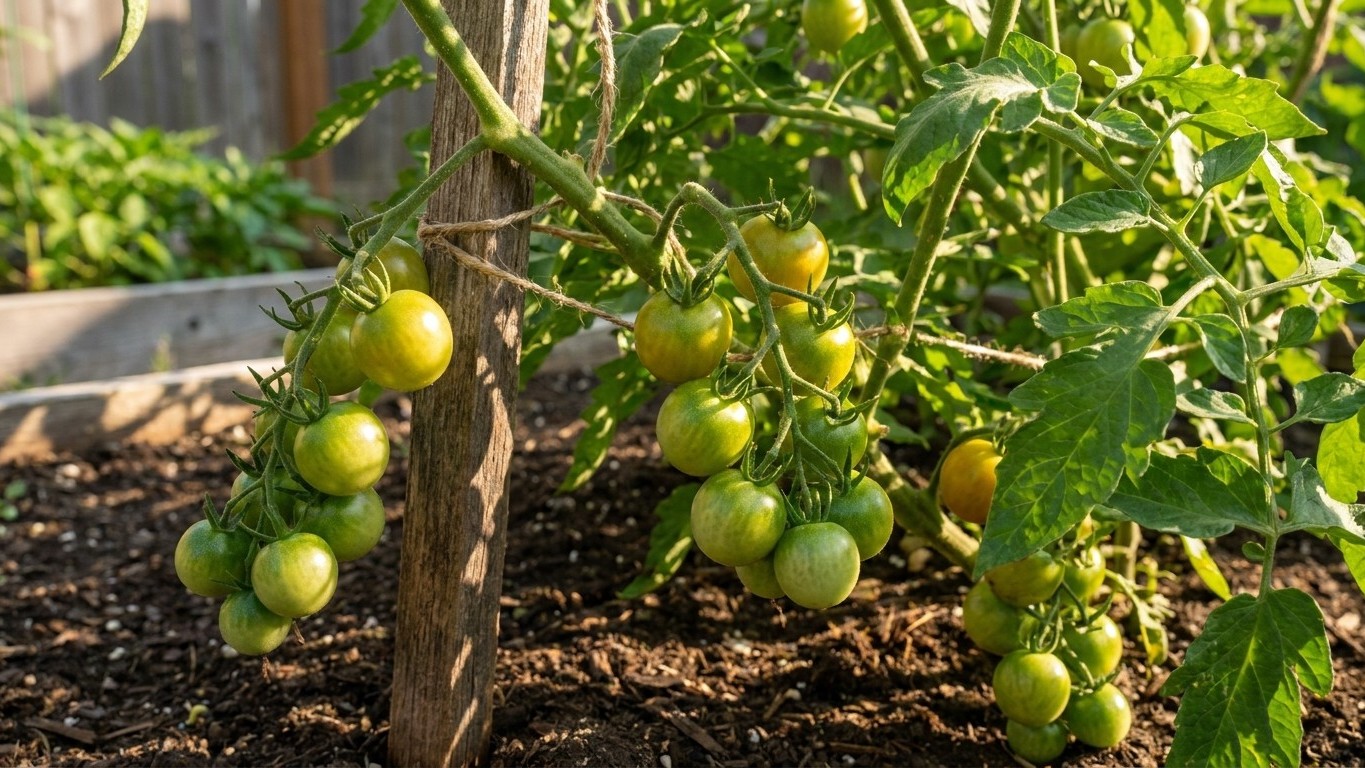

The Green Bee is a specialty indeterminate tomato that reaches harvest in 75 days from transplant, with tangy, firm-fleshed fruit built for a long shelf life rather than a quick kitchen turnaround. That maturity window puts it in the mid-to-late range for home gardens, which means the real question isn’t whether it’s a good tomato. It’s whether your growing season has room for it.
What Brandywine actually is
Three facts decide whether the Green Bee fits a given garden, and they all come from the same catalogue listing. The variety is indeterminate, which means the vine doesn’t stop growing once it sets fruit. It keeps climbing and cropping until frost cuts it down, unlike a determinate plant that ripens in one concentrated flush and then quits. That habit dictates the hardware: a tall cage or a sturdy stake is not optional here, because an unsupported indeterminate vine sprawls, tangles, and rots fruit against wet soil.
Days to maturity is listed at 75, and that figure is counted from transplant, not from the day you sowed seed indoors. This distinction matters more than gardeners usually admit. If you started seed eight weeks before your last frost and moved seedlings outside on schedule, the 75-day clock starts at that transplant date, not at germination. Confuse the two and you’ll misjudge your harvest by three to five weeks, which is often the difference between a full crop and one cut short by cold.
The fruit itself is built for texture and keeping rather than the soft, juicy bite some slicing tomatoes are known for. The flesh is firm, the flavor tangy rather than sweet, and the shelf life is long enough that a Green Bee tomato picked at the right stage can sit on a counter for days without turning to mush. That combination, indeterminate habit plus firm, tangy fruit plus a 75-day clock, is the whole profile you’re working with.
Where it ripens in time, and where it is a gamble
A 75-day maturity figure only means something once you set it against your local frost-free window, and doing that math is simpler than it looks. Start with your average frost-free window, the stretch between your last spring frost and your first fall frost. Subtract roughly two weeks at the front end, because soil needs time to warm before transplants can go in without stalling. Subtract the 75 days themselves. What’s left is your margin, the cushion of extra picking days before frost risk climbs back up.
In regions with a long, reliably warm season, the arithmetic is forgiving. A frost-free window stretching well past six months leaves the Green Bee with a month or more of margin after the fruit starts ripening, which means multiple weeks of harvest rather than a single frantic push before the first cold snap. Gardeners in the Gulf Coast states, the lower Southeast, and much of California’s Central Valley are typically working with this kind of cushion, assuming soil warms early enough in spring to allow a timely transplant.
The picture tightens in transitional zones, the broad middle of the country where the frost-free window runs closer to five months. Here the math still works, but the margin shrinks to a few weeks rather than a month or more, and a late spring or an early fall frost can eat into that cushion fast. Gardeners in these zones do best starting seed indoors on schedule and transplanting as soon as soil temperature allows, rather than waiting for a comfortable stretch of warm weather that may cut into the harvest window later.
The real gamble shows up in short-season regions, roughly the northern tier of states and higher-elevation pockets throughout the interior West, where the frost-free window can run close to four months or less. Subtract two weeks for soil warming and 75 days for maturity, and the leftover margin can shrink to two or three weeks, sometimes less in a cold year. That’s not necessarily a dead end. Gardeners in these zones often start seed earlier indoors, use black plastic mulch or row cover to push soil temperature up faster, and accept that a Green Bee crop there will be a compressed, single push rather than a long relaxed harvest. It’s workable. It’s just not comfortable, and a late frost in either direction erases the margin entirely.
No specific city-level frost dates are cited here because none were verified for this page, but the method above works with whatever local frost-free window a gardener already knows for their own area, whether that comes from years of personal observation or a regional planting guide.
The two ways a season goes wrong
A long frost-free window looks like safety, but it doesn’t guarantee a good tomato season, and two limits explain why. The first is accumulated warmth. A region can have a frost-free window stretching five or six months and still deliver cool nights through much of it, especially at higher elevation or near large bodies of water that keep temperatures moderate. Tomato flowers won’t set fruit reliably once nighttime temperatures drop below 50F, so a long season with chilly nights can still produce a thin harvest, frost or no frost. For a mid-season variety like the Green Bee, this risk matters most early and late in the season, when nights are more likely to dip into that range.
The second limit sits at the opposite end of the thermometer. Once daytime temperatures climb above roughly 86F for extended stretches, tomato pollen turns sterile and blossoms drop without setting fruit. This is the reason experienced growers in the Deep South and similar hot climates don’t plant one long tomato season at all. They run a spring crop that finishes before the worst of summer heat arrives, then a second crop in late summer timed to ripen once temperatures ease in fall. The middle of summer, in these climates, is effectively a dead zone for fruit set no matter how long the frost-free window technically runs.
For the Green Bee specifically, the 75-day maturity window means it lands in the “gets caught by heat” category more often than the “runs out of accumulated warmth” category, in the hottest growing regions, since a spring transplant timed early enough to beat the heat still needs those 75 days to clear before daytime temperatures regularly cross 86F. In cooler, shorter-season zones, the cold-night limit is the more immediate concern, particularly for the tail end of the harvest as fall nights drop.
What it resists, and what it does not
The catalogue listing for the Green Bee carries no published disease resistance codes at all. That’s worth stating plainly rather than glossing over, because it’s easy to assume a specialty variety comes with some built-in protection simply because so many modern tomato varieties do. This one doesn’t, at least not according to any resistance rating published for it.
That absence changes how the variety should be managed rather than ruling it out. Common tomato pressures like early blight, late blight, and fusarium wilt aren’t neutralized by anything in this plant’s genetics, so the usual cultural defenses carry more weight than they would with a resistant variety. That means consistent crop rotation, avoiding overhead watering that splashes soil-borne spores onto lower leaves, and spacing plants widely enough that foliage dries quickly after rain or dew.
It’s also worth flagging the difference between resistance levels in general, even though it doesn’t directly apply here, because gardeners moving between varieties in the same garden often misread it. When a catalogue lists intermediate resistance to a disease, that means the plant slows the disease’s progress and often produces a usable crop despite some infection, not that it escapes the disease entirely. High resistance is a stronger, more reliable barrier. Since the Green Bee carries neither rating for anything, growers should treat it as a variety with no chemical or genetic backstop, relying entirely on spacing, airflow, and rotation to keep common tomato diseases in check.
Growing it without the usual mistakes
Because the Green Bee is indeterminate, it needs a different plan than a determinate tomato that ripens in one flush and finishes. A determinate plant can get away with a short stake or a small cage, since its growth is naturally limited. The Green Bee will keep growing taller and producing new flower clusters until frost stops it, so undersized support is the single most common mistake with this variety. A tall stake, at minimum, or a cage built for full-season indeterminate growth, is worth setting up at transplant time rather than adding later once the vine is already sprawling.
Spacing needs to account for that same continued growth. A plant that’s still putting out new foliage in September needs enough room from its neighbors that airflow doesn’t collapse into a dense, humid tangle by midsummer, which is exactly the kind of environment foliar diseases favor, and matters more here given the lack of published resistance.
Feeding schedule is the other place timing gets missed. Because this variety keeps fruiting until frost, there’s a temptation to keep pushing nitrogen all season to sustain that growth. But heavy nitrogen late in the season tends to favor vine growth over fruit set, and it’s better to ease off nitrogen once the plant is fruiting steadily and switch to supporting fruit development rather than vegetative growth. Given the 75-day maturity clock, that shift typically makes sense once the first fruit has set and sized up, redirecting the plant’s energy toward the ongoing harvest that makes this variety worth growing in the first place.
The other timing mistake is starting seed too late for the transplant-based clock. Since the 75 days count from transplant, not sowing, gardeners who start seed on a generic tomato schedule without checking their own last-frost date risk transplanting too late for their maturity window, particularly in shorter-season zones where the margin is already tight.
Common questions
Is the Green Bee a good choice for a short growing season?
It can work, but the margin is thin. Subtract two weeks for soil warming and the 75-day maturity period from your frost-free window; if what’s left is only a couple of weeks, expect a compressed harvest rather than a long picking season, and consider starting seed early indoors and using row cover to push soil warming ahead of schedule.
Does the Green Bee resist common tomato diseases?
No resistance ratings are published for this variety. That means growers should rely on crop rotation, wide spacing, and avoiding overhead watering rather than counting on any built-in genetic protection.
Why does the Green Bee need a tall cage instead of a small one?
Because it’s indeterminate, the vine keeps growing and setting new fruit clusters until frost, unlike a determinate plant that stops at a set size. A short stake or small cage gets overwhelmed partway through the season, leading to sprawling growth and fruit rot.
When should nitrogen feeding stop for this variety?
Once the first fruit has set and begun sizing up, easing off heavy nitrogen and shifting toward fruit-supporting nutrition tends to work better than continuing to push vegetative growth, especially given how long this variety keeps producing through the season.