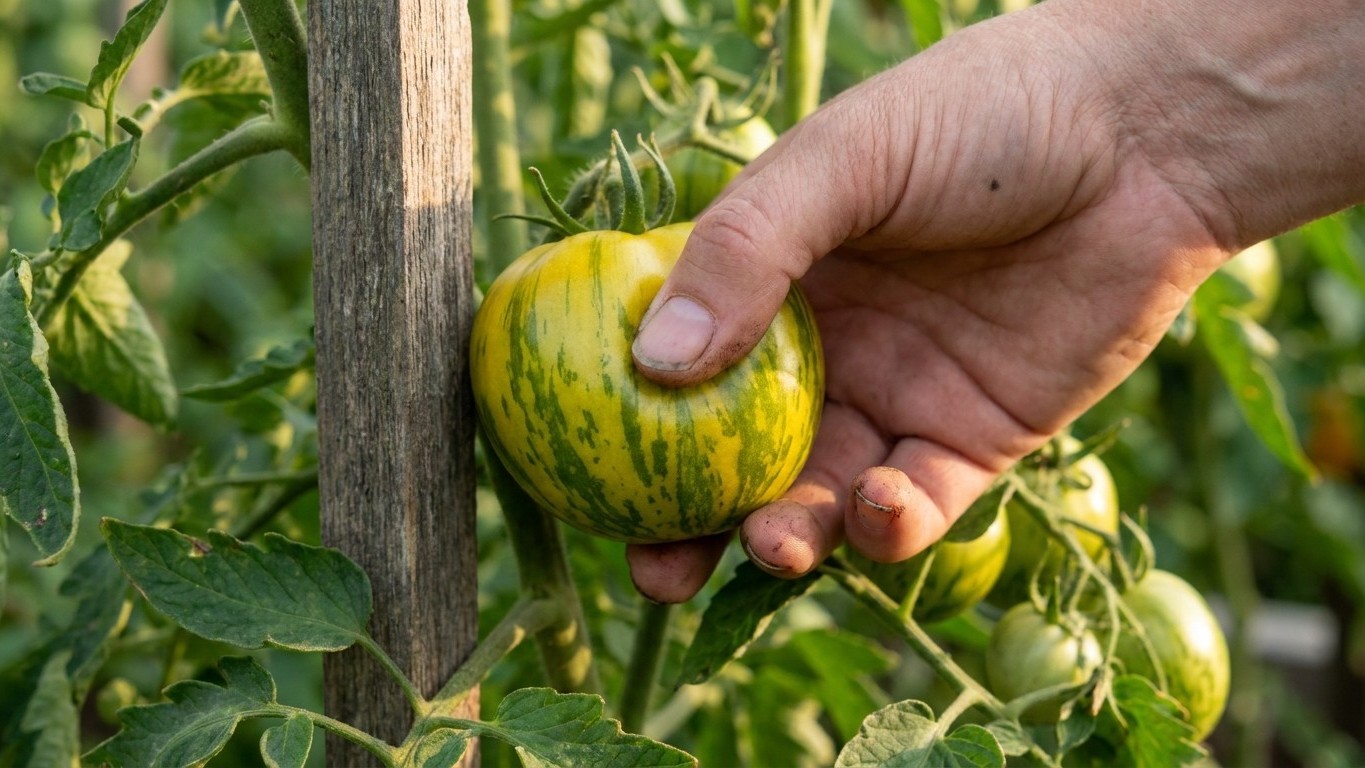

Green Zebra is an heirloom slicing tomato that ripens green-striped rather than red, and it takes about 72 days from transplant to reach that ripeness. Telling when it’s ready means watching for a yellow-green base color and a slight give under the thumb, not waiting for red that will never come. Whether that 72-day clock fits your growing season depends on where you garden and how you count the days.
What Brandywine actually is

Green Zebra is an heirloom, indeterminate tomato, which means the vine keeps growing and setting fruit until frost cuts it down rather than stopping after one flush. That habit decides how you build the garden around it: this plant wants a tall cage or a sturdy stake driven deep, because it will still be climbing and loading fruit in late summer when a determinate variety has already finished. Give it room. A single indeterminate vine sprawls wide if left unstaked, and crowding it against neighbors invites the leaf diseases that thrive in still, humid air.
The fruit itself is the reason gardeners plant it. When ripe, it’s striped green over a yellow-green undertone, sized for slicing rather than sauce or canning, and the flesh carries what’s often described as a sweet, zesty flavor that’s as distinctive as the coloring. That combination, a tomato that looks unripe but tastes fully finished, is exactly why the timing question matters so much: you can’t rely on color the way you would with a red variety, so you have to know your days-to-maturity number cold.
That number is 72 days, and it’s counted from transplant, not from the day you sowed seed indoors. This distinction trips up a lot of first-time growers. If you started seed eight weeks before your last frost, then moved seedlings outside, the 72-day clock starts ticking on transplant day, not seed day. Miss that and your harvest estimate is off by a month or more, which matters a great deal once you start comparing that number against your local frost-free window.
Where it ripens in time, and where it is a gamble
Seventy-two days is a middle-of-the-road maturity window for a slicing tomato. It’s not a 55-day quick-cropper, and it’s not a 90-day beefsteak that needs a long, generous season. That puts Green Zebra in reach of most gardens that grow tomatoes at all, but the margin you actually get depends on three numbers you need to line up: your local frost-free window, the two weeks or so that soil needs to warm before a tomato transplant will grow instead of sulk, and the 72 days the plant itself needs.
Here’s how the arithmetic works in practice. Take your area’s average frost-free window, the number of days between your last spring frost and your first fall frost. Subtract roughly two weeks from the start of that window, because tomato transplants set into cold soil stall rather than grow, so gardeners typically wait until soil has warmed before planting out even if the calendar says frost risk has passed. Then subtract the 72 days Green Zebra needs to reach ripeness. Whatever is left over is your actual picking season, the stretch of weeks when the vine is dropping ripe fruit rather than still building toward the first one.
In regions with a long, generous frost-free season, that leftover stretch is comfortable, often eight to ten weeks or more of harvest before fall frost forces the issue. That describes most of the Gulf Coast, the Southeast, and much of California’s Central Valley, where the growing season runs long enough that a 72-day tomato is rarely the limiting factor. Gardeners there have room to stagger a spring planting and, in the warmest zones, a second planting timed for fall.
In regions with a shorter window, the leftover stretch shrinks fast, and that’s where Green Zebra becomes a closer call rather than an automatic yes. Northern New England, the Upper Midwest, the Mountain West at elevation, and similar short-season pockets often have frost-free windows tight enough that after subtracting the soil-warming delay and the 72 days to maturity, a gardener is left with only a few weeks of actual harvest before frost returns. That’s still workable, but it leaves little room for a late, cool spring or an early fall cold snap to eat into the picking window. Gardeners in those areas do best starting transplants indoors on the early side and setting hardened seedlings out the moment soil conditions allow, rather than waiting for a calendar date.
The honest way to run this math for your own yard is to pull your local frost-free window from a source specific to your county or nearest weather station, since frost dates vary meaningfully even within a single state, and plug it into the same subtraction. No single number describes “the Midwest” or “the South” precisely enough to skip that step.
The two ways a season goes wrong
A long frost-free window looks reassuring on paper, but it doesn’t guarantee a good tomato season, because two separate limits sit outside what any frost table measures.
In the north, the problem is accumulated warmth, not just the count of frost-free days. A season can technically run 130 days between frosts and still deliver a string of cool nights that keep the plant from putting on the growth a 72-day maturity assumes. Tomato flowers, including Green Zebra’s, won’t set fruit when nighttime temperatures drop below 50°F, which happens more often than gardeners expect in early spring and again as fall approaches, even inside a nominally frost-free window. A long calendar window with a lot of cool nights inside it can produce fewer ripe tomatoes than a shorter window that stays consistently warm.
In the south, the opposite failure shows up in the middle of summer. Once daytime temperatures climb above roughly 86°F, tomato pollen becomes sterile and flowers drop without setting fruit, stalling production for weeks even though the plant looks healthy and keeps growing. That’s the reason experienced Southern growers plant tomatoes twice: a spring crop timed to finish before the worst summer heat, and a separate fall crop started from transplants set out in late summer to ripen once temperatures ease. One continuous 72-day cycle straight through a Deep South summer often runs headlong into that sterile-pollen stretch and loses weeks of potential harvest in the process.
For a variety with Green Zebra’s 72-day timing, the northern cold-night limit tends to matter more, since the maturity window is short enough to often dodge the worst of a Southern heat spike, while a slow, cool spring in a short-season region can eat directly into an already tight margin.
What it resists, and what it does not
There are no published disease resistances for Green Zebra. That’s worth stating plainly rather than glossing over, because plenty of gardeners assume an heirloom with this much of a following must carry some built-in protection, and it doesn’t, at least not according to available variety data. No resistance code, no intermediate rating, nothing on record.
Practically, that means Green Zebra carries the same exposure to common tomato diseases, early blight, late blight, fusarium wilt, verticillium wilt, and the rest, as any unprotected variety planted in conditions that favor them. Where a hybrid variety might carry a printed resistance rating that at least slows a specific pathogen (and it’s worth remembering that “intermediate” resistance on any tomato only slows disease progress rather than blocking it outright), Green Zebra has no such backstop published at all. The protection has to come entirely from how you grow it.
That puts more weight on cultural practice than it would for a resistant hybrid: rotating tomatoes to new ground each year, spacing plants so foliage dries quickly after rain or dew, watering at the soil line rather than overhead, and removing lower leaves that stay damp longest. None of that is unique to Green Zebra, but with no genetic resistance in reserve, skipping those habits carries more risk here than it would with a variety bred for disease tolerance.
Growing it without the usual mistakes
Because Green Zebra is indeterminate, the plan has to account for a vine that never really finishes. Set the stake or cage before you transplant, not after, since driving a stake through an established root system does real damage. A cage needs to be tall, taller than the flimsy wire rings sold for compact varieties, because this vine will keep climbing past the point where a shorter support runs out of room. Space plants generously, following standard indoterminate tomato spacing, so air moves between them once the foliage fills in during midsummer, which matters more here given the lack of published disease resistance.
Feeding follows the same logic as staking: because the plant fruits continuously rather than in one flush, it keeps pulling nutrients from the soil right up until frost, so a single early feeding won’t carry it through the season the way it might for a determinate variety that sets one crop and stops. Most growers ease off nitrogen once fruit is setting well, favoring a fertilizer with more phosphorus and potassium, since heavy nitrogen late in the season pushes leafy growth at the expense of fruit and also thickens the canopy in a way that traps humidity against the foliage.
The mistake this particular timing invites is impatience with the color. Because Green Zebra never turns red, gardeners new to the variety often pick too early, mistaking the deep green-striped fruit for unripe. Ripeness shows up as the base color shifting from solid green to a yellow-green undertone, paired with a slight softening when you press near the stem end. Picking by color logic borrowed from a red tomato costs you flavor here, since the sweetness the variety is known for develops in those last few days on the vine.
Common questions
How do I know a Green Zebra tomato is ripe if it stays green?
Look at the undertone rather than the stripes. A ripe fruit shifts from solid, hard green to a yellow-green base color beneath the stripes, and it gives slightly to gentle thumb pressure near the stem. Waiting for red will leave fruit on the vine well past its best flavor.
How many days does Green Zebra need from transplant to harvest?
About 72 days, counted from the day you set transplants into the garden, not from the day you sowed seed. That distinction can shift your expected harvest date by several weeks if overlooked.
Does Green Zebra resist common tomato diseases?
No disease resistances are published for this variety. Growers rely on cultural practices, crop rotation, spacing, and avoiding overhead watering, rather than any built-in genetic protection.
Does Green Zebra need staking?
Yes. It’s an indeterminate vine that keeps growing and fruiting until frost, so it needs a tall cage or a sturdy stake set at transplant time rather than a short support added later in the season.