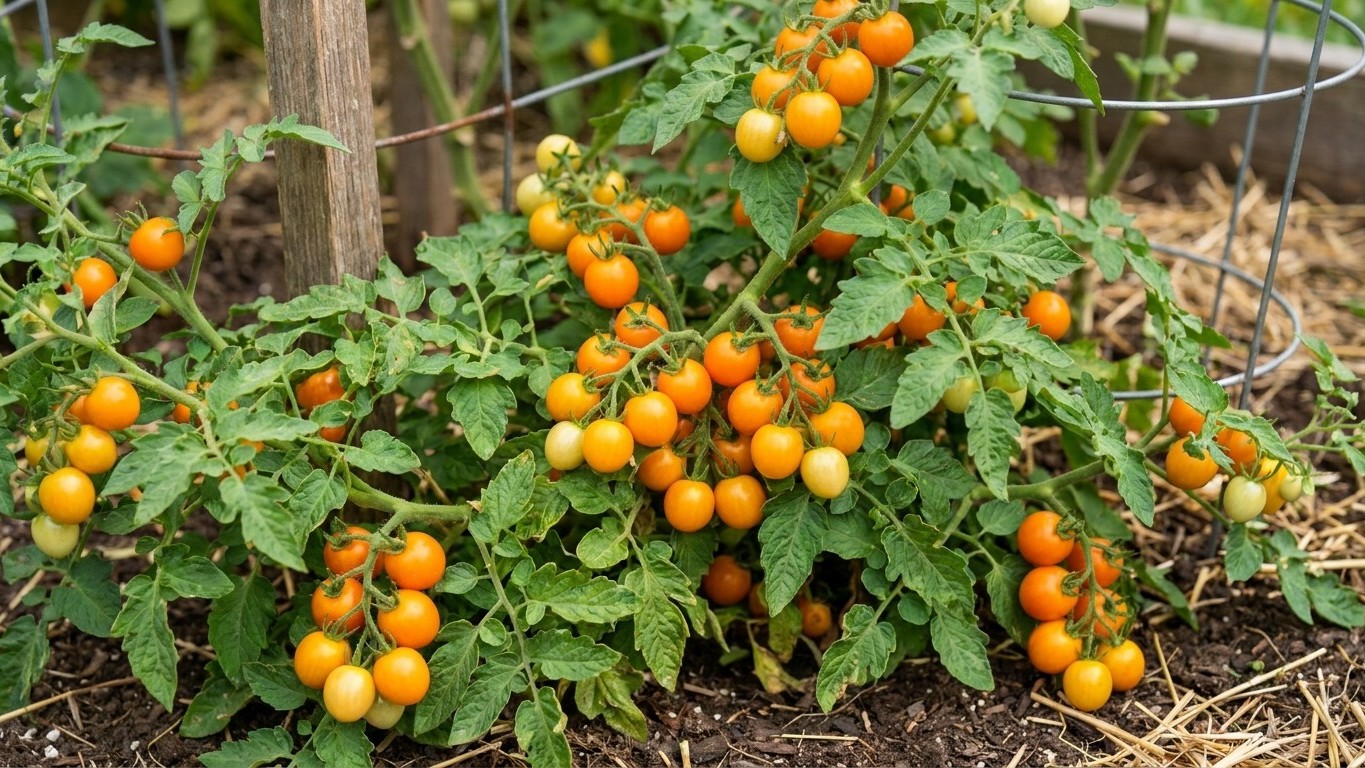

Indigo Kumquat is a specialty tomato that packs a lot of vine and a lot of small, bright orange fruit into a single indeterminate plant, ripening in about 75 days from transplant. It keeps producing until frost, which means the real question for most gardeners isn’t whether it will ripen once, but whether the calendar gives it enough room to keep going.
What Brandywine actually is
Indigo Kumquat is a specialty-type tomato, not a slicer and not a paste tomato. The fruit runs small, 15 to 20 grams each, roughly the size of a large grape or a small kumquat, which explains the name. The flesh carries a very sweet flavor with a surprising, tart kick of acidity, closer to a snacking tomato than something you’d slice for a sandwich.
The habit is indeterminate. That single word changes the whole growing plan: the vine keeps growing and fruiting until frost cuts it down, rather than setting one flush of fruit and stopping. Left alone, that vine sprawls and tangles, so it needs a tall cage or a stake driven in at planting time, not added later once the plant is already six feet of loose growth.
Days to maturity is listed as 75, and that figure is counted from transplant into the garden, not from the day you sowed seed indoors. That distinction matters more than it sounds. If you start seed eight weeks before your last frost, then hold the transplant date to when soil and air have actually warmed, the 75-day clock only starts ticking once the seedling goes into the ground. Confuse the two and you’ll expect fruit two or three weeks earlier than the plant is capable of delivering.
Where it ripens in time, and where it is a gamble
Seventy-five days is a middle-of-the-road maturity figure for a tomato, neither an early 55-day rusher nor a slow 90-day beefsteak. Whether that number fits comfortably into a given garden’s season comes down to simple arithmetic, and it’s worth doing on paper before you buy seed or starts.
Start with the frost-free window, the stretch between the average last spring frost and the average first fall frost for your area. From that window, subtract roughly two weeks at the start, because tomato roots sit and sulk in soil that hasn’t warmed past the mid-50s, even if the air feels mild enough for a jacket-free afternoon. Then subtract the 75 days to maturity. Whatever is left over is your actual harvest runway, the stretch of weeks where you’re picking rather than waiting.
In a garden with a long, warm season, that math is forgiving. A frost-free window stretched well past four months leaves plenty of runway after the two-week soil delay and the 75-day clock, meaning the plant reaches its first ripe fruit with a full second half of summer still ahead of it to keep producing. That’s the scenario where an indeterminate specialty tomato like this one earns its keep: weeks and weeks of small orange fruit rather than one anxious rush before the weather turns.
In a garden where the frost-free season runs closer to three months, the same subtraction leaves a much thinner margin. Two weeks lost to cold soil, 75 days to first fruit, and a frost-free window that isn’t dramatically longer than that total doesn’t leave much cushion for a cool spring, a late transplant, or a few overcast weeks that slow ripening. That’s not the same as saying the variety can’t be grown there. It means the grower needs to compress the front end: warm the soil early with black plastic or a cold frame, harden off transplants aggressively, and treat the last two or three weeks of the season as bonus fruit rather than a guarantee.
Exact frost-date figures for specific weather stations aren’t published here, so the honest move is to pull your own local frost-free window from your state extension service or a regional almanac, then run the subtraction above. The arithmetic is the tool. Once you have your own numbers, the answer to “does this variety ripen here” is a fact you can check yourself rather than a guess borrowed from a seed catalogue written for a different climate entirely.
The two ways a season goes wrong
A frost-free window that looks generous on paper can still fail a tomato crop in two different ways, and a frost table alone won’t warn you about either one.
In cooler, short-summer regions, the problem isn’t frost timing so much as accumulated warmth. A garden can have a technically long frost-free window and still deliver a string of cool nights that never quite push the plant into vigorous growth. Tomatoes stop setting fruit when nighttime temperatures drop below 50F, regardless of how many frost-free days remain on the calendar. A 75-day variety planted into a season with plenty of frost-free days but a run of chilly nights early or late in that window can still end up with fewer ripe fruit than the maturity number suggests.
In hot, long-summer regions, the failure runs the opposite direction. Once daytime temperatures climb above roughly 86F, tomato pollen turns sterile and blossoms drop without setting fruit, which is why gardeners across the Deep South and the desert Southwest don’t try to run one unbroken season. They plant a spring crop that finishes before the worst heat arrives, let the plants coast or come out during the hottest stretch, then set out a second round for an autumn harvest once temperatures ease.
For a 75-day variety like this one, the cold-night limit is the more relevant risk. Its maturity window sits in the middle of the calendar, not so early that it always beats the heat, and not so late that a short northern season is automatically doomed. The practical takeaway is to watch nighttime lows in spring and fall more closely than the daytime high, since that’s the threshold most likely to cost this particular plant its fruit set.
What it resists, and what it does not
No disease resistances are published for Indigo Kumquat. That’s a plain fact worth stating rather than glossing over, because plenty of tomato descriptions imply toughness through vague language about “vigorous” or “hardy” plants without ever naming an actual resistance code.
Some tomato varieties carry catalogue codes for resistance to fusarium wilt, verticillium wilt, or nematodes, sometimes graded as high resistance and sometimes as intermediate resistance. That distinction matters when it’s present: intermediate resistance means the plant slows a disease’s progress and often produces a partial crop despite infection, not that it escapes the disease entirely. Since none of that applies here, there’s no such cushion to lean on.
Without published resistance, the practical risk sits with common soil-borne tomato diseases wherever they’re present locally, and with the fungal leaf diseases that thrive in humid, poorly ventilated plantings. That doesn’t mean the plant is fragile. It means the usual defenses do the work instead of a bred-in resistance: rotate tomatoes to a bed that hasn’t grown them in the past three years, space plants for airflow, and avoid overhead watering that keeps foliage wet into the evening. None of that is unique to this variety, but it carries more weight here precisely because there’s no genetic backup plan listed on the tag.
Growing it without the usual mistakes
The indeterminate habit is the single fact that should shape every other decision made about this plant. Unlike a determinate tomato that sets one concentrated flush of fruit and finishes, Indigo Kumquat keeps producing new growth and new fruit clusters until frost stops it, which means the support structure has to be built for a plant that’s still climbing in August, not just in June.
A tall cage, at minimum four to five feet, or a sturdy stake set eight to twelve inches into the ground at planting time, keeps the sprawling vine off the soil where fruit rots and disease splashes up from wet ground. Adding support later, once the plant already has three feet of unsupported growth, usually means fighting brittle stems and snapped branches instead of gently training new growth as it appears.
Spacing needs room for that continued growth too. Crowding an indeterminate vine that’s still expanding in late summer traps humidity between plants, which feeds exactly the fungal leaf diseases that matter more here given the lack of published resistance.
On feeding, the mistake this variety’s long production window invites is either stopping too early, which starves a plant still setting fruit in September, or never tapering off, which pushes leafy growth instead of fruit as the season winds down. A modest, steady feeding through midsummer, tapering as nights cool and the plant’s energy naturally shifts toward ripening rather than expanding, matches the rhythm of a tomato that’s built to keep going rather than finish in one burst.
Common questions
Is Indigo Kumquat the same as an indigo-colored tomato?
No. Despite the “Indigo” in the name, the fruit color listed is orange, not the dark purple-blue skin associated with some other indigo-series tomatoes. The name here refers to the variety, not the color of the ripe fruit.
Can I grow it in a container?
Since it’s indeterminate and keeps growing until frost, it needs a large container, a tall cage or stake, and more consistent watering than a compact determinate variety would, since containers dry out faster and this plant keeps demanding resources all season.
Save any personal detail about specific past use, since none is claimed for this fact set.
How many days until I see a ripe fruit after transplant?
The catalogue figure is 75 days from transplant, not from seed-starting. Count from the day the seedling goes into the garden soil, after that soil has had roughly two weeks to warm.
Does it need a special fertilizer because it has no disease resistance listed?
No fertilizer substitutes for resistance genetics. The practical response to an unlisted resistance profile is crop rotation, airflow, and avoiding wet foliage, not a particular feeding schedule.