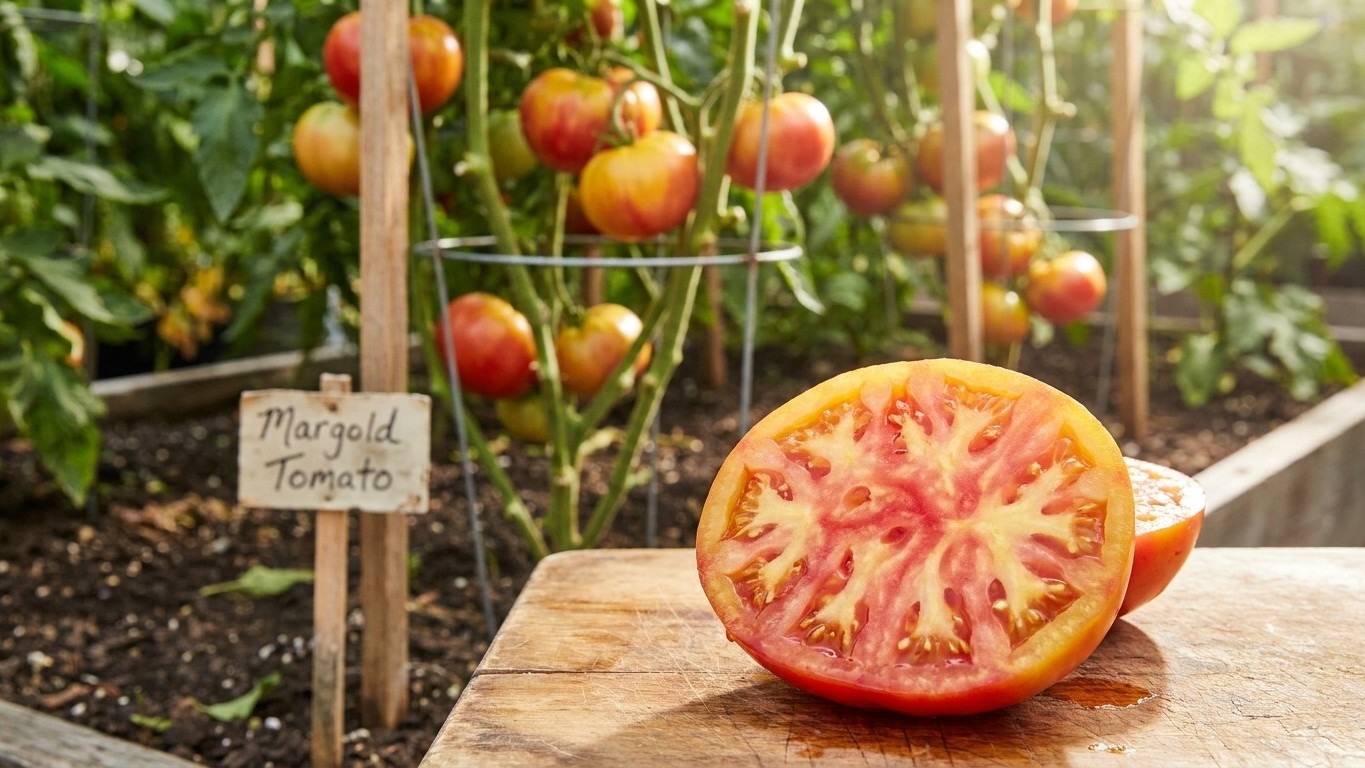

Margold is an indeterminate beefsteak tomato that ripens in 75 days from transplant, produces 7 to 10 ounce bicolor fruit with soft, meaty flesh built for slicing, and needs a tall cage or stake because the vine won’t stop growing until frost takes it. Whether that 75-day clock gives you a real harvest or a race against the calendar depends entirely on where you garden.
What Brandywine actually is

Margold sits in the beefsteak category, which means large, dense-fleshed fruit meant for the cutting board rather than the canning pot. The catalogue lists 75 days to maturity, and that figure is counted from transplant, not from the day you sowed seed indoors. The distinction matters because seed-to-transplant typically eats another five to seven weeks before that clock even starts, and gardeners who confuse the two end up disappointed when their “75-day tomato” takes four months to show color.
The plant habit is indeterminate, which means it keeps producing new flower clusters and new fruit along a vine that never tops out on its own. That’s the opposite of a determinate variety that sets one flush and finishes. An indeterminate beefsteak like Margold needs serious vertical support, a stake driven deep or a cage built for a plant that can top six feet, because a sprawling unsupported vine of this size buries fruit in foliage and invites rot.
The fruit itself is bicolor, meaning the skin and flesh carry a mix of red and yellow rather than a solid color, and the catalogue describes the flesh as very soft with excellent, sweet flavor and a meaty texture. That softness is a feature at the table and a liability in transport. This is a backyard slicer, not a variety bred to survive a trip to market.
Where it ripens in time, and where it is a gamble
Seventy-five days from transplant is a middle-of-the-road number for a beefsteak, but the math that decides whether it fits your season isn’t just about counting to 75 on a calendar. It’s about what’s left over after you account for two things a seed packet never mentions: how long you have to wait before soil is warm enough to transplant safely, and how many frost-free days remain after that.
Here’s how to run the arithmetic for your own yard. Start with your area’s frost-free window, the stretch between the average date of last spring frost and average date of first fall frost. Subtract roughly two weeks from the front end, because tomato transplants sulk or die in cold soil and most gardeners wait until nighttime lows are reliably above the mid-50s before setting plants out. Then subtract the 75 days to maturity. Whatever number remains is your cushion, the days you actually have to let fruit size up, ripen fully, and keep picking before frost ends the season.
In regions with a long frost-free season, that cushion is generous. Across much of the Gulf Coast and the Southeast, frost-free stretches commonly run past 240 days, which leaves Margold three months or more of harvest window after maturity is reached. Growers there aren’t fighting the calendar; they’re managing heat instead, which the next section covers.
The picture tightens fast as you move north. In much of the Upper Midwest and northern New England, the frost-free window can run closer to 120 to 140 days in a typical year. Subtract two weeks for soil warm-up and 75 days to maturity, and a grower is left with a cushion measured in a few weeks rather than months. That’s still workable, but it leaves little room for a cool, wet spring that delays transplanting, or an early fall frost that arrives ahead of average. A short-season grower who starts transplants a week late, or plants into soil that’s still too cold, can watch that cushion disappear entirely.
Mountain valleys and high-elevation gardens are the tightest case of all. Frost-free windows under 100 days aren’t rare in parts of the Rockies and the northern high plains, and in those spots the math simply doesn’t clear 75 days with any margin left for actual harvest. That doesn’t make Margold impossible there, but it does mean the grower needs every available trick, cloches, row cover, black plastic mulch to warm soil faster, to manufacture the days the open calendar won’t give them.
No single national frost-date figure applies evenly across a country this size, and this page doesn’t publish station-specific dates. The reliable move is to pull your own area’s average last and first frost dates from a local extension office or a regional climate summary, then run the subtraction above with your own numbers.
The two ways a season goes wrong
A frost-free window long enough on paper doesn’t guarantee a good tomato season, because two other limits operate independently of frost dates entirely.
The first is accumulated warmth. A season can be frost-free for 150 days and still be too cool, night after night, to let fruit set. Tomato flowers generally fail to set fruit when nighttime temperatures drop below 50°F, because pollen doesn’t transfer properly in cold conditions. Coastal Pacific Northwest gardens and high-elevation sites often hit this wall: the frost date is comfortably distant, but a run of 45°F nights in early summer stalls fruit set for weeks, quietly eating into the harvest window that looked fine on the calendar.
The second limit sits at the opposite end of the thermometer. Once daytime temperatures climb past roughly 86°F, tomato pollen becomes sterile and blossoms drop without setting fruit. This is why experienced growers across the Deep South and the desert Southwest don’t plant one long season, they plant a spring crop timed to finish before the worst heat arrives, then a second planting in late summer timed to fruit as temperatures ease into fall. A tomato that “should” have three months of harvest window on frost math alone can lose six or eight weeks of that window to a July and August that are simply too hot for pollen to function.
For a 75-day beefsteak like Margold, the cold-night limit is the one that matters most in northern and high-elevation gardens, since a tight frost-free window is often paired with cool nights early in the season. In the hottest parts of the country, the heat-sterility limit is the bigger risk, and a spring-then-fall approach fits this variety’s timing better than trying to push one continuous crop through a scorching midsummer.
What it resists, and what it does not
Margold carries three published disease resistances, and the catalogue grades all three as high: Verticillium Wilt, Tomato Mosaic Virus, and resistance to Leaf Molds A through E. High resistance means the plant strongly limits infection and symptom development from those specific pathogens, which is a real, useful trait in a beefsteak that otherwise offers a wide, soft-skinned target for disease.
What matters just as much is what isn’t on that list. No Fusarium wilt resistance is published for this variety, no resistance to early blight or late blight, and no nematode resistance. Those are separate diseases with separate causes, and high resistance to Verticillium wilt does nothing to protect the plant against them. A grower working in soil with a history of Fusarium, or in a humid climate where early blight is a yearly visitor, needs to manage those risks through crop rotation, mulching, and airflow rather than counting on the plant’s genetics to carry the load.
It’s also worth being precise about what “resistance” means even where it is published. High resistance is not immunity. A resistant plant can still become infected under heavy disease pressure; it simply slows the disease down and usually keeps symptoms milder than a fully susceptible variety would show. Treat these three ratings as a real advantage, not a guarantee that the plant will sail through a season untouched.
Growing it without the usual mistakes
Because Margold is indeterminate, the support plan has to be built for a plant that keeps growing all season rather than one that sets fruit and stops. A single tomato cage sized for a compact determinate variety won’t hold this vine by midsummer. A stake driven at least a foot into the ground, or a heavy-gauge cage built tall, gives the plant something to lean on as it keeps adding height and weight through the season.
Spacing needs to account for that same sprawling habit. Crowding an indeterminate beefsteak tightens airflow around the very soft, meaty fruit this variety is known for, and poor airflow around dense foliage is exactly the condition that favors the fungal diseases this variety has no published resistance to, like early blight. Give the plant room, and prune away some of the lower leaves as the season progresses to keep air moving near the soil line.
Feeding should taper off as fruit begins to size up rather than continuing at full strength all season. Heavy nitrogen late in the season pushes leafy growth at the expense of fruit set and can also thin the plant’s disease resistance from the inside out, since a lush, soft plant is a more attractive target than a hardened one.
The timing mistake this specific variety invites is starting transplants too early and then setting them out before soil has genuinely warmed. A 75-day clock feels like it leaves plenty of room to wait for good conditions, and it does, so there’s little reason to rush cold, stressed transplants into the ground just to save a week. A transplant that sits and sulks in cool soil for ten days gains nothing over one planted ten days later into soil that’s actually ready.
Common questions
Is Margold a determinate or indeterminate tomato?
Indeterminate. The vine keeps growing and setting new fruit until frost stops it, which is why it needs a tall stake or cage rather than a small cage sized for a compact bush variety.
How many days does Margold take to ripen?
The published figure is 75 days, counted from the date of transplant into the garden, not from the date the seed was sown.
Does Margold resist tomato diseases?
It carries high resistance to Verticillium Wilt, Tomato Mosaic Virus, and Leaf Molds A through E. No resistance to Fusarium wilt, early blight, late blight, or nematodes is published for this variety, so those risks still need to be managed through good garden practice.
Can Margold be grown in a short-season climate?
It can if the frost-free window after accounting for soil warm-up leaves a real cushion beyond the 75 days to maturity. In areas with frost-free windows under roughly 100 days, that cushion is thin to nonexistent, and season-extension methods like row cover or black plastic mulch become necessary rather than optional.