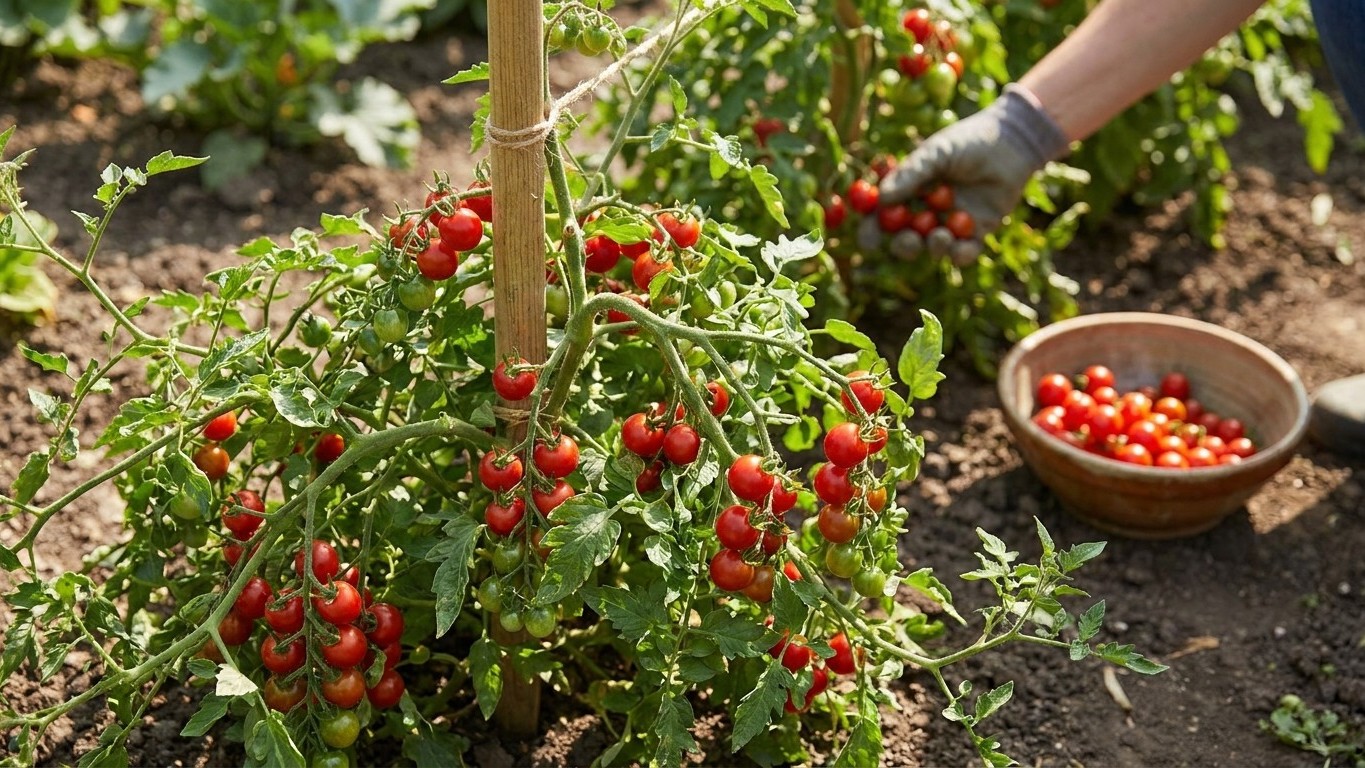

Mochi is a cherry tomato that ripens in about 60 days from transplant, produces small 20–25 gram fruit on an indeterminate vine, and holds up well through a full season of steady picking. That maturity window puts it within reach of nearly every U.S. garden, but the vine’s habit and its narrow disease resistance mean the real work starts after the fruit sets.
What Mochi actually is

Mochi is a cherry-type tomato, bred for the bite-sized fruit that goes straight into salads or gets eaten off the vine while you’re weeding something else. The catalogue lists its fruit weight at 20–25 grams, small enough that a single plant in full production can fill a bowl in one pass down the row.
The habit is indeterminate, which is the fact that decides how you build your garden around it. An indeterminate vine doesn’t stop at a set height or a single flush of fruit; it keeps growing, flowering, and setting new tomatoes until frost cuts it down. That means Mochi needs a tall cage or a stake tied up as the season goes, not the short wire ring that works fine for a compact determinate variety. Skip the support and you get a sprawling mat of vine and fruit sitting on wet soil, which invites rot faster than almost anything else you could do wrong.
Days to maturity is listed at 60, and that figure is counted from transplant, not from the day you sowed seed indoors. If you started seed eight weeks before your last frost and moved seedlings out on schedule, the 60-day clock starts the day the plant goes into the ground, not before. Confusing the two bases is the single most common reason home gardeners think a variety “ran late” when it actually performed exactly as advertised.
In the kitchen, Mochi is built for salads and snacking, nothing more elaborate. It’s not the tomato you’re reaching for to make sauce by the quart; it’s the one you toss whole into a bowl of greens or eat standing at the counter.
Where it ripens in time, and where it is a gamble
Sixty days from transplant is a short clock as tomatoes go, which is exactly what makes Mochi forgiving in places where a 90-day beefsteak would be a real risk. The way to check whether it fits your garden is to do the arithmetic yourself, in this order: start with your local frost-free window, the number of days between your average last spring frost and your average first fall frost. Subtract roughly two weeks, because tomato transplants sit and sulk in cold soil and won’t really start growing until the ground has warmed past the low 50s. Then subtract the 60 days Mochi needs to reach first ripe fruit. What’s left over is your picking margin, the stretch of warm weather you get to actually harvest before frost ends the season.
In a garden with a long, warm frost-free season, that margin runs into months, and Mochi will keep producing right up until the first hard freeze because of its indeterminate habit. In a garden with a short frost-free window, the same arithmetic can leave a picking margin of only a few weeks, and a few weeks of cherry tomatoes off an indeterminate vine is a modest return for a full season of staking and tying.
Specific frost dates vary block by block, let alone state by state, and no single figure published here can stand in for your own microclimate. What holds true everywhere is the shape of the trade-off: gardens with short growing seasons should count on Mochi’s short maturity to buy them margin, but they should also expect that margin to be measured in weeks rather than months. Gardens with long, mild seasons don’t need to worry about the arithmetic at all, since even a slow start still leaves plenty of season on the other side. If you’re not sure which category you fall into, your county extension office or a local frost-date table will give you the last-frost and first-frost averages for your area, and from there the subtraction above takes five minutes.
One practical wrinkle: because Mochi keeps setting new fruit all season, a short picking margin doesn’t just mean fewer tomatoes, it means the plant is cut off mid-cycle, with green fruit still ripening on the vine when frost arrives. Gardeners in shorter-season areas sometimes pull green fruit before a frost and ripen it indoors on a windowsill rather than lose it outright, though that’s a fallback, not the plan.
The two ways a season goes wrong
A long frost-free window looks reassuring on paper, but it doesn’t guarantee a good tomato season, because two other limits sit outside what any frost table measures.
In northern gardens, the frost-free window can be long enough on the calendar while the accumulated warmth underneath it stays short. Tomatoes need consistently warm nights to set fruit, and when nighttime temperatures drop below 50°F, pollen doesn’t perform and blossoms drop without setting. A cool, cloudy stretch in early summer can quietly erase weeks of what looked like margin on the calendar.
In southern and Gulf Coast gardens, the opposite failure shows up in the height of summer. Once daytime temperatures push past roughly 86°F, tomato pollen becomes sterile and fruit set stalls out, sometimes for weeks at a stretch. That’s why experienced growers in hot climates plant a spring crop that finishes before the worst heat, then a second, autumn crop timed to set fruit as temperatures cool back down, rather than expecting one plant to produce straight through July and August.
For a variety with Mochi’s short, 60-day clock, the cold-night problem matters more than the heat-sterility problem in most parts of the country. Because it ripens fast, it’s well suited to slipping a crop in before a northern garden’s brief warm stretch closes, or getting a jump on spring before southern heat shuts pollination down. Gardeners in the hottest zones should still plan around a summer gap, but Mochi’s short maturity makes it easier to schedule around than a slower variety would be.
What it resists, and what it does not
The published resistance for Mochi covers Leaf Molds, graded A through E, at High resistance. That’s a meaningful, specific claim: it means the plant has a strong, verified ability to resist infection across that full range of leaf mold strains, not a general hardiness that happens to include mold.
What matters just as much is what isn’t on that list. No other disease resistance is published for this variety, no early blight, no late blight, no fusarium or verticillium wilt, no nematode resistance. That’s not a guess or an omission on this page; it’s simply what the catalogue data states, and stating anything more protective than that would be misleading. Growers who’ve dealt with fusarium wilt or late blight in their soil before should treat Mochi as fully exposed to those pressures, exactly as they would treat an heirloom with no listed resistance at all.
Leaf mold thrives in humid, poorly ventilated conditions, so the resistance Mochi does carry is worth leaning on: good airflow around the indeterminate vine, achieved through steady pruning of lower leaves and wide spacing, reduces the humid microclimate where mold problems start in the first place, even beyond what the genetic resistance alone provides. But airflow won’t do anything for blight or wilt. In gardens with a known history of those diseases, crop rotation and resistant rootstock (if grafting) remain the tools that actually apply, since Mochi’s own resistance package doesn’t cover them.
Growing it without the usual mistakes
Because Mochi is indeterminate, the plant treats a single season as one long project rather than one flush of fruit, and the support has to be built for that from the start. A short tomato cage bought for a determinate patio variety will be outgrown by midsummer; a tall stake, at least 6 feet, or a sturdy cage of similar height, tied and re-tied as the vine climbs, is the realistic minimum.
Spacing matters more with an indeterminate cherry than gardeners often expect, since the plant keeps adding foliage all season and a tight row turns into a wall of leaves by August. Give it the room a full-season vine needs, not the room a young transplant looks like it needs in June.
On feeding, the mistake this variety invites is straightforward: pushing nitrogen late in the season to keep the plant looking lush. That produces more leaf at the expense of fruit set and ripening, which runs directly against what you want from a plant that’s supposed to be setting cherry tomatoes continuously until frost. Ease off nitrogen once the first fruit sets and let the plant put its energy into the crop it’s already carrying.
On harvest, the catalogue’s own guidance is specific: pick regularly and gently, since overripe cherry tomatoes split and bruise easily on a vigorous vine, but let fruit hang on the plant as long as it reasonably can before picking, because the sweetness builds in those last days on the vine. Pull them too early for convenience and you trade flavor for a slightly tidier bowl.
Common questions
Is Mochi tomato a determinate or indeterminate variety?
Indeterminate. The vine keeps growing and setting new fruit until frost, which is why it needs a tall cage or stake rather than a short cage or no support at all.
How many days does Mochi tomato take to ripen?
About 60 days, counted from the day of transplant into the garden, not from the date you sowed seed indoors.
Does Mochi tomato resist blight?
No blight resistance is published for this variety. Its only listed resistance is to Leaf Molds A through E, rated High. Treat it as unprotected against early blight, late blight, and soil-borne wilts.
What is Mochi tomato best used for in the kitchen?
Salads and snacking. It’s a small, 20–25 gram cherry tomato meant to be eaten whole rather than cooked down into sauce.