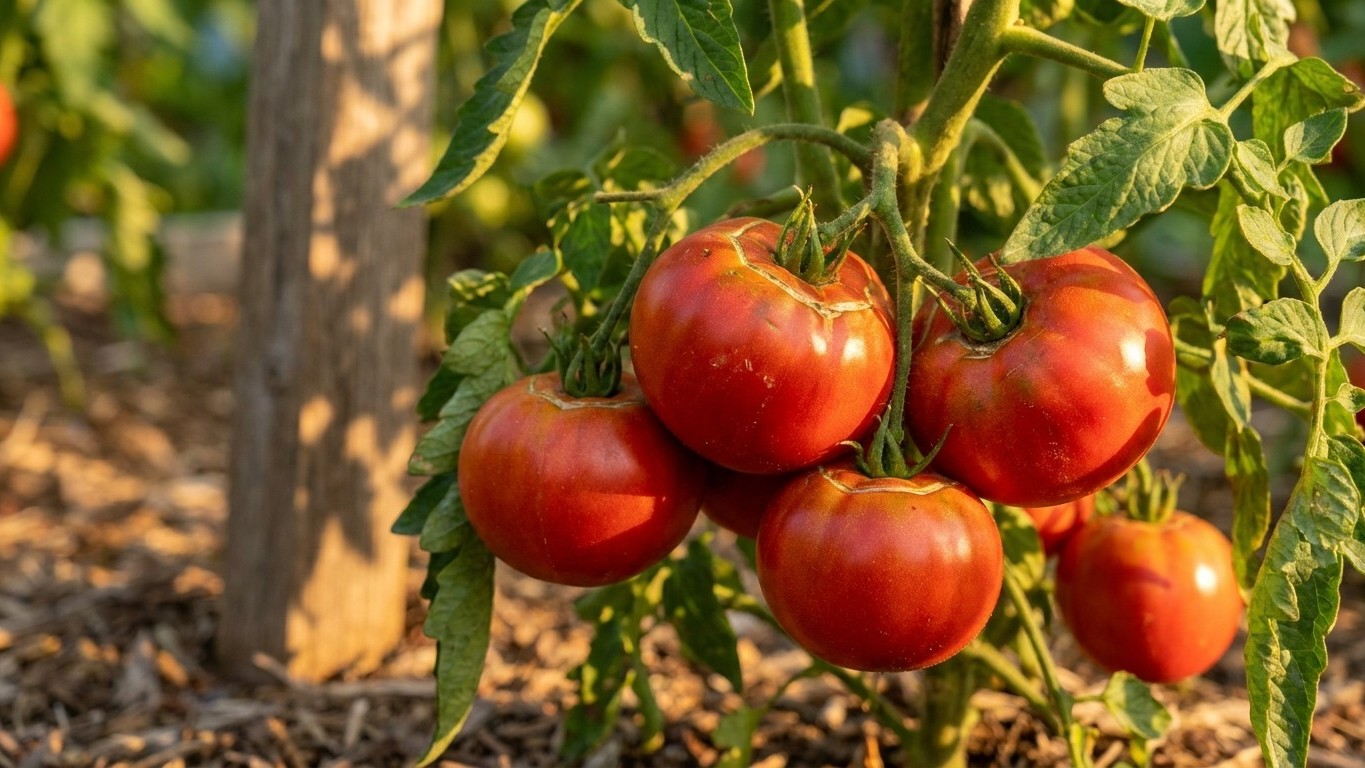

Moskvich is a compact, cold-tolerant heirloom slicer that ripens in about 60 days from transplant, which puts it among the faster main-crop tomatoes a home gardener can grow. That speed is the whole story here: it changes where the variety works, what it needs staked, and which growing mistakes actually matter for this specific plant rather than for tomatoes in general.
What Moskvich actually is
Moskvich is an heirloom, indeterminate tomato that produces red fruit weighing 4 to 6 ounces, sized for slicing rather than canning or snacking. Indeterminate means the vine keeps growing and setting fruit until frost stops it, unlike a determinate plant that grows to a fixed size and ripens most of its crop in one flush. That single fact decides the support you need: a short cage or unstaked sprawl won’t hold a plant that is still climbing in September.
The catalogue figure that matters most is 60 days to maturity, and that count starts at transplant, not at the day you sowed seed indoors. Seed started six to eight weeks before your last frost, then moved outside after the soil has warmed, is the clock the 60 days is measured against. Confuse that with days from sowing and you’ll expect ripe fruit weeks before it’s realistic.
The fruit itself is described with rich flavor, which for a red heirloom this size usually means it’s grown for the table rather than for shipping or shelf life. Plan on eating or preserving it close to harvest. Nothing in the variety’s profile suggests it holds up to rough handling, so treat it like a variety you pick a few days before you need it, not one you stockpile.
Where it ripens in time, and where it is a gamble
Sixty days from transplant is short by tomato standards, most main-crop slicers run 70 to 85 days, and that gap is the whole reason Moskvich gets planted where longer-season heirlooms struggle. But short maturity doesn’t erase the arithmetic every gardener has to do. It just makes the math friendlier.
The calculation runs the same way everywhere: start with your area’s frost-free window, the number of days between your average last spring frost and average first fall frost. Subtract roughly two weeks, because tomato transplants sit in the ground doing very little until the soil itself warms into the 60s, even if the air is technically frost-free. Then subtract the 60 days to maturity. What’s left is your margin, the number of days you can actually pick fruit before frost ends the season, or the number of days you’re short if the total comes out negative.
Gardeners can check their own local frost dates against the 30-year climate normals published by NOAA’s National Centers for Environmental Information, and cross that against their USDA Plant Hardiness Zone from the USDA Agricultural Research Service map, since both change the picture below.
Short-season regions
In the colder end of USDA Zones 3 and 4, typical frost-free windows run around 100 to 120 days. Subtract two weeks for soil warm-up and the 60 days to maturity, and a gardener in that band is usually left with something like three to five weeks of actual harvest before frost, tight, but workable, and a large part of why a fast heirloom like this one gets grown at all in short-summer states.
Mid-length seasons
Zones 5 and 6, which cover a wide swath of the Midwest, mid-Atlantic and interior Northeast, typically see frost-free windows in the 140 to 160 day range. Run the same subtraction and the margin stretches to eight or nine weeks, comfortable room for a full harvest and even a second wave of fruit before the vine finally quits.
Long, hot seasons
Zones 7 through 10, across much of the South, Gulf Coast, and West Coast, often have frost-free windows of 200 days or more, in the warmest pockets, effectively frost-free year-round. Here the limiting factor isn’t frost at all; it’s the heat gap described next.
| Region (USDA zone) | Typical frost-free window | Approx. harvest margin for Moskvich |
|---|---|---|
| Zones 3-4 | 100-120 days | 3-5 weeks |
| Zones 5-6 | 140-160 days | 8-9 weeks |
| Zones 7-10 | 200+ days | Limited by summer heat, not frost |
The two ways a season goes wrong
A long frost-free window on paper doesn’t guarantee a good crop, and Moskvich’s short maturity shifts which failure mode actually matters for this variety.
In cold-summer regions, the frost date isn’t the only ceiling. Tomatoes need accumulated warmth, not just frost-free days, to flower and set fruit, and nights that regularly drop below 50°F will stall pollination even when the calendar says the season is technically open. Because Moskvich only needs 60 days, it’s better positioned than a long-season heirloom to dodge this problem, most of its fruiting window falls in the warmer heart of summer rather than depending on marginal early or late weeks. This is the smaller risk for this particular variety.
The bigger risk, especially for southern growers, sits at the other end of the thermometer. Above roughly 86°F, tomato pollen becomes sterile and blossoms drop without setting fruit, which is why a long, hot growing season doesn’t translate into one long harvest. Growers in the Deep South and similar climates typically get a spring crop before the heat peaks and a second autumn crop once temperatures ease, rather than continuous fruiting straight through July and August. Moskvich’s speed is an asset here: a 60-day plant can slip a full crop into the spring window before the heat shuts pollination down, then go again for a fall planting, something a slower 80-day heirloom often can’t manage twice in one year.
What it resists, and what it does not
No disease resistance is published for Moskvich. That’s a plain fact worth stating rather than glossing over: this variety carries none of the resistance codes seed catalogues use for tomatoes bred against verticillium wilt, fusarium wilt, or nematodes, the kind of shorthand you’ll see as V, F, or N on other varieties. Heirlooms often skip that breeding entirely, since resistance genes were mostly introduced through modern hybridization, and Moskvich’s age and open-pollinated status mean it wasn’t selected for those traits.
That doesn’t mean the plant is defenseless, but it does mean the defense has to come from the gardener, not the genetics. Crop rotation matters more here than it would for a resistant hybrid: avoid planting Moskvich, or any tomato, in soil that grew tomatoes, potatoes, peppers, or eggplant in the last two to three years, since those crops share the soil-borne pathogens that hit tomatoes hardest. Good airflow from adequate spacing, drip irrigation instead of overhead watering, and mulch to keep soil-borne spores from splashing onto lower leaves all substitute for resistance the plant simply doesn’t have.
If early blight or fusarium shows up in your garden most years, that’s a real consideration against choosing this variety over a resistant hybrid, not a reason to avoid tomatoes altogether, just an honest trade-off between heirloom flavor and built-in protection.
Growing it without the usual mistakes
The indeterminate habit is the detail that trips up gardeners who assume a fast, 60-day tomato will behave like a compact determinate bush. It won’t. This vine keeps growing and setting new fruit until frost, which means it needs a tall cage, five to six feet at minimum, or a sturdy stake with regular tying, installed at planting time rather than added later once the plant is already sprawling. A short tomato cage bought for a patio variety will be outgrown within a month.
Spacing should account for that continued growth too: give plants at least 24 to 36 inches apart so the vine has room to lean into a stake without shading its neighbors as the season goes on. Because it keeps fruiting rather than ripening in one flush, feeding needs to continue longer than it would for a determinate variety, but the timing still matters. Heavy nitrogen once fruit has set pushes leafy growth at the expense of ripening fruit, so shift to a lower-nitrogen, higher-potassium feed once the first trusses are sizing up, and keep watering consistent to avoid the blossom-end rot that uneven moisture invites on a heavy-fruiting indeterminate.
The mistake this variety specifically invites is treating the 60-day figure as the end of the story. Sixty days gets you the first ripe fruit; because it’s indeterminate, harvest then continues in waves for weeks or months afterward, right up to frost. Gardeners who plan for a single harvest and pull the plant early leave real production on the vine.
Common questions
Is Moskvich tomato determinate or indeterminate?
Indeterminate. The vine keeps growing and producing fruit until frost, which is why it needs a tall cage or stake rather than a short one.
How many days does Moskvich tomato take to ripen?
About 60 days, counted from the date of transplant into the garden, not from when the seed was sown.
Does Moskvich tomato resist blight or wilt?
No disease resistance is published for this variety. Growers should rely on crop rotation, spacing, and good watering practices rather than built-in genetic resistance.
What does Moskvich tomato taste like, and how is it used?
It’s described as having a rich flavor, and its 4 to 6 ounce red fruit is sized and shaped for slicing, best suited to fresh eating rather than canning or paste.