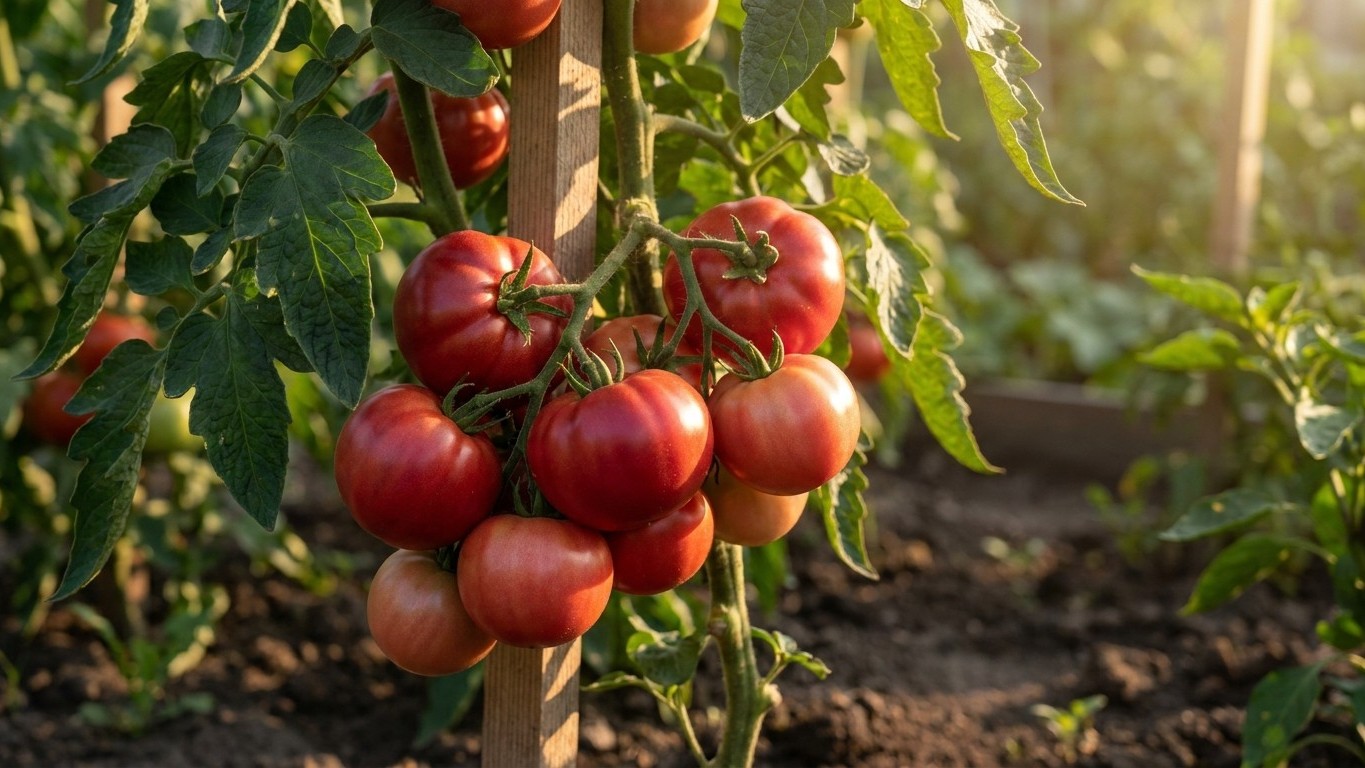

Mountain Merit is a red slicing tomato, bred to crop on a compact, determinate plant in about 75 days from transplant. It picked up an All-America Selections award for combining strong disease resistance with good flavor and heavy production, which makes it a reasonable pick for gardeners who’ve lost a crop to late blight or nematodes before. Whether it fits your season is a separate question, and it depends on your local frost dates more than on the seed packet.
What Brandywine actually is
Three facts decide whether Mountain Merit belongs in a given garden. First, it needs 75 days from transplant to reach a ripe, picking-ready fruit, and that count starts the day the seedling goes into the ground, not the day the seed was sown indoors. Confusing the two bases is the single most common reason gardeners think a tomato “ran late” when it was actually on schedule the whole time.
Second, it’s a determinate plant. That means the vine grows to a set size, stops, and puts most of its energy into ripening a crop that comes in over a relatively short window rather than trickling out fruit all summer the way an indeterminate vine does. Determinate habit is good news for anyone who wants a manageable plant on a stake or in a cage rather than a sprawling six-foot vine needing a trellis system, and it’s also good news if you’re planning to can or freeze a batch of sauce, since a lot of ripe fruit arrives at once instead of two tomatoes a week for three months.
Third, the fruit itself is a standard red slicer, the kind meant for sandwiches, salads, and fresh eating rather than for paste or drying. It’s not a specialty shape or color; it’s a workhorse tomato built to produce reliably where disease pressure is the bigger threat than flavor experimentation.
Where it ripens in time, and where it is a gamble
The math that matters for any tomato is simple, even if nobody writes it down at the seed rack. Start with your area’s frost-free window, the stretch between the last frost in spring and the first frost in fall. Subtract about two weeks at the front end, because tomato roots don’t really get going until the soil has warmed past the mid-50s, and setting transplants out into cold ground just stalls them instead of giving them a head start. What’s left is your usable growing window. Subtract the variety’s days to maturity from transplant, in this case 75, and whatever remains is your actual harvest period, the stretch where you’re picking ripe fruit rather than waiting or racing the calendar.
Run that arithmetic for a garden with a 150-day frost-free window, which is roughly what a lot of the Mid-Atlantic and the mid-South work with. Take off two weeks for soil warm-up and you’re at about 136 usable days. Subtract Mountain Merit’s 75 days and there’s still around 60 days of harvest before the first fall frost shuts things down. That’s a comfortable margin, enough room for a stretch of slow ripening in a cool spell without the season running out on you.
Now do the same math somewhere tighter. A short-season garden in the northern tier, the kind of frost-free window you’d find across much of the Upper Midwest or northern New England, can run closer to 100 to 110 days total. Take off the two-week soil-warming buffer and you’re down to roughly 85 to 95 usable days. Mountain Merit’s 75 days still fits, but the harvest window shrinks to a couple of weeks, which is exactly why a determinate variety with a moderate maturity date is a better bet up there than a slow 90-day indeterminate heirloom. A long-maturing beefsteak simply doesn’t leave enough daylight to work with in that kind of garden.
At the other end, gardens along the Gulf Coast or through the Desert Southwest often have frost-free windows well past 240 days, sometimes with no hard frost at all in a typical year. There, the limit stops being frost altogether and becomes something else entirely, which the next section covers.
The practical takeaway: check your own frost-free window against local records before you plant, run the same subtraction, and treat 75 days as the number that has to fit inside what’s left, not inside the raw calendar.
The two ways a season goes wrong
A long frost-free window on paper doesn’t guarantee a good tomato season, and two limits explain why. In cold-climate gardens, the frost-free count can look generous while the actual accumulated warmth stays thin, because a lot of those “frost-free” days sit in the 50s and 60s rather than the 70s and 80s tomatoes want. Fruit set also stalls outright when nighttime temperatures drop below 50F, since pollen doesn’t perform well in cold air regardless of how many days remain before frost. A short, cool summer can leave a plant sitting with green fruit that never quite finishes.
Move south and the opposite problem takes over. Once daytime highs push past roughly 86F, tomato pollen turns sterile and blossoms drop without setting fruit at all. That’s why growers across the Deep South and much of Texas plant a spring crop timed to finish before the worst of the heat, then a second, separate autumn crop once temperatures ease back down, rather than counting on one unbroken season. The frost-free window down there is long enough for two full plantings, but the middle of it is effectively dead time for tomato production.
For Mountain Merit specifically, the second problem carries more weight than the first. Its 75-day maturity is fast enough to dodge most cold-climate shortfalls, fitting comfortably inside even a tight northern window. But because it’s determinate, the whole crop sets fruit within one relatively narrow window rather than spreading blossoms out over the summer the way an indeterminate vine does. If that single setting window lands in a stretch of 90-plus-degree days, there’s no second wave of flowers later in the season to fall back on. In hot-summer regions, timing the transplant date to finish flowering before the heat peaks, or running it as an early spring crop, matters more for this variety than worrying about a short frost-free calendar.
What it resists, and what it does not
Mountain Merit carries genuine, catalogue-graded resistance to five specific pressures, and the grades aren’t all the same strength. High resistance means the plant substantially limits the disease’s ability to establish and spread. Intermediate resistance means something narrower: the plant slows the disease down and reduces its severity, but it can still develop symptoms under strong pressure. Treating “intermediate” as if it were the same guarantee as “high” is how a gardener ends up surprised by a disease the packet technically listed.
| Pressure | Resistance level |
|---|---|
| Nematodes | High |
| Late Blight | Intermediate |
| Gray Leaf Spot | High |
| Verticillium Wilt | High |
| Tomato Spotted Wilt Virus | High |
That Late Blight sits at intermediate rather than high is worth flagging on its own, since late blight is one of the more destructive tomato diseases in wet, humid regions and can move through a planting fast once conditions favor it. Mountain Merit will slow an outbreak more than an unprotected variety would, but a rainy, humid stretch can still bring symptoms, and fungicide or good airflow practices still matter.
Just as important is what’s absent from this list. No resistance to Fusarium wilt, Early Blight, or Septoria leaf spot is published for this variety. If those are common problems in your soil or region, Mountain Merit doesn’t offer built-in protection against them, and crop rotation or other management steps are still necessary.
Growing it without the usual mistakes
Because Mountain Merit is determinate, it doesn’t need the aggressive pruning and suckering routine that indeterminate vines get. Removing suckers on a determinate plant cuts into the very growth that’s meant to produce this season’s fruit, so a lighter touch, mostly just tidying the lower leaves for airflow, works better than a heavy hand with pruning shears. Support-wise, a sturdy cage or a single stake set at transplant time is usually enough, since the plant stays compact rather than sprawling.
Spacing matters more than it might seem for a compact plant. Crowding determinate tomatoes reduces airflow right when the crop is setting fruit all at once, and that’s exactly the window when a fungal issue like the intermediate-rated late blight can do the most damage. Giving plants two to three feet of breathing room, rather than packing them in tight, pays off specifically for this variety.
On feeding, back off nitrogen once flowering starts. A determinate plant that gets pushed with heavy fertilizer late in the season tends to put energy into leaves rather than the fruit set it’s already committed to, which works against the whole point of a short, concentrated harvest.
The mistake its timing invites is treating it like a single-planting, single-harvest crop in a region with a long enough season for two rounds. Since the whole crop ripens in one flush, staggering two or three transplant dates two to three weeks apart, rather than setting everything out on the same day, spreads the harvest and hedges against a heat spike or a cold snap hitting the entire crop’s flowering window at once.
Common questions
Is Mountain Merit a good choice for a short-season garden?
Its 75-day maturity from transplant is fast enough to fit comfortably inside most short northern windows once the two-week soil-warming buffer is subtracted, which is one of its main advantages over slower-maturing slicers.
Does Mountain Merit need staking?
Yes, though less than an indeterminate variety. A cage or single stake set at transplant is generally enough to support the compact, determinate growth habit.
Is Mountain Merit resistant to all tomato diseases?
No. It carries published high resistance to nematodes, gray leaf spot, verticillium wilt, and tomato spotted wilt virus, plus intermediate resistance to late blight. No resistance is published for Fusarium wilt, early blight, or Septoria leaf spot.
Why did my Mountain Merit plants stop setting fruit in midsummer?
Above roughly 86F, tomato pollen becomes sterile and blossoms drop without setting fruit. Because Mountain Merit is determinate and sets its crop in one concentrated window, a heat spike during flowering can affect the whole crop rather than just part of it.