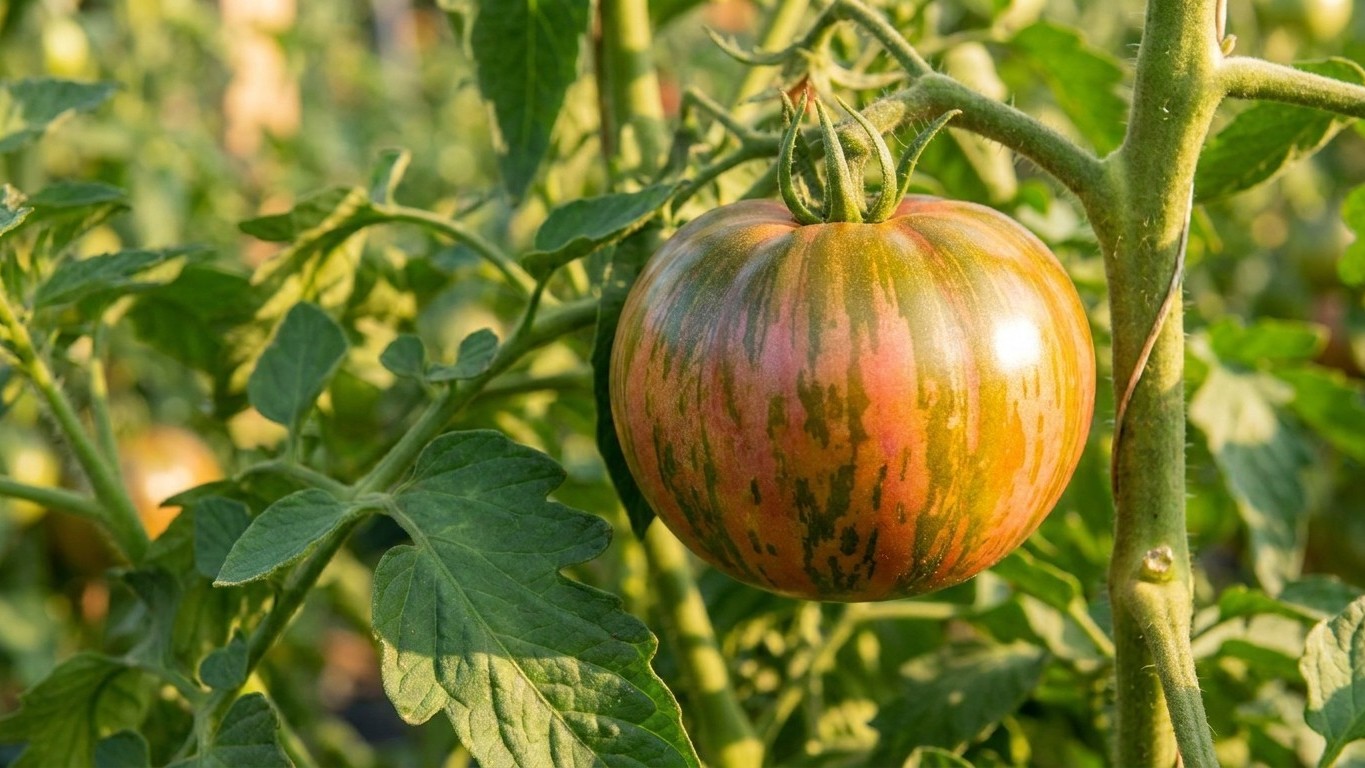

A green tomato is a green tomato, until you know it’s a Pink Berkeley Tie Dye and the streaking is the point, not a warning sign. This is a 70-day indeterminate specialty slicer that stays green (with color breaks) even ripe, so the usual “wait for red” rule doesn’t apply here, and any fruit still hard and pale at frost can go straight into a skillet or a jar instead of the compost pile.
What Pink Berkeley Tie Dye Tomato actually is

Pink Berkeley Tie Dye is a specialty tomato, not a standard red slicer, and that distinction matters before you plant a single seed. The fruit runs 8-12 oz, sized for slicing rather than sauce, and the flesh carries what the catalogue describes as a unique appearance with heirloom-quality flavor, meaning the streaked skin isn’t just cosmetic, it comes paired with the dense, complex taste growers expect from an heirloom-type variety.
The plant is indeterminate. It keeps growing and setting fruit until frost stops it, rather than producing one flush and quitting. That single fact drives most of the support and spacing decisions later in this page, so it’s worth flagging now.
Days to maturity is listed at 70, and that figure is counted from transplant, not from the day you sowed seed indoors. Anyone doing the frost-date math in the next section needs to start the clock from the day the seedling goes into the garden, not from germination. Confusing the two bases is the single most common error gardeners make when they think a variety “should have” ripened by a certain date and it hasn’t.
Where it ripens in time, and where it is a gamble
Seventy days from transplant is a moderate window, not a short one and not a marathon. It sits in the middle of the tomato calendar, which means the deciding factor isn’t the variety itself so much as how much usable season a given garden actually has once you subtract the parts of spring that don’t count.
Here’s the arithmetic every gardener can run for their own address. Start with the frost-free window, the number of days between the average last spring frost and the average first fall frost. Subtract roughly two weeks from the front end, because tomato roots don’t grow much in soil colder than about 60F, so a “frost-free” date on paper isn’t a “safe to transplant” date in practice. Then subtract the 70 days to maturity. What’s left over is the picking window, the stretch of real season where fruit actually ripens on the vine before cold shuts things down.
In a long-season region, the kind of place where the frost-free window regularly stretches past 180 days, that arithmetic leaves a comfortable cushion. Even after losing two weeks to soil warm-up and 70 days to maturity, there’s a month or more of harvest left, room for the plant to keep setting fruit through late summer and still finish a second or third wave before frost.
In a short-season region, the math gets tight fast. A frost-free window closer to 110 or 120 days, common across parts of the northern tier and at higher elevations, leaves maybe 20 to 30 days of actual picking after the soil-warming and maturity deductions. That’s not zero, but it means every week of delayed transplanting or every stretch of cool, cloudy weather eats directly into the harvest rather than into some cushion that doesn’t exist. Gardeners in those zones do better starting seed indoors early enough to set out sturdy, already-flowering transplants the moment soil temperature allows, rather than treating the average last-frost date as a starting gun.
No published frost-date figures for specific stations are cited here, so treat the ranges above as the shape of the problem, not a substitute for checking a local frost-free season length before committing a garden bed to a 70-day variety.
The two ways a season goes wrong
A long frost-free window looks like safety on paper, but it doesn’t guarantee a good crop, and two limits that never show up on a frost calendar explain why.
The first is accumulated warmth. A region can have a generous number of frost-free days and still deliver a cool, cloudy stretch where nights regularly drop below 50F. Tomato flowers won’t set fruit in that kind of cold, even without a frost anywhere near. A grower in a maritime or high-elevation climate can watch a Pink Berkeley Tie Dye plant flower for weeks with nothing to show for it, simply because the nights never warmed up enough to let pollination happen.
The second limit sits at the other end of the thermometer. Once daytime temperatures push above roughly 86F, tomato pollen goes sterile and flowers drop without setting fruit, which is exactly why gardeners in hot southern regions plan around two separate harvest pushes, a spring crop that finishes before the worst heat and a fall crop planted once temperatures ease back down, rather than counting on one unbroken season.
For a 70-day variety like this one, the cold-night limit matters more than the heat limit in most parts of the country, because a mid-length maturity window is easier to squeeze into a heat gap than a long-season 90-day heirloom, but it’s still vulnerable to a slow, cool spring that delays the first fruit set. Southern growers running a spring/fall split should treat 70 days as workable for either window, as long as transplants go in early enough that the maturity clock finishes before the 86F ceiling arrives.
What it resists, and what it does not
The catalogue data for Pink Berkeley Tie Dye lists no disease resistances at all. That’s worth stating plainly rather than glossing over, because plenty of tomato listings carry resistance codes for verticillium wilt, fusarium wilt, or nematodes, and the absence of any such code here means this variety has no documented built-in defense against those common soil-borne problems.
That doesn’t mean the plant is unusually fragile, specialty and heirloom-type varieties frequently carry no resistance package simply because breeding for disease resistance and breeding for the specific streaked appearance and flavor profile are separate goals, and this variety was clearly bred for the latter. But it does mean the usual fallback advice, “check the resistance code before you worry,” doesn’t apply here. There isn’t one to check.
In practical terms, that shifts the disease-prevention work onto the grower rather than the genetics. Crop rotation matters more when a variety has no resistance to lean on, so avoid planting this tomato in soil that grew tomatoes, peppers, or eggplant the previous year if verticillium or fusarium wilt has shown up in that bed before. Watering at the base rather than overhead, and mulching to keep soil-borne spores from splashing onto lower leaves, become the main tools available, since there’s no genetic backstop doing part of the job.
Growing it without the usual mistakes
An indeterminate habit changes the whole game plan compared to a determinate tomato that ripens in one flush and finishes. This plant keeps growing taller and keeps setting new fruit clusters until frost cuts it down, which means the support has to be built for the long haul from day one, not added later once the vine outgrows a flimsy cage.
A tall stake, at least 6 feet, or a heavy-duty cage sized for a full-season indeterminate vine, is the right call at transplant time, not after the plant has already sprawled. Skimping here is the single most common mistake with indeterminate varieties: gardeners install a standard tomato cage sized for a compact bush type, and by midsummer the vine has toppled it, fruit is lying on the ground, and rot sets in on the 8-12 oz fruit that would otherwise have hung cleanly until harvest.
Feeding follows the same long-season logic. Because the plant keeps producing new growth and new fruit clusters into late summer, it needs steady nitrogen and potassium through the season rather than a single early feeding, but that fertilizing should taper off once night temperatures start dropping toward fall and the plant is unlikely to finish new fruit before frost. Continuing to push nitrogen late in the season just grows more vine the plant can’t use, at the expense of ripening what’s already set.
Spacing needs to account for a vine that doesn’t stop, generally 24 to 36 inches between plants when staked, more if left to sprawl. And because the fruit color doesn’t shift dramatically to a clear red at ripeness the way a standard slicer does, harvest timing relies more on gentle-give-to-the-touch and the streaked color pattern reaching full development than on color alone, so a hard squeeze test matters more here than eyeballing color from a few feet away.
Common questions
Is Pink Berkeley Tie Dye Tomato a good choice for a short-season garden?
At 70 days from transplant it sits in the moderate range, workable in a shorter season if transplants go out as sturdy, already-flowering plants the moment soil has warmed, rather than on the calendar date of the average last frost.
What do I do with fruit that’s still hard and green when frost is coming?
Because this variety keeps color streaking even when ripe rather than turning fully red, a green, still-firm fruit at frost can be picked and used the way any green tomato is used, sliced and fried, pickled, or turned into relish, or brought indoors to finish softening at room temperature away from direct sun.
Does this variety need a cage or a stake?
It needs one or the other, sized for a full-season indeterminate vine. A standard compact cage built for a determinate bush type won’t hold this plant once it’s several feet tall and loaded with 8-12 oz fruit.
Is it resistant to common tomato diseases?
No resistances are published for this variety, so growers should rely on crop rotation, base watering, and mulching rather than assuming any built-in protection against verticillium or fusarium wilt.