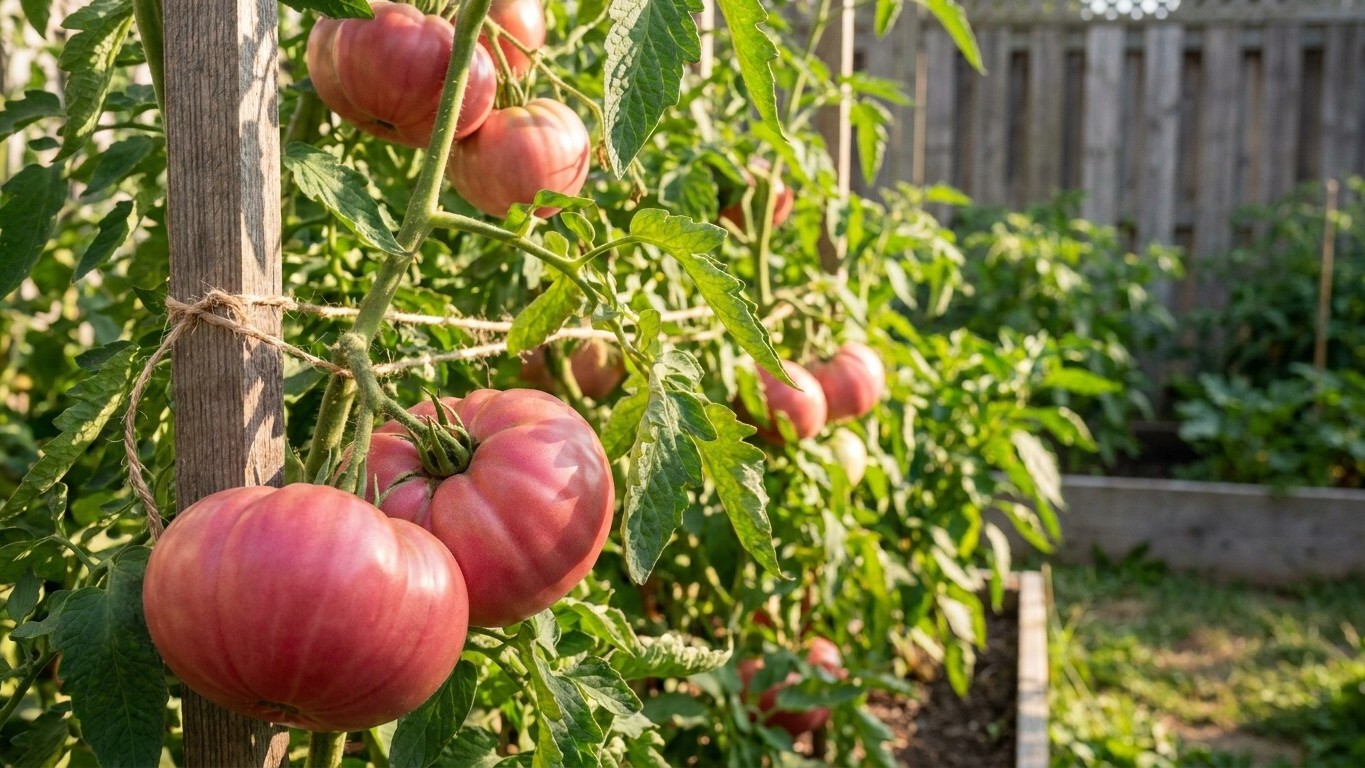

Pink Delicious is an indeterminate slicing tomato that needs about 90 days from transplant to first ripe fruit, and because the vine never stops growing, it keeps setting new trusses right up until frost knocks it down. No disease resistance is published for it, which changes how you plant it more than the flavor description ever will.
What Brandywine actually is
Three facts decide whether Pink Delicious belongs in a given garden. First, the maturity figure: 90 days counted from transplant, not from the day the seed goes into a tray indoors. That distinction matters because a gardener who starts counting from sowing will think the plant is running late when it isn’t; the clock only starts once the seedling is in the ground and growing.
Second, the growth habit. Pink Delicious is indeterminate, meaning the main stem keeps elongating and producing flower clusters all season instead of stopping after one flush. That habit calls for a tall cage or a sturdy stake set at planting time, because retrofitting support onto a six-foot vine in July is a fight nobody wins.
Third, what the fruit is for. This is a slicing tomato with a rich, heirloom-like flavor, good eaten raw and just as good cooked down. It shows up on a BLT or a plate of bruschetta as easily as it goes into a pot of sauce or a savory pie filling. That range is worth knowing before you plant, because a variety built for slicing behaves differently in the kitchen than a paste tomato bred to cook down fast, and it changes how many plants you actually need.
Where it ripens in time, and where it is a gamble
The math a gardener needs is simple once it’s laid out, and it starts with the frost-free window for a specific location, not a regional guess. Take the number of frost-free days a location typically gets, then subtract roughly two weeks at the start of the season, because tomato roots stall in cold soil and transplanting too early just means the plant sits and sulks instead of growing. What’s left after that subtraction is the real growing window, and Pink Delicious needs 90 of those days before the first fruit turns color, with more time needed after that for a real harvest rather than one lonely ripe tomato.
In a region with a long, reliably warm frost-free season, that arithmetic leaves comfortable slack. Subtract two weeks for soil warm-up and 90 days for maturity, and there are still weeks left over for the vine to keep producing before autumn cold shuts it down. That’s the scenario where an indeterminate 90-day tomato earns its keep: not one harvest, but a steady trickle of ripe fruit from midsummer until the first hard frost.
In a region where the frost-free season is short, the same subtraction leaves a much thinner margin. Two weeks for soil warm-up plus 90 days for maturity can eat most of a short window, leaving only a handful of days between the first ripe tomato and the first frost that ends the season. That doesn’t make the variety impossible there; a gardener can push the start with black plastic mulch, row cover, or a greenhouse start indoors well before the outdoor transplant date. But it does mean the margin for error, a cool spring, a late transplant, a cloudy stretch, is much smaller, and a grower in that kind of climate should treat 90 days as a floor, not a target.
The practical move for any reader is to pull up the average frost-free window for their own county or nearest weather station, run this same subtraction, and see what’s left. A variety rated at 90 days isn’t a fixed promise; it’s a number that only means something once it’s checked against a real local calendar.
The two ways a season goes wrong
A long frost-free window on paper doesn’t guarantee a good tomato season, and there are two separate failure modes that a frost date alone won’t show. The first shows up in northern gardens: even when the calendar gives 150 or more frost-free days, the accumulated warmth during that stretch can still run short. Tomatoes need consistently warm nights to set fruit, and when nighttime temperatures drop below 50°F, pollen doesn’t function well and blossoms drop without setting. A cool, cloudy summer can leave a vine loaded with flowers and short on fruit even though frost never touched it.
The second failure mode runs the opposite direction, in hot climates. Once daytime highs push past roughly 86°F for extended stretches, tomato pollen turns sterile and fruit set stalls out, sometimes for weeks at a stretch during the hottest part of summer. That’s why growers in hot regions typically split the year into a spring crop planted early and an autumn crop planted for cooler fall weather, rather than expecting one unbroken season from May through October.
For a 90-day indeterminate variety like Pink Delicious, the cold-night failure matters more than the heat failure in most of the country, simply because its long season means more of its productive window falls in the cooler shoulder months, spring and fall, when night temperatures near that 50°F threshold are the real threat. Gardeners in short-season northern climates should watch nighttime lows as closely as the calendar date of first frost.
What it resists, and what it does not
No disease resistance is published for Pink Delicious. That’s worth stating plainly rather than glossing over, because plenty of modern hybrid tomatoes carry catalogue codes for resistance to verticillium wilt, fusarium wilt, or nematodes, and Pink Delicious simply doesn’t carry any of those listed. That doesn’t mean the plant is unusually fragile; it means the grower gets no built-in insurance against soil-borne disease and needs to compensate with practice instead of genetics.
In practical terms, that shifts the work onto crop rotation and site selection. Tomatoes planted in the same soil year after year build up populations of verticillium and fusarium fungi that live in the ground and infect through the roots; without genetic resistance, the only real defense is not planting tomatoes, peppers, or eggplant in the same bed more than once every three or four years. Raised beds with fresh soil, or containers, sidestep the problem entirely for gardeners without room to rotate.
It’s also worth being honest about what a resistance code would and wouldn’t have meant if one existed. Seed catalogues distinguish high resistance from intermediate resistance, and intermediate only slows a disease’s progress under high pressure, it doesn’t prevent infection outright. Since Pink Delicious carries neither rating, there’s no ambiguity to untangle here, just a plant that needs clean soil and good rotation more than most.
Growing it without the usual mistakes
Because Pink Delicious is indeterminate, the support plan has to go in on planting day, not after the vine gets away from you. A single stake works for a determinate bush tomato that stops growing after one flush, but an indeterminate vine chasing frost all season needs a cage built from concrete reinforcing wire, five or six feet tall, or a stake driven deep and tied to as the plant climbs. Spacing matters too: give each plant at least 24 to 36 inches in the row so the sprawling growth doesn’t shade out its neighbors or trap humidity that invites fungal disease.
Feeding follows a different rhythm than a fast, determinate variety as well. Because the plant is setting fruit continuously rather than in one flush, nitrogen-heavy fertilizer should taper off once flowering starts in earnest; too much nitrogen late in the season pushes leafy growth at the expense of fruit set, which is the last thing an indeterminate vine needs when it’s already racing a long clock.
The mistake its specific timing invites is starting too late and expecting the same fall harvest a short-season variety would give. Because 90 days is a long clock relative to many quicker slicing tomatoes, transplanting Pink Delicious even a week or two behind schedule can cost a meaningful chunk of the productive window before frost. Starting seed indoors on schedule, hardening off properly, and transplanting as soon as the soil has warmed rather than waiting for a perfect calm day all matter more here than with a 60-day variety that has slack to spare.
Once the vine is established and producing, the ongoing job is mostly about keeping it upright and picking regularly. Indeterminate plants left unpicked will slow new fruit set as the vine directs energy toward ripening what’s already there rather than setting new blossoms, so a weekly harvest through the season keeps the plant working at its own pace all the way to frost.
Common questions
Is Pink Delicious a determinate or indeterminate tomato?
It’s indeterminate. The vine keeps growing and setting new fruit clusters through the season until frost stops it, which is why it needs a tall cage or stake rather than a small tomato cage or no support at all.
How many days does Pink Delicious take to ripen?
About 90 days, counted from the day the seedling is transplanted into the garden, not from the day the seed was sown indoors.
Does Pink Delicious resist common tomato diseases?
No resistance is published for this variety. That means no built-in protection against verticillium wilt, fusarium wilt, or nematodes, so crop rotation and clean soil matter more than they would with a resistant hybrid.
What is Pink Delicious best used for in the kitchen?
It’s a slicing tomato with rich, heirloom-like flavor, good eaten raw in salads, bruschetta, and sandwiches like a BLT, and equally suited to being cooked down into sauce or baked into a savory pie.