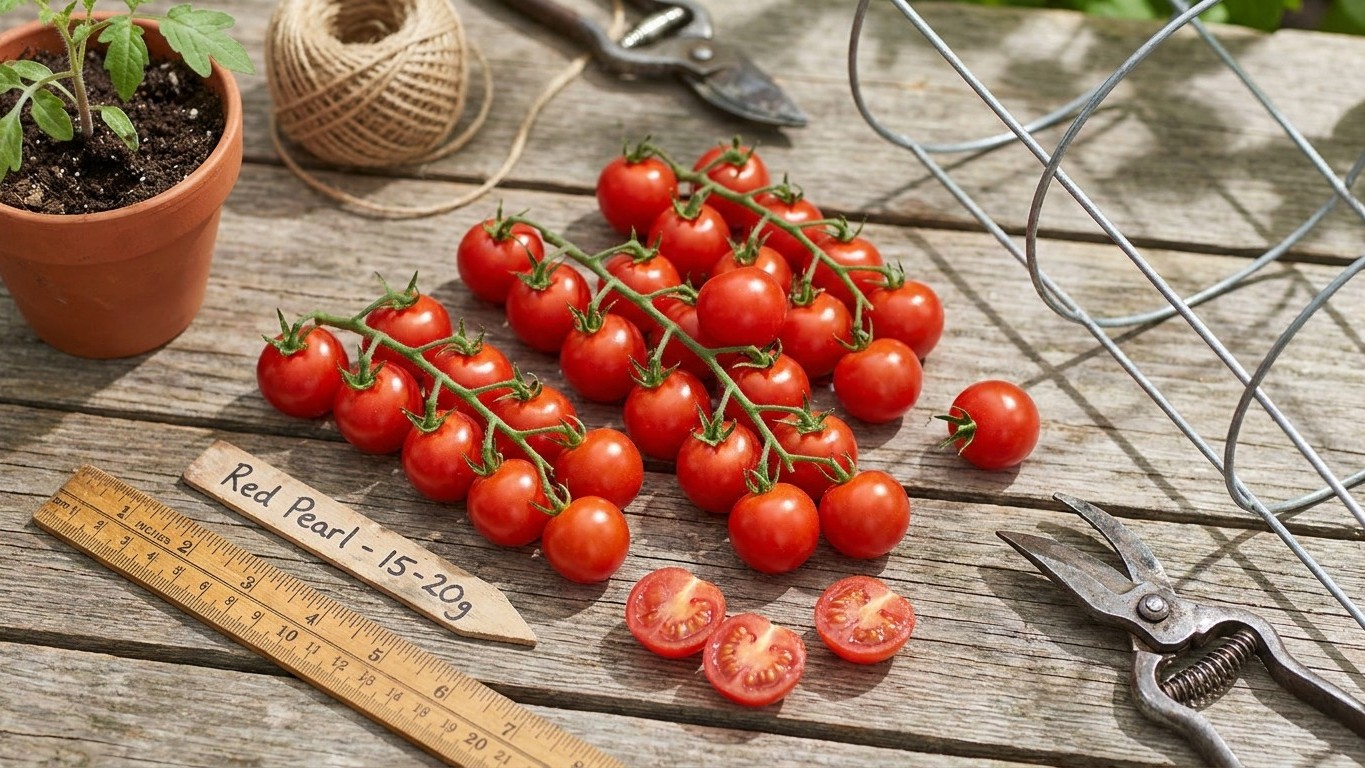

Red Pearl is a grape tomato bred for the salad bowl and the snack drawer, not the sandwich plate. It’s an indeterminate vine that keeps setting fruit until frost, producing marble-sized grapes of 15 to 20 grams with good flavor and a meaty texture. Catalogue data puts it at 58 days from transplant, which changes how you plan the season depending on where you garden.
What Brandywine actually is

Three facts decide whether this variety fits a given garden. First, the fruit itself: a grape tomato in the 15 to 20 gram range, small enough to eat by the handful, with a flavor and meaty texture that hold up better in a lunchbox than a slice of beefsteak ever would. Second, the timeline: 58 days to maturity, and that figure is counted from transplant, not from the day you sow seed indoors. Add whatever weeks your seedlings spend under lights before they go in the ground, and the real clock from seed to first ripe fruit runs longer than the catalogue number suggests on its own.
Third, the habit. Red Pearl is indeterminate, which means the vine doesn’t stop growing once it sets its first cluster. It keeps stretching, branching, and fruiting straight through summer until frost cuts it down. That’s good news for volume, since you’re not stuck with one big flush and then nothing, but it means the plant needs a tall cage or a stake from the start. A short tomato cage bought for a compact patio variety won’t hold this vine by midsummer.
Put those three together and you get a plant suited to gardeners who want a steady trickle of small, sweet fruit for salads and snacking rather than a handful of giant slicers for canning. The fast 58-day window also means it’s one of the more forgiving grape varieties for shorter growing seasons, a point worth returning to below.
Where it ripens in time, and where it is a gamble
The arithmetic that matters here is simple, even if the answer changes by region. Start with your area’s frost-free window, the stretch between the average last spring frost and the average first fall frost. Subtract roughly two weeks, because tomato seedlings shouldn’t go into cold soil even after the frost risk passes; most growers wait until nighttime lows are reliably holding above the mid-50s. Then subtract the 58 days Red Pearl needs from transplant to first ripe fruit. Whatever remains is your harvest window, the stretch of season where the vine is actually producing rather than just growing toward its first tomato.
In a region with a long frost-free season, that leftover harvest window can stretch for months, which matters a great deal for an indeterminate variety that keeps fruiting until the cold finally stops it. Gardeners in the Gulf Coast states, the Southeast, and much of the Southwest typically work with frost-free periods long enough that Red Pearl’s 58-day clock leaves a wide margin for a full run of continuous harvest, even after accounting for the soil-warming delay.
In shorter-season regions, the math gets tighter. Gardens in the Upper Midwest, northern New England, and similar short-summer climates often have frost-free windows compressed enough that the two-week soil-warming delay plus 58 days to first fruit eats a meaningful chunk of the available season before the first grape tomato ever ripens. That doesn’t rule Red Pearl out. Its comparatively fast maturity actually makes it a better bet for a short season than a slower slicing tomato would be, since less of the calendar is spent waiting and more is left for picking.
This page doesn’t carry specific frost-date figures for individual weather stations, so the practical move is to run this arithmetic with your own local frost-free window, which your county extension office or a NOAA climate-normals lookup for your nearest station can supply. Plug the numbers in yourself: frost-free days, minus roughly two weeks for soil warm-up, minus 58 for maturity. Whatever is left tells you honestly whether you’re working with a generous harvest season or a short sprint before frost ends it.
The two ways a season goes wrong
A long frost-free window on paper doesn’t guarantee a good tomato season, and two limits explain why. In northern gardens, accumulated warmth can run short even when the calendar between frosts looks generous, because tomatoes don’t just need frost-free days, they need enough consistently warm days to actually set fruit. When nighttime temperatures drop below 50F, which happens in shoulder-season stretches even in a technically long frost-free window, flowers drop without setting fruit. A cold, cloudy stretch in early summer can stall production even with weeks of season left on the clock.
In southern gardens, the opposite problem shows up in the other direction. Once daytime temperatures climb above roughly 86F, tomato pollen becomes sterile and flowers simply fail to set fruit, no matter how healthy the vine looks. That’s the reason experienced growers in hot climates plant a spring crop that finishes before the worst heat arrives, then start a second crop in late summer to catch the cooler autumn stretch, rather than expecting one continuous harvest all season.
For Red Pearl specifically, the fast 58-day timeline works in its favor on both ends. It can complete its first flush of fruit before a cool spring stalls flowering in the north, and it can often finish an early round before the hottest weeks shut down pollination in the south. But because it’s indeterminate and keeps flowering right through midsummer, southern gardeners shouldn’t expect it to skip the heat problem entirely. The vine will likely lose fruit set during the hottest weeks even after a strong early harvest, which is why the same spring-and-fall approach that applies to slower varieties still pays off here.
What it resists, and what it does not
The published resistance for Red Pearl covers one disease: Late Blight, rated Intermediate. That distinction matters more than it sounds. Intermediate resistance means the plant slows the progress of the disease and may show milder symptoms under pressure, not that it escapes infection altogether. Treating an Intermediate rating as if it were High resistance is a common way to lose a crop, because gardeners skip the sanitation and spacing habits that Late Blight still requires even on a partially resistant plant.
Just as important is what isn’t on the list. The catalogue data for Red Pearl names no resistance to Early Blight, Septoria leaf spot, Fusarium wilt, Verticillium wilt, or root-knot nematodes. That doesn’t mean the plant is guaranteed to catch any of these, but it means there’s no built-in protection against them either. Treat Red Pearl as unprotected against everything except a partial slowdown of one disease, and plan your garden hygiene, crop rotation, and airflow accordingly. Watering at the base rather than overhead, spacing plants for air circulation, and rotating tomato beds year to year still do the heavy lifting here, because the genetics aren’t doing it for you beyond that single Intermediate rating.
Growing it without the usual mistakes
Because Red Pearl is indeterminate, it needs a different plan than a determinate variety that ripens in one flush and finishes. A determinate tomato can get by on a short cage since its final size is predictable. Red Pearl’s vine keeps climbing and branching all season, so a tall stake or a sturdy, tall cage set up at transplant time avoids the common mistake of installing support that the plant outgrows by midsummer, at which point it’s much harder to retrofit without damaging branches already loaded with fruit.
Feeding follows the same logic as the growth habit. Since the vine fruits continuously rather than in one burst, it benefits from steady, moderate feeding rather than a single heavy dose early on. Too much nitrogen, especially once fruit set begins, pushes the plant toward leafy growth at the expense of the small grape clusters that are the whole point of growing this variety. Easing off nitrogen once flowering starts, while keeping potassium and phosphorus steady, keeps the plant’s energy going into fruit rather than foliage.
The mistake this variety specifically invites is underestimating the vine because the fruit is so small. Gardeners sometimes assume a grape tomato with a fast 58-day timeline will stay compact, then find themselves with an unstaked, sprawling plant by July. Stake early, prune suckers if you want fewer but slightly larger clusters, and pick ripe grapes promptly and often. Because fruit is small and numerous, letting clusters sit too long on the vine slows the plant’s overall output more than it would with a large slicing tomato, since the plant reads a full cluster as a signal to stop pushing new flowers.
Common questions
How many days from transplant does Red Pearl need to start producing ripe fruit?
Catalogue data lists 58 days from transplant to first ripe fruit, not from the date you sow seed. Seedling time indoors adds to the total calendar, even though it doesn’t count against the 58-day figure itself.
Is Red Pearl resistant to blight?
It carries Intermediate resistance to Late Blight only. That slows the disease under pressure but doesn’t prevent infection, and no resistance is listed for Early Blight or other common tomato diseases.
Can Red Pearl be grown in a container given its indeterminate habit?
It can, but the container and support need to match an indeterminate vine that keeps growing until frost. A large pot with a tall stake or cage set up at planting time works better than a small container meant for a compact, determinate variety.
What’s the best use for Red Pearl tomatoes in the kitchen?
Salads and snacking are the intended use for this grape variety, given its small 15 to 20 gram size, good flavor, and meaty texture. It’s built for eating fresh by the handful rather than for sauce or canning.