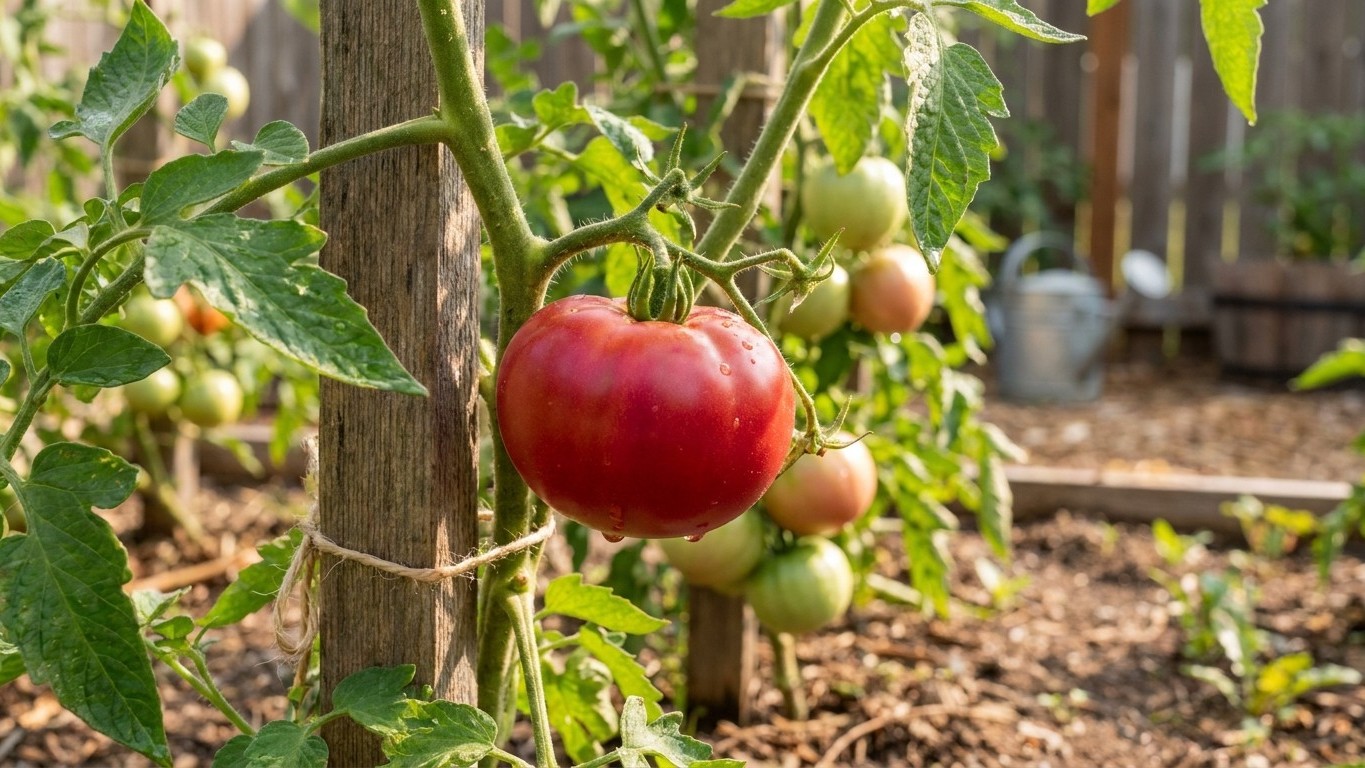

RuBee Dawn is an indeterminate red slicing tomato that reaches maturity in about 60 days from transplant, producing 3 inch round fruit prized for a deep crimson color and early ripening. That maturity figure is short enough to work in most home gardens, but “short” only matters once you check it against your own frost dates, your soil temperature in spring, and how your summer nights behave.
What Brandywine actually is
Three facts decide whether RuBee Dawn fits a given garden. First, it is indeterminate: the vine keeps growing and setting fruit until frost cuts it down, which means it needs a tall cage or a stake rather than a short cone. Second, its maturity is listed at 60 days, and that figure is counted from transplant into the garden, not from the day the seed goes into a tray indoors. Confusing the two bases is the single most common reason gardeners think a variety is “late” when it isn’t; it just started the clock later than they assumed.
Third, the fruit itself: round slicers about 3 inches across, red-skinned thanks to a crimson gene expression that pushes the color deeper than a standard red tomato. The catalogue description calls it a stellar slicer with big fruit, very early ripening, and strong flavor for a tomato that matures this fast. Early-season slicers often trade some flavor complexity for speed, so a variety that keeps both is worth noting.
None of this tells you whether RuBee Dawn will actually finish a crop where you garden. That’s arithmetic, and it’s the next question.
Where it ripens in time, and where it is a gamble
Sixty days from transplant sounds simple until you place it against a real calendar. The math a gardener needs runs in one direction: start with your area’s frost-free window (the stretch between your average last spring frost and your average first fall frost), subtract roughly two weeks for the soil to warm enough after that last frost date to safely set out a young tomato plant, then subtract the 60 days RuBee Dawn needs to mature. Whatever days remain are your harvest window, the stretch where you’re actually picking ripe fruit rather than racing weather.
Do that subtraction with a long frost-free season, say one running well past 180 days, and the arithmetic leaves months of harvest, plenty of slack for a cool spring or an early cold snap in fall. Gardens with that kind of window can transplant on the early side, get fruit inside the 60-day mark, and still have a long tail of picking before frost returns.
Shrink that window to something closer to 100 or 110 frost-free days, common across parts of the northern tier and higher elevations, and the same subtraction gets tight. Two weeks for soil warming plus 60 days to maturity already eats most of a 110-day season before the first fruit even colors up. In those gardens, RuBee Dawn’s short maturity is exactly the advantage: a variety needing 80 or 90 days from transplant would leave almost no harvest window at all, while 60 days still fits with room to pick.
The useful habit isn’t memorizing a chart of cities; it’s running your own local frost-free window (available from NOAA’s National Centers for Environmental Information climate normals for your nearest station) through that same three-step subtraction. A gardener in a short-season zone who does this once, for their own address, learns more than any general regional guide can tell them, because local frost dates vary by hundreds of feet of elevation and by proximity to water in ways a national map smooths over.
Where the arithmetic gets genuinely uncomfortable, meaning the harvest window shrinks below a few weeks, that’s a signal to start seed indoors earlier relative to the last frost, use row cover to push the transplant date up, or accept a shorter overall harvest and plan the garden around it rather than assuming the variety will simply adapt.
The two ways a season goes wrong
A long frost-free window on paper doesn’t guarantee a good tomato season, and a short one doesn’t automatically doom it. Two limits sit underneath the frost calendar that it never shows.
In cooler regions, accumulated warmth can run short even inside a technically long frost-free window, particularly at elevation or near large bodies of cold water where daytime highs stay mild but nights drop hard. Tomato fruit set stalls when nighttime temperatures fall below 50F; the flowers may open, but pollen won’t transfer properly, and blossoms drop without ever becoming fruit. A season can be 150 frost-free days long and still deliver a thin harvest if a string of cool nights hits during flowering.
In hot regions, the opposite failure shows up in midsummer. Once daytime temperatures climb above roughly 86F, tomato pollen becomes sterile, and plants stop setting fruit even though they keep flowering and look perfectly healthy. This is why growers in hot-summer regions typically plan two crops, a spring planting that finishes before the heat peaks and an autumn planting that starts once nights cool back down, rather than expecting one plant to fruit continuously from May through September.
For RuBee Dawn specifically, the 60-day maturity tilts the risk toward the cold-night problem more than the heat problem. A fast-finishing variety is well positioned to slip a spring crop in ahead of the worst summer heat in hot regions, or to squeeze a full harvest into a short cool-summer window before nights turn too cold for fruit set in the fall. The gardener most likely to lose a crop with this variety is the one in a marginal-length season who transplants too early into soil and night temperatures that haven’t recovered yet, not the one battling July heat.
What it resists, and what it does not
RuBee Dawn carries a specific, mixed set of published disease resistances, and the distinction between grades matters more than the list itself. The catalogue rates it with High resistance to Alternaria Stem Canker, Fusarium Crown and Root Rot, and Leaf Molds A through E. High resistance means the plant is bred to hold up well against these pathogens under normal pressure, though “resistant” in seed catalogues never means immune; it means disease pressure has to be unusually severe to cause real damage.
Alongside that, it carries Intermediate resistance to Nematodes and to Gray Leaf Spot. Intermediate is a meaningfully weaker grade than High, and it does not mean the plant escapes these problems. It means the plant slows the progression of the disease or tolerates a lower level of infection without collapsing, but a garden with heavy nematode pressure in the soil, or with wet, humid conditions that favor gray leaf spot, can still see real symptoms and yield loss. Treating “Intermediate” as if it were “High” is the kind of mistake that costs a crop right when a grower assumed they were covered.
Just as important: this published list does not include resistance to early blight, late blight, Septoria leaf spot, bacterial spot, or Verticillium wilt. Where those pressures are common in a region, RuBee Dawn offers no bred-in protection, and standard cultural controls (crop rotation, mulching to limit soil splash, adequate airflow between staked plants) are doing the actual work, not the variety’s genetics.
Growing it without the usual mistakes
Because RuBee Dawn is indeterminate, it needs a support plan built for a plant that keeps growing all season rather than one that ripens in a single flush and stops. A tall stake, at minimum 6 feet, or a sturdy cage of similar height, is the baseline; anything shorter and the vine will outgrow its support by midsummer and start sprawling, which raises disease pressure by putting foliage and fruit closer to the soil. Space plants roughly 24 to 36 inches apart to give that continuous growth enough airflow, especially important given the gray leaf spot exposure noted above.
Because it’s an indeterminate slicer rather than a determinate variety that sets one flush and finishes, the feeding and pruning approach differs from a bush-type tomato. Determinate varieties benefit from feeding hard early and then backing off once fruit sets, since the plant’s total yield is already largely determined by that point. RuBee Dawn, by contrast, keeps producing new flowers and fruit through the season, so a lighter, more consistent feeding schedule across the summer supports that ongoing production better than one heavy early feeding. Stop nitrogen-heavy feeding roughly a month before your expected first frost; pushing new vegetative growth late in the season diverts energy from ripening the fruit already on the vine and produces green tomatoes that won’t finish in time.
The mistake this variety’s timing specifically invites is transplanting too early to chase its early maturity. A 60-day tomato tempts gardeners to get it in the ground the moment the calendar allows, but if soil and night temperatures haven’t caught up yet, the plant sits stalled rather than growing, and the earliness advantage disappears. Waiting for the soil to genuinely warm, even if that means transplanting a week or two after the last frost date rather than on it, protects the very speed that makes this variety worth growing.
Common questions
Is RuBee Dawn a determinate or indeterminate tomato?
It’s indeterminate. The vine keeps growing and setting fruit until frost stops it, so it needs a tall stake or cage rather than a short cage or no support at all.
Its 60-day maturity is counted from the transplant date, not from when seed is sown indoors. Add the weeks a plant typically spends growing indoors before transplant if you’re working backward from a target harvest date.
Does RuBee Dawn resist late blight?
No. The published resistance list covers Nematodes, Gray Leaf Spot, Alternaria Stem Canker, Fusarium Crown and Root Rot, and Leaf Molds A through E. Late blight, early blight, and several other common tomato diseases are not on that list, so cultural controls remain the main defense against them.
Why didn’t my RuBee Dawn set fruit even though it flowered?
Two temperature ranges block fruit set regardless of the variety: nighttime temperatures below 50F and daytime temperatures above roughly 86F both interfere with pollen and stop flowers from becoming fruit. Given this variety’s short 60-day maturity, cool nights during a marginal spring or fall are the more likely culprit than summer heat.