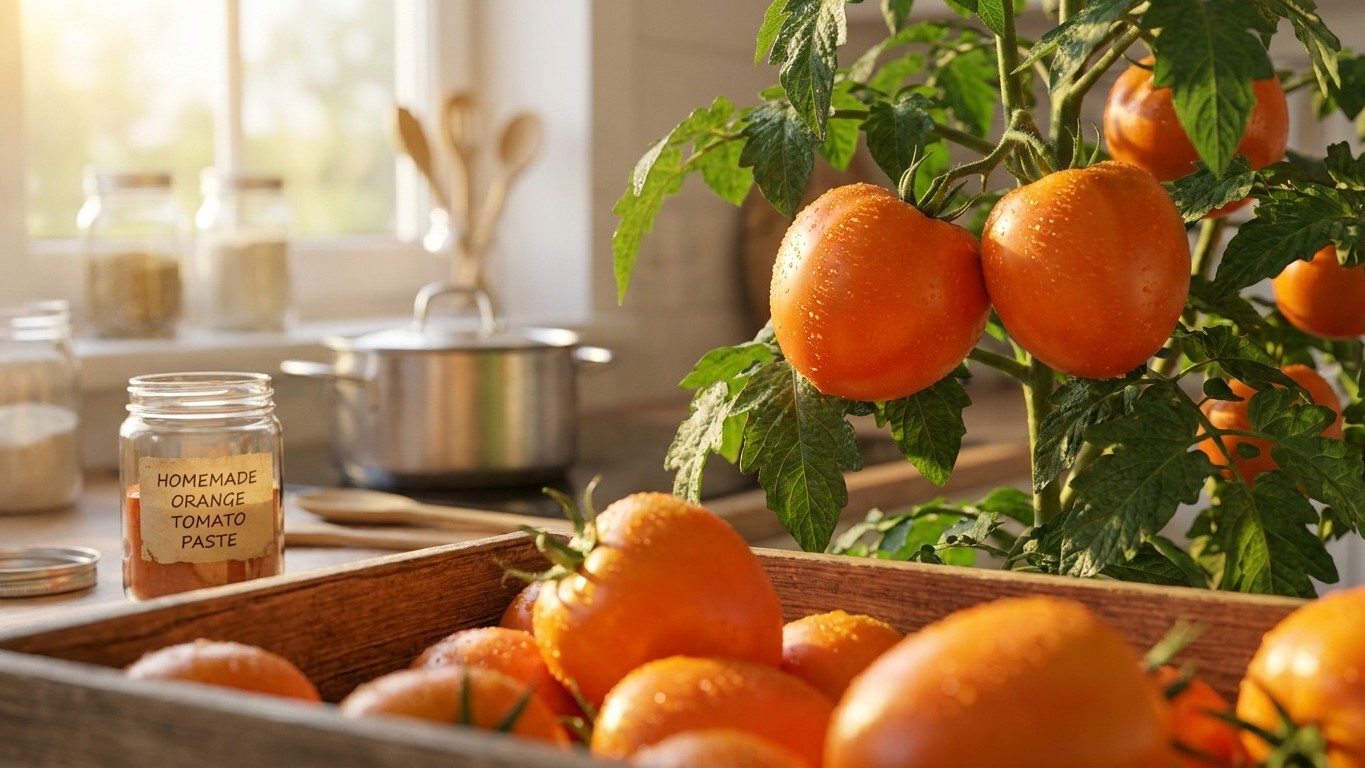

Sunrise Sauce is a determinate, orange-fleshed paste tomato that reaches maturity in 57 days from transplant, and it earns its keep in the kitchen more than in the garden bed: the 4-6 oz fruit is bred for sauce and canning, with a flavor described as noticeably sweeter than most paste tomatoes in its class. Whether that 57-day clock actually fits your growing season is the real question, and it depends on more than just counting forward from your last frost.
What Sunrise Sauce actually is

Three facts decide whether this tomato belongs in a given garden. First, it’s determinate, meaning the plant grows to a fixed, compact size, sets most of its flowers within a few weeks, and then ripens that whole crop in a relatively short window rather than trickling out fruit all summer. Second, it’s rated at 57 days to maturity, and that count starts from transplant, not from the day you sowed seed indoors. Seed catalogs almost always use transplant as the baseline because germination timing and indoor growing conditions vary too much to count from seed reliably.
Third, the fruit itself: orange, 4 to 6 ounces, shaped and textured for cooking down rather than slicing for a sandwich. The flesh is meatier than a slicing tomato and lower in water content, which is exactly what you want when the end goal is a jar of sauce rather than a fresh salad. What sets this variety apart from other orange paste types on the market is a flavor that’s been bred to be sweeter than typical paste tomatoes, which tend toward mild or slightly acidic. That sweetness matters if you’re making sauce with less added sugar to balance acidity, or if you plan to eat some fresh off the vine before the rest goes into the canner.
Because it’s determinate, the plant stays shorter and bushier than an indeterminate vine. That changes how you stake it, how far apart you space plants, and when you stop feeding it, all of which gets covered further down. For now, the takeaway is simple: this is a fast, compact, once-and-done tomato built for a big canning day, not a slow trickle of fruit from July through October.
Where it ripens in time, and where it is a gamble
The math that matters here isn’t complicated, but almost nobody does it before they buy seed. Start with your frost-free window, the stretch between the average date of your last spring frost and your average first fall frost. Subtract roughly two weeks, because tomato transplants sit and sulk if they go into soil that hasn’t warmed enough, even if the air temperature says it’s safe. Then subtract the 57 days to maturity. What’s left over is your actual harvest margin, the number of days you have to pick fruit before frost threatens again.
In a region with a long, generous frost-free season, that math is forgiving. Much of the Deep South, the Gulf Coast, and coastal California fall into this category, where growing seasons commonly stretch well past 200 days. A 57-day tomato dropped into a season that long leaves enormous slack, enough that gardeners in these regions can often get a spring crop and still have time left for something else in the same bed.
Short-season regions are where the arithmetic gets tight. Northern New England, the Upper Midwest, and high-elevation gardens in the Mountain West often work with frost-free windows that leave much less room once you subtract the two-week soil-warming buffer and the 57 days themselves. In those places, a fast variety like Sunrise Sauce is actually an advantage rather than a liability. It’s precisely the kind of tomato that short-season gardeners should be looking for, because slower 80-day paste varieties simply don’t have room to finish before a hard frost shows up.
This page doesn’t have station-specific frost dates to hand you for your exact town, and rather than guess, it’s worth saying so plainly. What does exist is a public, searchable record: NOAA’s National Centers for Environmental Information publishes average first and last frost dates by individual weather station, and it’s free to look up. Find the station closest to your address, pull the two dates, and run the subtraction above. That fifteen minutes of homework tells you more about whether Sunrise Sauce fits your yard than any generic zone map ever will.
The two ways a season goes wrong
A long frost-free window on paper doesn’t guarantee a good tomato season, and there are two separate failure modes that a frost calendar alone won’t reveal.
In the north, the problem isn’t frost, it’s accumulated warmth. A season can technically be frost-free for 130 days and still not deliver enough consistently warm weather to push a tomato plant through flowering and fruit set on schedule. Tomato flowers stop setting fruit when nighttime temperatures drop below 50°F, which happens routinely in early spring and again in early fall across much of the northern tier, effectively shrinking the usable part of an already short season.
In the south, the opposite problem shows up in the middle of summer. Once daytime temperatures climb above roughly 86°F for extended stretches, tomato pollen becomes sterile and flowers simply won’t set fruit, no matter how healthy the plant looks. This is exactly why experienced gardeners in hot climates plant tomatoes twice, once in early spring for a crop that finishes before the worst heat, and again in late summer for a fall harvest after temperatures ease back down, rather than expecting one plant to produce continuously from May through September.
For Sunrise Sauce specifically, its speed works in its favor on the cold end of that equation. A 57-day clock gives it a real shot at squeezing a full harvest into a short northern season before nights drop below that 50°F threshold again in fall. In hot southern climates, the bigger risk isn’t the season length, it’s timing the transplant so flowering happens before the summer heat spike arrives, not during it.
What it resists, and what it does not
Sunrise Sauce carries two published disease resistances, and both are rated at the strongest catalogue grade: High resistance to Verticillium Wilt and High resistance to Fusarium Wilt race 1. That’s worth taking seriously, since both are common soilborne fungal diseases that can devastate a tomato crop, especially in beds where tomatoes or related crops have been grown repeatedly.
It’s worth being precise about what “High” resistance actually means, because the word “resistance” gets misread as immunity. A tomato with High resistance can still show some disease symptoms under heavy pathogen pressure, particularly in soil that’s been contaminated for years. What High resistance buys you is a plant that’s substantially less likely to be knocked out by that specific pathogen compared to an unrated variety, not a guarantee that the disease can never touch it.
Just as important is what isn’t on this list. The catalogue data for this variety names only Verticillium Wilt and Fusarium Wilt race 1, nothing else. That means no published resistance to other common tomato problems: no listed protection against nematodes, no resistance to other Fusarium races beyond race 1, no listed defense against early blight, late blight, Septoria leaf spot, bacterial spot or speck, or tomato spotted wilt virus. If any of those are active problems in your area or your soil’s history, this variety offers no catalogue-backed protection against them, and standard prevention (crop rotation, mulching to limit soil splash, and good airflow between plants) still carries the load.
Growing it without the usual mistakes
Because Sunrise Sauce is determinate, it doesn’t need the tall stakes or overhead trellis system that an indeterminate vine demands. A standard cage or a short stake is usually enough to keep the compact plant upright and its fruit off the soil. Space plants a bit closer together than you would an indeterminate variety, since the plant simply won’t keep growing taller and wider all season the way a vining tomato does.
The most common mistake with determinate tomatoes is treating them like indeterminate ones when it comes to pruning and feeding. Aggressively removing suckers, a habit that helps indeterminate vines focus energy, actually reduces total yield on a determinate plant, because the plant has a fixed, preset amount of growth and fruit-bearing wood built into its genetics. Let it branch out. Similarly, once fruit set is underway, easing off nitrogen-heavy feeding matters more here than with a slow-ripening vine, since excess nitrogen late in a short season pushes leafy growth at the expense of the fruit that’s supposed to ripen on schedule.
The timing mistake specific to this variety is planting too early into cold soil. That two-week soil-warming buffer mentioned earlier isn’t optional. A transplant set into soil that’s still cold effectively stalls, sitting in place instead of growing, which quietly erases the advantage of a fast 57-day maturity rating. Wait for the soil, not just the calendar.
Finally, plan around the harvest pattern itself. Because the crop ripens in a concentrated flush rather than trickling in over months, this is a “canning day” tomato: line up jars, lids, and a water bath canner before the fruit starts coloring up, because a determinate plant can go from a handful of ripe tomatoes to a full harvest basket within a week or two. Gardeners who want a steady trickle of fresh tomatoes for the table all summer typically pair a determinate paste variety like this one with a separate indeterminate slicer planted alongside it.
Common questions
Is Sunrise Sauce indeterminate or determinate?
It’s determinate. The plant stays compact, sets its crop over a defined window, and ripens most of its fruit together rather than producing continuously through the season.
How many days does Sunrise Sauce take to ripen?
57 days, counted from the date of transplant into the garden, not from seed-starting.
What color is Sunrise Sauce and how does it taste?
The fruit is orange and weighs 4 to 6 ounces. It’s described as noticeably sweeter than most other paste tomatoes in its class, which sets it apart from typical red paste varieties.
Does Sunrise Sauce resist tomato diseases?
The published data shows High resistance to Verticillium Wilt and High resistance to Fusarium Wilt race 1. No other resistances are listed, so growers should still guard against nematodes, other blights, and other Fusarium races through crop rotation and general garden hygiene.