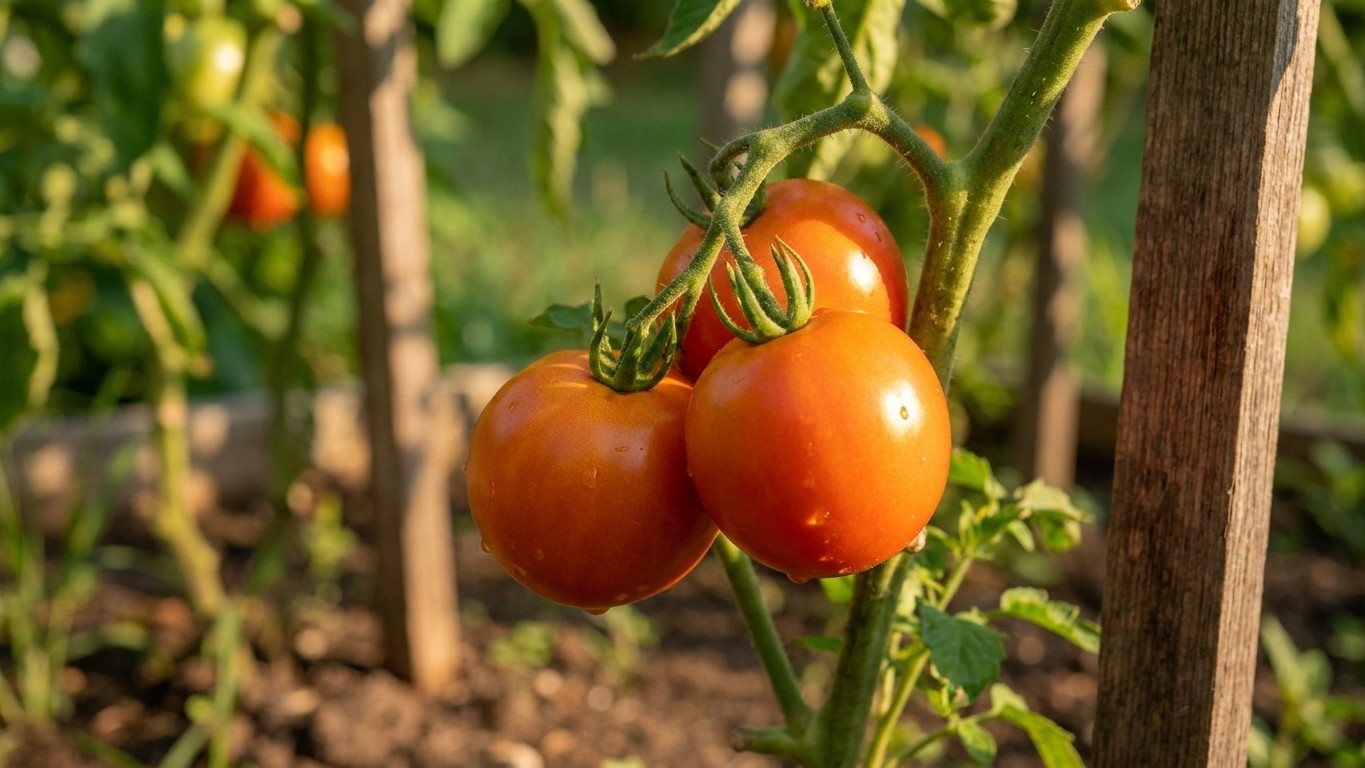

The Sunset Torch tomato reaches harvest in 63 days from the day you set transplants in the ground, which puts it comfortably inside a normal growing season almost anywhere in the country. The real question isn’t whether it ripens in time. It’s whether your local frost-free window, minus the two weeks soil needs to warm before transplant, leaves enough runway after that 63-day count for a full harvest rather than a rushed one.
What Brandywine actually is
Sunset Torch is a determinate tomato, meaning the plant grows to a set size, sets its fruit over a compressed window, and then largely stops. That’s a different plant to manage than an indeterminate vine that keeps climbing and fruiting until frost cuts it down. Catalogue data lists it at 63 days to maturity, and that count starts from transplant, not from the day you sow seed indoors. If you’re working backward from a target harvest date, seed-starting time (typically six to eight weeks before your last frost) has to be added on top of those 63 days, not folded into them.
The fruit itself is built for the table rather than the canning kettle: sweet, mild, and fruity in flavor, sized and shaped for salads, snacking, kabobs, and cocktails. That’s a useful detail when you’re deciding how many plants to put in, because a determinate variety aimed at fresh eating doesn’t need the six or eight plants you’d dedicate to a sauce tomato. Two or three plants, spaced properly, will keep a household in salad tomatoes through its ripening window.
Because it’s determinate, the plant’s compact growth habit also changes staking needs. It won’t sprawl the way an indeterminate beefsteak does, so a shorter cage or a simple stake does the job, and you won’t be pruning suckers all summer to control size. That’s less labor, but it also means the plant can’t be coaxed into a longer season by pinching and retraining. What you plant is roughly what you get.
Where it ripens in time, and where it is a gamble
The arithmetic that matters is simple, and every gardener can run it for their own yard. Start with your area’s frost-free window, the number of days between the average last spring frost and the average first fall frost. Subtract about two weeks, because tomato transplants shouldn’t go into the ground until the soil has actually warmed, not just the air. Then subtract the 63 days to maturity. What’s left over is your cushion, the number of days you get to actually pick fruit before frost ends the season.
In regions with a long, warm growing season, that cushion is wide. Much of the Southeast, the mid-Atlantic, and the lower Midwest run frost-free windows well past 180 days, which leaves Sunset Torch with more than two months of harvest time after the 63-day count is satisfied. In those places, this variety isn’t a stretch at all. It’s a variety you plant because it ripens early and gets out of the way, not because it’s the only thing that fits.
The calculation looks different in short-season country. Parts of the Northern Plains, the interior Mountain West, and northern New England work with frost-free windows that can run closer to 100 to 120 days in a given locality. Run the math there: 110 days of frost-free window, minus 14 for soil warming, minus 63 for maturity, leaves roughly a month of harvest. That’s workable, but it’s tight enough that a late spring cold snap or an early fall frost can cut the harvest short before it really gets going. Gardeners in that situation aren’t wrong to grow Sunset Torch, but they should treat the 63-day figure as a minimum, not a comfortable estimate, and lean on cold frames, row cover, or wall-of-water plant protectors to buy a week or two on either end.
There isn’t a region in the continental United States where a 63-day determinate tomato is outright impossible, and it would be misleading to say otherwise. The honest distinction is between places where the variety has margin to spare and places where the margin is thin enough that a single bad week matters. If you don’t know your own area’s frost-free window off the top of your head, your local county extension office keeps historical frost date records for exactly this purpose, and it’s worth five minutes to look them up before you commit garden space.
The two ways a season goes wrong
A long frost-free window looks reassuring on paper, but it doesn’t guarantee a good tomato season, and a short one doesn’t automatically doom it either. Two limits sit outside what any frost date table can show, and both matter more to a fast-maturing variety like this one than growers often assume.
In cooler northern gardens, the frost-free count can be generous while the accumulated warmth across those days is still short. Tomatoes need consistently warm nights to set fruit, and when nighttime temperatures fall below 50°F, pollen doesn’t perform the way it needs to and blossoms drop without setting. A 63-day tomato started in cool, cloudy conditions can sit at day 40 with barely any fruit forming, because the calendar has moved but the plant’s internal clock, which runs on heat, hasn’t kept pace. This is the limit that matters most for Sunset Torch in the north: not whether frost arrives in time, but whether enough warm nights show up early enough to get the clock started.
In hot southern gardens, the opposite problem shows up midsummer. Once daytime temperatures push past roughly 86°F for sustained stretches, pollen turns sterile and fruit set stalls out even though the plant looks healthy and keeps flowering. That’s why experienced growers in hot climates plant a spring crop timed to finish before the worst heat, then a second crop in late summer timed to fruit as temperatures ease into fall, rather than expecting one continuous harvest. Because Sunset Torch matures quickly at 63 days, it’s actually well suited to that two-crop approach: fast enough to squeeze in before the heat shuts pollination down, and fast enough again to get a second round finished before fall frost.
What it resists, and what it does not
Catalogue data for Sunset Torch lists no published disease resistances. That’s worth stating plainly rather than glossing over, because it’s easy to assume a modern variety carries some baseline protection against common tomato diseases when the sheet simply doesn’t say so. No resistance code means no resistance code, not an oversight in labeling.
In practice, that puts the disease-management burden on cultural practice rather than genetics. Fungal problems like early blight and septoria leaf spot, along with soil-borne wilts, aren’t going to be slowed by anything built into this plant’s genetics the way they would be in a variety bred with, say, verticillium or fusarium resistance markers. That makes a few habits load-bearing rather than optional: rotate tomatoes away from last year’s tomato or pepper ground, water at the soil line instead of overhead to keep foliage dry, and mulch under the plant so soil-borne spores don’t splash up onto lower leaves during rain or irrigation.
Because the fruiting window is compressed by the determinate habit, a foliar disease that takes hold in a resistant variety and merely slows things down would be far more costly here. There’s no resistance gene buying time for this plant to recover mid-season. A blight outbreak that hits during the flowering-to-fruit-set window can take out a meaningful share of a harvest that was only ever going to happen once. Watching for early leaf spotting and acting on it immediately matters more with this variety than with one that has intermediate resistance built in to absorb the first wave of infection.
Growing it without the usual mistakes
The determinate habit is the detail that should drive every decision here, and the most common mistake is treating this plant like an indeterminate vine. Because Sunset Torch sets its whole crop over a short window rather than trickling out fruit all summer, aggressive pruning of suckers, which is standard advice for sprawling indeterminate varieties, actually costs yield here. Suckers on a determinate plant become part of the fruiting structure, and cutting them back the way you would on a beefsteak variety just removes flowers you were counting on.
Spacing should reflect the plant’s fixed, compact size rather than the sprawling footprint of an indeterminate. A simple tomato cage, sized to the plant’s mature height, is usually enough support, and there’s no need to build the tall, heavy-gauge cages meant for vines that keep climbing past 6 feet.
Feeding schedule is another place the determinate habit changes the plan. Because the plant isn’t going to keep growing and setting new fruit clusters indefinitely, heavy nitrogen late in the season doesn’t buy more harvest, it just pushes leafy growth at the expense of the fruit that’s already forming. Easing off nitrogen once flowering starts, and switching to a lower-nitrogen, higher-potassium feed through fruit set, matches what the plant is actually doing at that stage.
The timing mistake this variety invites is planting too early to feel productive, then losing the harvest to a cool snap that stalls fruit set before the plant reaches its 63-day count. Given how compressed the fruiting window already is, that’s the one error with no room to recover from. Waiting those extra one to two weeks for soil to genuinely warm, rather than jumping the gun on a warm afternoon in early spring, protects the harvest far more than it costs in calendar time.
Common questions
Is Sunset Torch a good tomato for containers?
Its determinate, compact habit suits container growing well compared to a sprawling indeterminate variety, since it won’t outgrow a mid-size pot the way a vining tomato eventually will.
Can I get a second harvest from the same plants?
Because it’s determinate, the plant sets its crop over one compressed window and then largely stops producing new fruit, unlike an indeterminate variety that keeps flowering until frost. A second harvest generally means a second planting, timed for a fall crop where the season allows it.
Does 63 days mean I’ll be picking ripe fruit on day 63?
It means the plant reaches maturity and begins producing ripe, harvestable fruit around that point from transplant. Because it’s determinate, expect the bulk of the crop to come in over a relatively short stretch after that, rather than trickling in over months.
Should I stake or cage this variety?
A cage sized to its compact, determinate growth is generally sufficient. It doesn’t need the tall staking or trellis systems built for sprawling indeterminate vines.