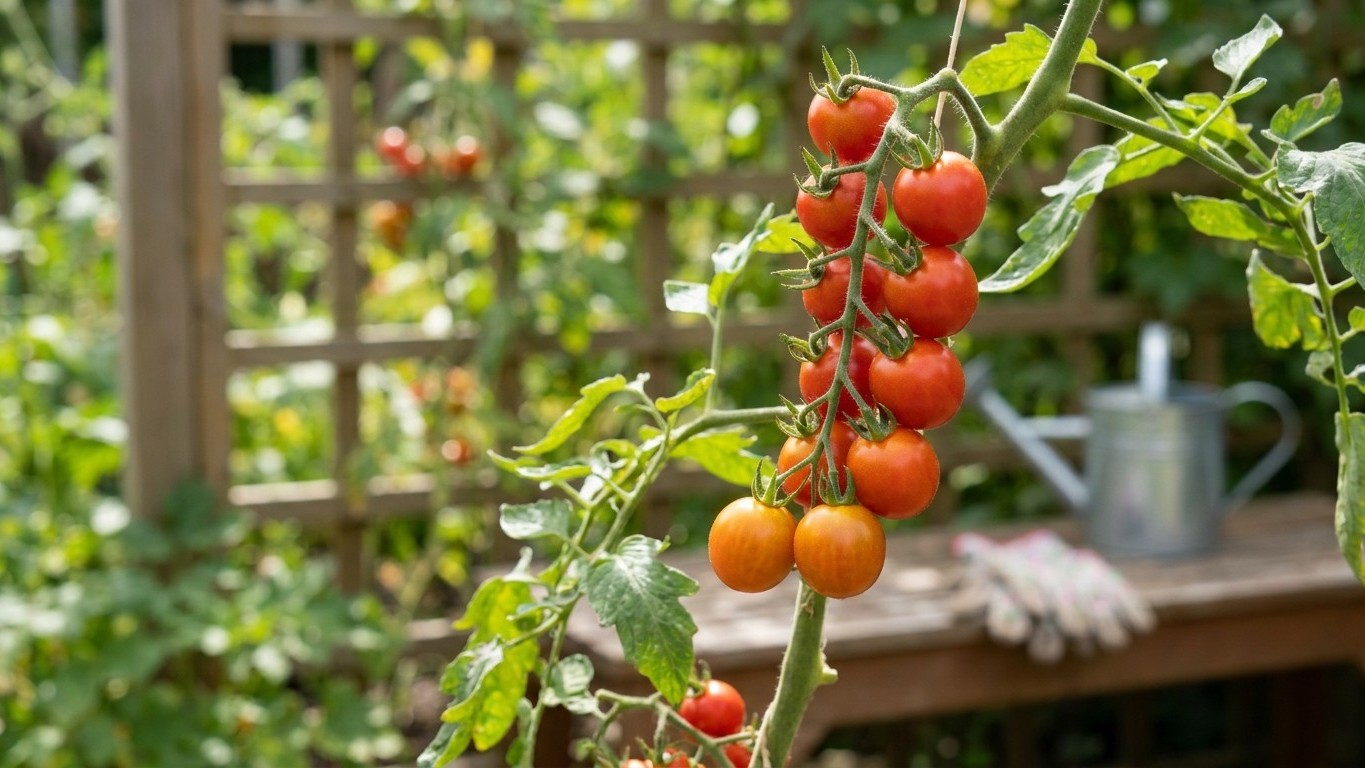

Supersweet 100 sounds like a tomato that finishes fast and stays tidy, the way “supersweet” and “100” together imply something small and quick. It isn’t. This is an indeterminate vine that keeps climbing and setting new trusses right up to frost, reaching six to eight feet if you let it, and the sweetness in the name describes sugar, not size or speed. Sixty-five days gets you the first fruit, not the last.
What Supersweet 100 actually is

The habit is the first thing to plan around. Supersweet 100 is indeterminate, meaning the vine keeps growing and setting new trusses all season instead of stopping at a fixed height and ripening in one wave, and left unsupported it will reach six to eight feet or more by late summer. That single fact decides most of the work: staking, spacing, and how long you keep feeding it.
Seed catalogues put Supersweet 100 at about 60 days from transplant to first ripe fruit, with the usual week or two of give depending on how warm the season runs. That is a mid-early figure for a cherry tomato, faster than most beefsteak and paste types but not as quick as some purpose-bred short-season cherries. If you want a direct comparison, Sakura Tomato: Where It Ripens in Time covers a cherry variety that finishes faster but on a smaller vine.
The fruit itself is round, bright red at full ripeness, about an inch across, and carried in trusses that can hold dozens of tomatoes at once as the vine matures. The name refers to sugar content rather than size: these are snacking and salad tomatoes, not a paste or canning type, and the small fruit size means a single truss can ripen unevenly over a week or more. If you haven’t settled on a cherry tomato for this year’s bed, the full list of Tomato Varieties covers the other common options side by side.
What Supersweet 100 is good for
A cherry tomato this size rarely makes it as far as a cutting board. The fruit is mostly skin and sweet juice relative to flesh, and with dozens of tomatoes ripening per truss on an indeterminate vine, the practical destination is a bowl on the counter or straight into your mouth while you’re tying up the plant. That is not a knock on the variety; it is simply how small, high-sugar fruit behaves. There isn’t enough dense flesh in any one tomato to bother cooking down, and the water content that makes it juicy and pleasant to eat raw is the same thing that would leave a sauce thin and separated if you tried to reduce a panful of them.
Where it earns its keep is salads, snacking, skewers, halved into a pasta salad, or scattered raw over anything that benefits from a burst of sweetness and acidity. The name is a flavor claim rather than a size claim, and going by the category alone, expect the classic cherry-tomato profile: high sugar balanced by enough acid to keep it from tasting flat, with a thin skin that gives way easily. Beyond that, no specific brix number or tasting-note detail is published for this variety, so don’t expect more precision than “sweet red cherry tomato” implies.
If your goal is a big batch of sauce or paste for canning, this is the wrong plant entirely — that job wants a low-water, high-flesh paste tomato that reduces on its own without hours at the stove. Supersweet 100’s job is fresh eating, and given how heavily an indeterminate vine like this one produces once it’s established, plan on more tomatoes at once than a single household salad habit can use, with extras best handled by giving them away or freezing them whole for later cooking rather than trying to turn them into something they’re not built for.
Where it ripens in time, and where it is a gamble
To find out whether Supersweet 100 fits your season, run the same arithmetic used here. Take the frost-free window at your nearest weather station, subtract the roughly two weeks the soil needs to warm before a tomato transplant is safe outdoors, then subtract the about 60 days to first ripe fruit. What is left is your margin, the days you actually get to pick fruit before frost ends the season. Under thirty days of margin means a single flush, and a cool year can take even that.
Where the margin is thinnest
In Yukon, at the Whitehorse station, growers set transplants out in mid June and see first ripe fruit by mid August, leaving only 7 days of margin before frost, a risky verdict. Even that thin window assumes a warm summer. Whitehorse accumulates only about 600 growing-degree-days a year, well short of what a heat-loving crop needs regardless of how long the frost-free stretch runs, so the practical fix is a greenhouse or polytunnel rather than a different planting date.
Nunavut is tighter still. At Rankin Inlet, transplants go out in early July and first fruit ripens in early September, a 12-day margin, against roughly 159 growing-degree-days across the whole year at that station. Outdoors, Nunavut has no realistic path to a Supersweet 100 crop. Under cover is the only option worth trying.
Where a real margin still needs help
Move south into the Northwest Territories, Alberta, Manitoba, and Saskatchewan, and the frost-free window opens up to a real margin, more than 40 days in each case. The verdict for all four still comes back greenhouse, because the day count hides a heat problem. At Yellowknife the margin runs to 42 days but the station totals only about 905 growing-degree-days a year. At Calgary it is 44 days against 1171. Winnipeg and Saskatoon do better on cumulative heat, 1832 and 1549 growing-degree-days respectively, close enough that the extension services in those provinces call it marginal rather than impossible: an early-maturing cultivar plus a plastic mulch to lift soil temperature can turn a marginal season into a picked one.
Where frost is not the problem
Further south the picture changes entirely. At Washington‘s Seattle station, transplants set out from mid March to early April are already producing ripe fruit by late May, a comfortable 166-day margin. South Carolina at Charleston, Florida at Jacksonville, Texas at Houston, Nevada at Las Vegas, and Louisiana at New Orleans all carry margins beyond 170 days, some past 230. None of these gardens will lose Supersweet 100 to frost. What can cost them the crop instead is heat, covered next.
The two ways a season goes wrong
A long frost-free window is not the same thing as a good tomato season, and Supersweet 100’s timing makes one of these two failures more relevant than the other.
The cold-country limit
In the northern territories above, the frost table can show forty or more days of margin and still deliver a poor crop, because growing-degree-days accumulate slowly no matter what the calendar says. Tomato flowers also stop setting fruit once nighttime temperatures fall below 50F, which happens routinely in short northern summers even while daytime highs look warm enough. An indeterminate vine that is still pushing new trusses into a cool September is not going to finish them.
The hot-country limit
In Texas, Florida, South Carolina, Louisiana and Nevada, the opposite problem shows up. Tomato pollen goes sterile above roughly 86F, and flowers open and drop without setting fruit through the hottest stretch of summer, which is why growers in those states run a spring crop and a separate autumn crop rather than one continuous season. Because Supersweet 100 matures in about 60 days rather than the 80 or more a big slicer needs, a spring transplant set at the start of the window is usually fruiting well before that heat arrives, and a second round started once temperatures ease can still ripen before fall frost in the same garden. For this variety, the southern heat gap is the one worth planning a second planting around. The northern degree-day limit is the harder one to work past, since no amount of rescheduling adds heat that isn’t there.
What it resists, and what it does not
Supersweet 100 carries the catalogue code VF, and both parts of that code are graded the same way: Verticillium Wilt resistance is graded High, and Fusarium Wilt races 1 resistance is also graded High. A high grade means the plant effectively shuts the disease down where the soil-borne strain matches the resistance gene, not just slows it, which matters if you’re replanting tomatoes into ground where either disease has shown up before.
That code covers exactly two diseases and nothing else. The catalogue lists no resistance to early blight, late blight, septoria leaf spot, root-knot nematodes, or tobacco mosaic virus. Growers should not read the VF code as broad protection. Rotate out of last year’s tomato bed where you can, stake plants to keep foliage off wet soil, and scout for the dark concentric leaf spots of early blight the same way you would on a variety with no resistance at all. Verticillium and fusarium resistance buy you two fewer things to worry about, not a low-maintenance plant.
Growing it without the usual mistakes
Because Supersweet 100 is indeterminate rather than the determinate, one-flush type, the whole care plan runs on a different clock. A determinate cherry tomato sets most of its fruit in a short window and can be left largely alone once it’s staked. Supersweet 100 keeps building new growth and new trusses until frost, which changes three things.
Support and spacing
Give it a sturdy stake, cage, or trellis from the day it goes in the ground, not once it starts to sprawl. A standard tomato cage is undersized for a vine that reaches six to eight feet, and a plant that outgrows its support mid-season ends up lying on the ground, which is when fruit splits and slugs get to it first. Space plants wider than you would a compact cherry type, since the vine keeps filling in laterally as well as up.
Feeding and watering
Do not stop fertilizing on the schedule you’d use for a determinate variety that finishes early. Supersweet 100 is still setting new fruit in late summer, so a steady feeding program through the season keeps yield up rather than tapering off. Consistent watering matters more here than on larger-fruited tomatoes, since small cherry fruit crack easily when a dry spell is followed by heavy rain or a soaking. A layer of mulch to even out soil moisture does more for this variety than for a slicing tomato with thicker skin.
Harvest
Pick often. Because fruit ripens unevenly across each truss, checking the vine every couple of days rather than waiting for a whole cluster to color keeps ripe fruit from sitting in the sun and splitting, and picking regularly also encourages the plant to keep setting new flowers instead of slowing down once it’s carrying a heavy load of ripe fruit.
Common questions
Can I grow Supersweet 100 in a pot?
You can, but it needs a large container, at least fifteen to twenty gallons, and a tall stake or cage built into the pot from the start. This is not a patio variety in the way a determinate dwarf type is, and a small container will limit both root growth and fruit set well before frost is the issue.
Why is my Supersweet 100 splitting before I can pick it?
Cracking on cherry tomatoes almost always comes down to uneven watering, a dry stretch followed by heavy rain or a deep soak. Mulching to keep soil moisture steady and picking fruit as soon as it colors, rather than leaving it to fully ripen on the vine, both cut down on splits.
Is Supersweet 100 the same as Sweet 100?
No. Sweet 100 is the older parent variety, and Supersweet 100 was bred from it with the added Verticillium and Fusarium resistance described above, along with a reported improvement in sugar content. The fruit size, cluster habit, and vine size are otherwise very similar between the two.
How long does Supersweet 100 keep producing?
Until frost kills the vine, since it’s indeterminate rather than a one-flush determinate type. In a garden with a comfortable margin, that can mean months of picking once the first fruit colors, tapering only as nights cool enough to slow flowering and, eventually, as pollen sterility or falling temperatures stop new fruit from setting.