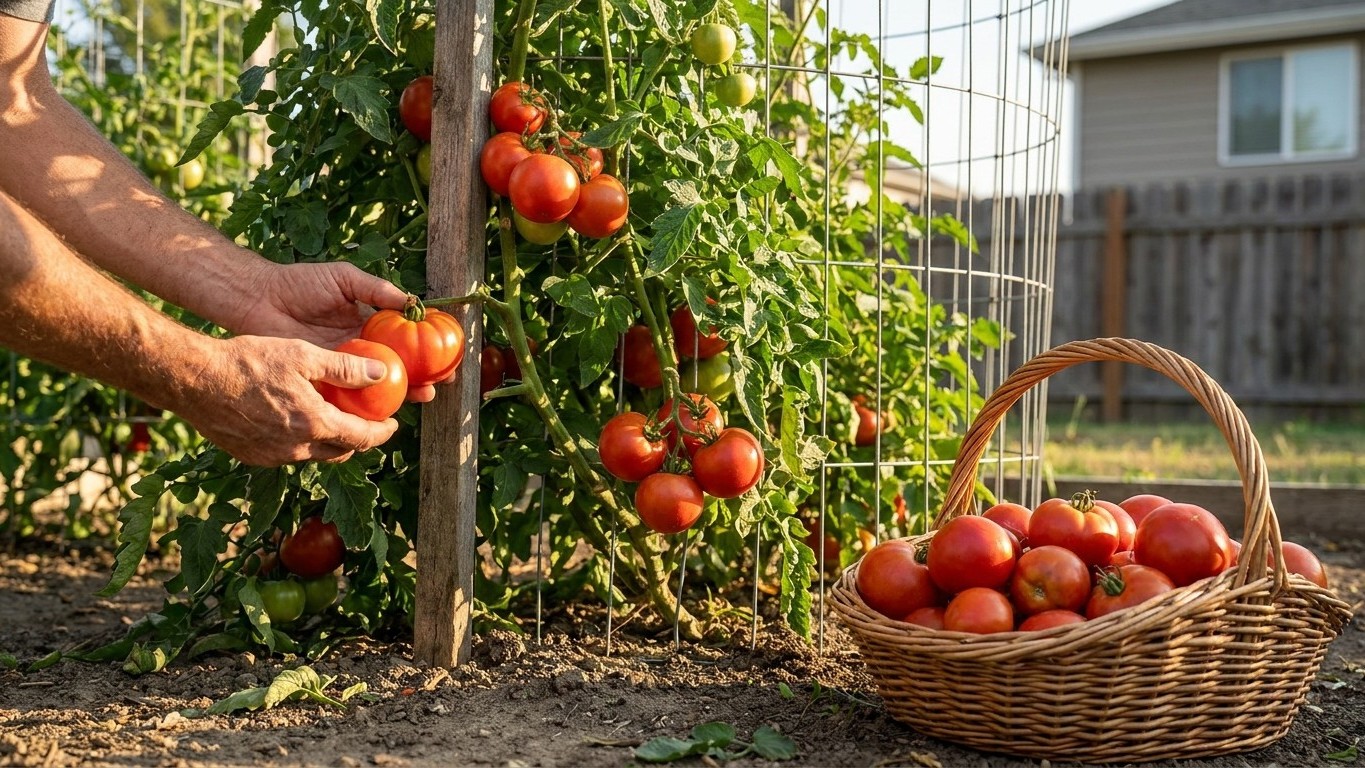

Tidy Rose is an indeterminate slicing tomato that ripens in 55 days from transplant, which puts it well within reach for most of the country as long as the plant gets a tall cage or stake to keep pace with its vine. The short maturity window is the whole story here: it decides where this tomato is an easy yes and where it’s a closer call once soil temperature and nighttime lows enter the math.
What Brandywine actually is
Tidy Rose is an indeterminate tomato, meaning the vine keeps growing and setting fruit until frost cuts it down rather than stopping after one flush. That habit is the first thing to plan around: without a tall cage or a sturdy stake, the plant sprawls, fruit rots on damp soil, and picking turns into a hunt through a tangle of stems.
The catalogue lists 55 days to maturity, and that figure is counted from transplant into the garden, not from the day the seed goes into a starter tray. That distinction matters for anyone penciling in a harvest date: add the four to six weeks most gardeners spend raising a seedling indoors before the 55-day clock even starts.
The fruit itself is built for the table more than the pantry. Catalogue notes describe the flavor as complex and sweet, and the suggested uses run toward sandwiches, Caprese salad, and tomato pie, the kind of dishes where a slicing tomato with real character does the work rather than a paste tomato meant for the canner. That use case, more than the color or size, is what should guide a gardener deciding whether Tidy Rose earns a spot in a bed already crowded with sauce tomatoes and cherry types.
Where it ripens in time, and where it is a gamble
Fifty-five days is short as far as slicing tomatoes go, and that speed is exactly what buys this variety room in places where a longer-season heirloom would run out of summer. The arithmetic a gardener needs is simple, and it works the same way in Vermont as it does in Georgia: take the length of the frost-free window, subtract roughly two weeks for the soil to warm enough after the last frost for a transplant to take off, then subtract the 55 days to maturity. What’s left over is the cushion for picking, for a slow spring, or for the plant recovering from transplant shock.
Run that math and Tidy Rose comes out ahead almost everywhere a home garden exists. A frost-free window needs to clear roughly 70 days, 14 for soil warming plus the 55-day clock, before the variety has any chance at all, and the overwhelming majority of the continental United States, from the Gulf Coast through the Mid-Atlantic and across most of the Midwest, sits well above that floor even in an average year. That’s the case for a lot of fast tomatoes: the number that matters isn’t whether they can ripen, it’s how much slack is left afterward for a full harvest rather than a single scramble of fruit before the first hard freeze.
The tighter margins show up at the edges of the map. Gardeners in the shortest-season pockets, interior valleys at higher elevation, the far northern tier of states, and mountain regions where frost can arrive before Labor Day, are the ones who need to check their local frost-free window rather than assume. In those spots the two-week soil-warming buffer isn’t a formality, it’s the difference between a plant that stalls in cold ground and one that gets a real head start. A local extension office or a soil thermometer answers that question far better than a national average ever could, because frost dates shift by weeks between a valley floor and a ridge ten miles away.
For everyone else, the question isn’t whether Tidy Rose fits the season. It’s how many weeks of surplus harvest that short maturity buys once the first ripe fruit comes in, since an indeterminate plant with 55-day speed and a long frost-free window ahead of it can produce for months rather than weeks.
The two ways a season goes wrong
A long frost-free window on paper doesn’t guarantee a good crop, and two limits explain most of the disappointing seasons that a frost date alone can’t predict.
In cooler regions, the problem is accumulated warmth rather than calendar days. A season can technically run 130 or 150 frost-free days and still deliver too few genuinely warm ones for a tomato plant to thrive, especially if nights routinely drop below 50°F. Tomato flowers won’t set fruit reliably in that kind of cold, so a plant can sit in blossom for weeks without turning a single flower into a tomato. This is the risk that matters most for Tidy Rose specifically, because gardeners in shorter, cooler seasons are often the ones reaching for a fast 55-day variety in the first place, and a run of chilly nights early in the season can erase the speed advantage entirely.
In hot regions, the opposite failure shows up in mid-summer. Once daytime highs push past roughly 86°F for stretches at a time, tomato pollen goes sterile and blossoms drop without setting fruit, which is why gardeners across the Deep South and the desert Southwest plan around two separate crops, an early spring planting that finishes before the worst heat and a second planting timed to fruit in the cooler weeks of fall, rather than expecting one plant to produce all summer long. Because Tidy Rose matures so quickly, it’s actually well suited to that split-season strategy: a spring transplant can finish its run before peak heat arrives, and a second round set out in mid-to-late summer has time to ripen before frost.
What it resists, and what it does not
Catalogue data lists Tidy Rose as resistant to Fusarium Wilt and Verticillium Wilt, but neither resistance is graded as High or Intermediate in the published notes, so treat it as baseline protection rather than a guarantee. Both diseases are soil-borne fungal problems that clog a plant’s vascular system, causing yellowing and wilting that often starts on one side of the plant, and resistance genes reduce how badly a plant is affected rather than making infection impossible. A resistant plant can still slow down in heavily contaminated soil, it just won’t collapse the way a fully susceptible variety would.
What isn’t on that list matters just as much. No resistance to late blight, early blight, root-knot nematodes, or tobacco mosaic virus is published for this variety, which means none of the usual defenses against those problems come built in. In a garden with a history of early blight, that means the standard prevention playbook, mulching to keep spores from splashing up off the soil, watering at the base rather than overhead, and giving plants enough airflow, still carries the full weight of keeping the crop healthy. Resistance to two wilts doesn’t buy protection anywhere else.
Growing it without the usual mistakes
Because Tidy Rose is indeterminate, it needs a different plan than a determinate tomato that sets one flush and finishes. A cage built for a compact bush variety won’t hold this plant by midsummer; it calls for a tall cage, five to six feet, or a single stake with the main stem tied up every week or two as it climbs. Skimping on support early is the single most common mistake with fast-growing indeterminate types, because the plant looks manageable in June and becomes an unwieldy mass by August once fruit weight is added to the equation.
Spacing should give each plant real room, since good airflow is doing double duty here, cutting down on the fungal pressure the plant’s limited resistance doesn’t cover. Feeding heavy nitrogen once flowering starts is worth avoiding too; it pushes leafy growth at the expense of fruit set, which matters even more on a variety whose whole appeal is a fast, sustained harvest rather than one big vine. A balanced fertilizer at planting, then a lighter hand once the first flowers appear, keeps the plant’s energy pointed at fruit rather than foliage.
Consistent watering matters more with Tidy Rose than the calendar suggests, because a 55-day tomato moves through its growth stages quickly, and an uneven watering schedule that might only stunt a slower heirloom can trigger blossom end rot or cracked skins on a plant racing toward its first ripe fruit. Since the plant keeps producing until frost, staying ahead of picking once fruit starts turning is the last piece: a plant left to hold overripe tomatoes slows down new fruit set, undercutting the very trait that makes this variety worth growing in a short season.
Common questions
How many days does Tidy Rose actually take to produce a ripe tomato?
The published figure is 55 days, and it’s measured from the day a transplant goes into the garden, not from seed. A gardener starting seeds indoors needs to add the weeks spent raising that seedling before the 55-day count begins.
Does Tidy Rose need a cage or can it be left to sprawl?
It’s an indeterminate variety, so it keeps growing all season and needs a tall cage or a stake with regular tying. Left unsupported, the vine sprawls, fruit sits on wet soil, and disease pressure goes up.
Is Fusarium and Verticillium resistance enough to skip crop rotation?
No. The catalogue lists resistance to both wilts without specifying a High or Intermediate grade, which means the plant can still be affected in heavily contaminated soil. Rotating tomato beds and avoiding replanting in the same spot each year still matters.
Why would fruit not set even with a long frost-free season?
Two temperature limits sit outside the frost date entirely: nights below 50°F stop fruit from setting in cool regions, and days above roughly 86°F make pollen sterile in hot ones. A long season on paper doesn’t protect against either.