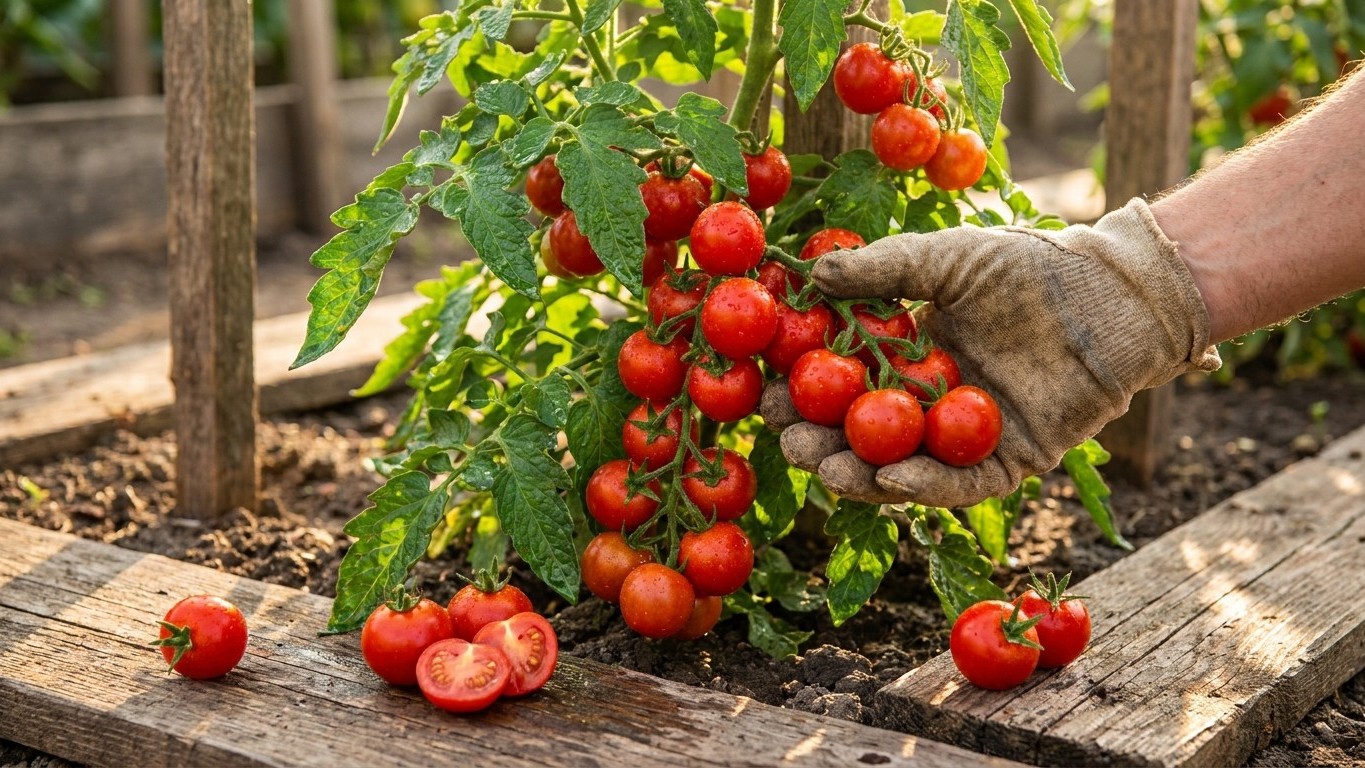

Tiny Temptation is a determinate cherry tomato that sets its whole crop in one short window and ripens in about 63 days from transplant, which puts it in the early-season camp. That speed matters more than any other spec: it decides how far north you can push this variety and how tightly you need to time the planting to dodge both a late frost and a scorching midsummer.
What Brandywine actually is
Tiny Temptation is a determinate cherry tomato, which means the plant grows to a set height, flowers over a compressed window, and delivers most of its fruit in one flush rather than trickling out tomatoes all summer the way an indeterminate vine does. That habit shapes everything from staking to harvest planning, and it’s worth understanding before you decide where this variety fits in a garden.
The catalogue lists 63 days to maturity, and that figure is counted from transplant, not from the day you sow seed indoors. If you start seed six to eight weeks before your last frost, as most gardeners do for tomatoes, the 63-day clock only starts ticking once the seedling goes into warm garden soil. Confusing days-from-seed with days-from-transplant is one of the most common ways gardeners misjudge whether a variety will finish in their region.
The fruit itself is small, round, and built for eating fresh. Flavor is rated very sweet, and the practical use follows from that: salads, bruschetta, pasta dishes, and straight-off-the-vine snacking. This isn’t a paste tomato or a slicer bred for sandwiches. It’s a quick, sugary bite-size tomato, and the short maturity window is part of what keeps the sugars concentrated rather than diluted over a long, slow ripening season.
Where it ripens in time, and where it is a gamble
The question that actually matters for any tomato variety isn’t “how many days to maturity” in isolation, it’s how that number stacks up against a region’s frost-free window. The arithmetic is simple enough to redo for your own backyard: take your area’s average frost-free season length, subtract roughly two weeks for the soil to warm enough to safely transplant tomatoes after the last frost date, then subtract the 63 days this variety needs to mature. Whatever is left is your cushion for actually picking fruit before the first fall frost ends the season.
Run that math across a few regions and the pattern becomes clear. In the Upper Midwest, a city like Minneapolis, Minnesota typically sees a frost-free season running roughly late May to late September, around 140 days total. Subtract two weeks for soil warm-up and the 63 days to maturity, and a grower there is still left with several weeks of harvest before frost returns. That’s a comfortable margin for a fast variety like this one, and it’s exactly the kind of climate where a 63-day tomato earns its keep, since many longer-season slicers simply can’t finish before the cold comes back.
Move to the Mid-Atlantic, and a city like Richmond, Virginia enjoys a frost-free window closer to 200 days, stretching from mid-April into early November. Here the 63-day maturity isn’t a constraint at all; the grower has room to stagger plantings or even squeeze in a second round later in summer for a fall harvest.
The Deep South tells a different story, not because the season is too short, but because it’s too long and too hot in the middle. A city like Atlanta, Georgia can see 230 days or more of frost-free weather, but the peak of summer brings weeks where fruit set stalls regardless of how quickly a variety matures on paper. In that climate, the smart move is treating Tiny Temptation as two separate short crops, one planted early enough to finish before the worst heat arrives, and a second planted in mid-to-late summer to mature once temperatures ease in early fall.
The desert Southwest is its own case. Around Phoenix, Arizona, the frost-free season runs long, but summer daytime highs regularly blow past the range where tomato pollen stays viable, making the same split-season approach almost mandatory rather than optional.
| Region | Reference city | Typical frost-free window | How this variety fits |
|---|---|---|---|
| Upper Midwest | Minneapolis, MN | ~140 days | Comfortable margin after the 63-day maturity; a good fit for a single-season crop |
| Mid-Atlantic | Richmond, VA | ~200 days | Plenty of slack; room for staggered or second plantings |
| Deep South | Atlanta, GA | ~230+ days | Long enough overall, but midsummer heat splits the season into spring and fall crops |
| Desert Southwest | Phoenix, AZ | ~long, heat-limited | Split-season planting needed to dodge extreme heat rather than frost |
The two ways a season goes wrong
A long frost-free window on paper doesn’t guarantee a good tomato season, and there are two failure modes a simple frost date table can’t show. In the north, even where the frost-free period looks adequate, accumulated warmth can run short. Tomatoes don’t just need frost-free days, they need enough consistently warm nights to set fruit at all, and nighttime temperatures below 50°F will stall pollination even when there’s no frost in sight. A cool, cloudy summer in a marginal northern climate can leave a grower with plenty of calendar days left but very little actual fruit.
In the south, the opposite problem shows up. Above roughly 86°F, tomato pollen becomes sterile, and blossoms drop instead of setting fruit. That’s why growers in hot climates don’t try to run one long season, they plant a spring crop that finishes before the heat peaks, then a second crop in late summer once temperatures fall back into a workable range. The middle of summer, however long and frost-free it may be, is effectively dead time for fruit set.
For a 63-day determinate variety like Tiny Temptation, the southern heat limit matters more than the northern cold-accumulation limit. Because this plant sets its entire crop in one compressed flush rather than trickling fruit out over months, timing that flush to land before the pollen-sterilizing heat arrives is the real skill. Miss that window in a hot climate and there’s no second wave of blossoms later in the same plant to fall back on, since the fruit-set has already happened, or failed, all at once. In cooler northern climates, the quick 63-day maturity actually works in the grower’s favor, since it needs less accumulated warmth overall than a long-season slicer would.
What it resists, and what it does not
The catalogue data for Tiny Temptation lists no published disease resistances. That’s worth stating plainly rather than glossing over, because plenty of tomato descriptions lean on resistance codes to reassure buyers, and the absence of any listed code here means this variety carries no documented protection against common tomato diseases like early blight, late blight, fusarium wilt, or verticillium wilt.
That doesn’t mean the plant is unusually fragile, only that its performance against disease pressure hasn’t been bred in and documented the way it has for many hybrid varieties. In practice, that shifts more of the disease-prevention work onto cultural practices: crop rotation, avoiding overhead watering that splashes soil-borne spores onto foliage, and adequate spacing for airflow. It’s also a reminder not to assume protection where none has been claimed. A gardener who plants Tiny Temptation next to a bed with a known fusarium history shouldn’t expect the tomato to shrug it off the way a variety bred with an “F” resistance code might. When resistance isn’t listed, it isn’t there, and the grower’s own soil management has to do that job instead.
Growing it without the usual mistakes
Because Tiny Temptation is determinate, the whole management plan differs from what works for an indeterminate cherry tomato that produces continuously until frost. Determinate plants stop growing taller once they set their terminal flower cluster, and they concentrate their harvest into a short window rather than spreading it across the season. That’s actually an advantage for anyone who wants a big batch of cherry tomatoes all at once for canning, drying, or a single large bruschetta-making session, rather than a slow trickle of a handful of fruit every few days.
Support still matters even though the plant won’t grow indefinitely. A sturdy cage or a single stake set at transplant time keeps the compact but fruit-heavy branches off the ground once the crop comes in, since a determinate plant loaded with a full flush of cherry tomatoes can still sprawl under the weight. Spacing can run a bit tighter than for a sprawling indeterminate vine, since the plant’s final size is more predictable.
Feeding is where a lot of gardeners overcorrect. Once fruit has set, cut back on nitrogen-heavy fertilizer, since it’s more useful in pushing early vegetative growth. Extra nitrogen once flowering starts tends to encourage leafy growth at the expense of the fruit set, which is the opposite of what a short-season determinate needs.
The mistake this variety’s timing invites is treating a “ripens all at once” tomato like a season-long producer and planting only one batch. Because the whole crop matures in a tight window, staggering two or three plantings two to three weeks apart, where the season allows it, spreads that single flush into a more usable, rolling harvest instead of a single overwhelming week of ripe cherry tomatoes followed by nothing.
Common questions
Is Tiny Temptation good for containers?
Its determinate, compact habit suits container growing better than a sprawling indeterminate variety would, though a support stake or small cage still helps once the fruit load sets in.
Can I get two harvests in one season?
Only in regions with a long enough frost-free window to fit two separate 63-day cycles around the hottest weeks of summer, which typically means the Deep South or the desert Southwest rather than the Upper Midwest.
Why did my plant flower but not set fruit?
Check nighttime temperatures first. Below 50°F or above roughly 86°F, pollen doesn’t function properly and blossoms drop without setting fruit, regardless of how healthy the plant looks.
Does no published resistance mean the plant is weak?
No. It means disease tolerance hasn’t been bred in or documented for this variety, so preventive practices like rotation and good airflow carry more of the disease-prevention work than they would for a variety with listed resistance codes.