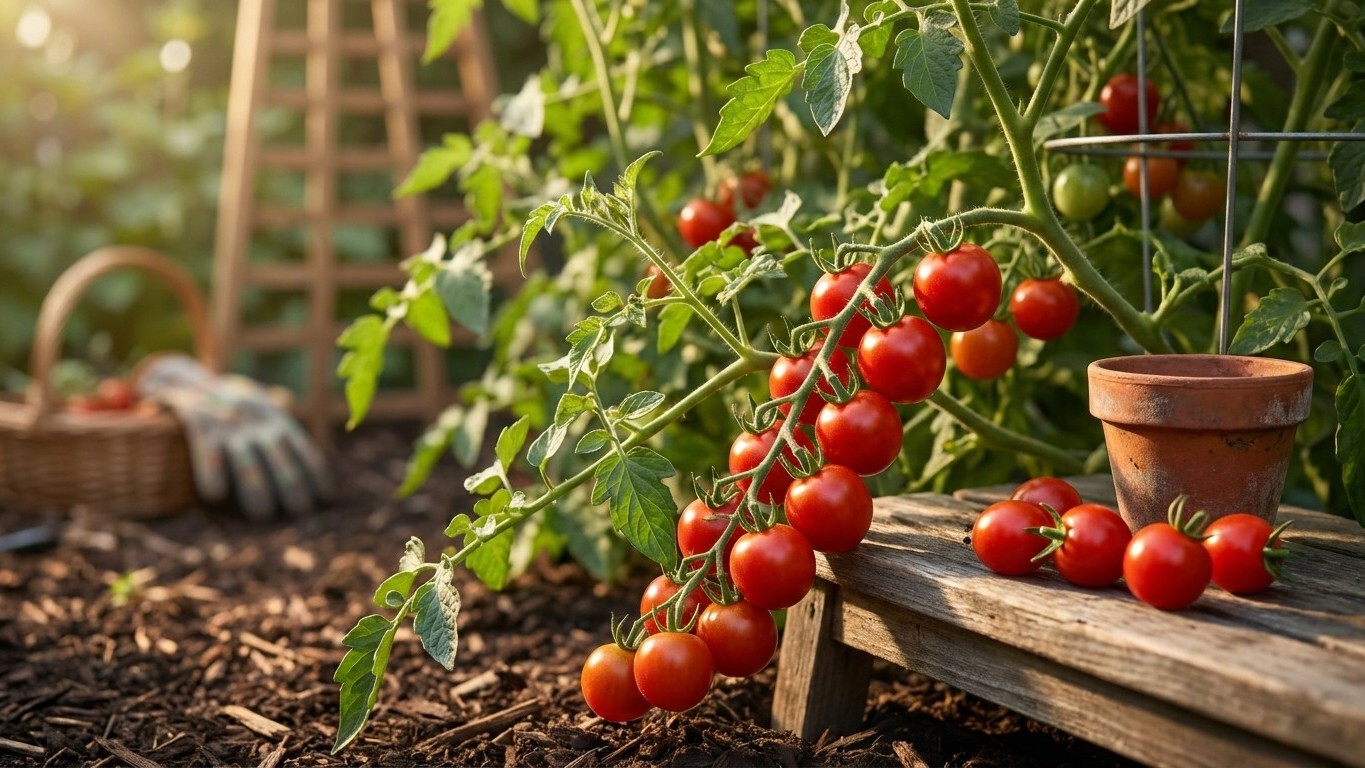

Tomatoberry is a red cherry tomato that ripens in about 60 days from transplant, growing on an indeterminate vine that keeps producing until frost shuts it down. That maturity window puts it solidly in reach for most of the country, but “60 days” only tells half the story: what happens before and after that count is what decides whether a gardener gets buckets of fruit or a handful of green ones on a dead vine in October.
What Brandywine actually is
Tomatoberry is a cherry tomato, full stop, not a slicer and not a paste type. The fruit runs 10-15 grams, small enough to pop whole, and the flavor is described as firm and meaty with excellent sweetness, which is why it lands on plates as a salad topper or a straight-from-the-vine snack rather than something you’d slice for a sandwich.
The plant is indeterminate. That single word changes the whole growing plan: an indeterminate vine does not stop at a set height or produce one flush and quit. It keeps climbing, keeps setting new flowers, and keeps ripening fruit in waves until a hard freeze ends the season. That means a tall cage or a stake isn’t optional trim, it’s the structural difference between a productive plant and a collapsed tangle of stems on the ground by midsummer.
On timing, the catalogue figure is 60 days to maturity, and that count starts from transplant into the garden, not from the day the seed goes into a tray indoors. This distinction matters more than it sounds. A gardener who starts seeds in early March and counts 60 days from the seed packet date will think the tomato is ready in early May, when in fact the clock hasn’t even started until the seedling goes into warm outdoor soil, usually weeks later. Every planting calculation in this article uses the transplant date as day zero, because that’s the basis the figure was measured on.
Where it ripens in time, and where it is a gamble
Sixty days is a short season for a tomato. That’s the headline fact, and it’s worth sitting with before getting to geography. Plenty of popular slicing varieties run 75, 80, even 90 days from transplant, so a 60-day cherry tomato is built for gardeners who don’t have months of guaranteed warmth to spare.
The arithmetic a gardener needs to run for their own backyard is simple, and it doesn’t require a specific catalogue or app to do it. Start with the frost-free window: the number of days between the last expected spring frost and the first expected fall frost in the local area. Subtract roughly two weeks from the front end, because tomato transplants shouldn’t go into the ground until the soil itself has warmed, not just the air; a transplant set into cold, wet soil right after the “last frost” date often sits and sulks rather than growing. Subtract the 60 days to maturity. Whatever is left over is the picking window, the stretch of time when ripe fruit is actually coming off the vine rather than sitting green, waiting.
For a region with a long frost-free season, say one running well past 150 days, that arithmetic leaves a comfortable margin. Soil warms in time, the 60-day clock finishes with weeks to spare, and the picking window stretches long enough to get multiple waves of fruit off an indeterminate vine before frost ends things. This is the profile of most of the South, the mid-Atlantic, and the lower Midwest, where growers routinely treat a 60-day tomato as an easy, low-stress choice.
The gamble shows up in short-season regions, the parts of the northern tier and higher-elevation areas where the frost-free window can run closer to 90 or 100 days. Subtract two weeks for soil warming and 60 days for maturity, and the leftover picking window shrinks to a matter of weeks rather than months. It’s still workable arithmetic, unlike it would be for a 90-day slicer, but it leaves little room for a cool, wet spring that delays transplanting or a stretch of cloudy weather that slows ripening. In those places, a 60-day variety like this one isn’t a gamble in the sense of being unlikely to produce at all, but the margin for error is thin enough that a late start can genuinely cost a grower their harvest.
Specific frost-date figures by weather station aren’t part of the published data referenced for this page, so the honest move is to tell readers to pull their own local frost-free window (most state extension offices and seed-starting calendars publish it by county) and run the subtraction themselves rather than rely on a generic number that may not match their yard.
The two ways a season goes wrong
A long frost-free window on paper doesn’t guarantee a good tomato season, and this is where a lot of gardeners get surprised. There are two separate failure modes, and they sit at opposite ends of the map.
In northern and high-elevation gardens, the frost-free count can look generous while the accumulated warmth underneath it is thin. Tomatoes don’t just need to avoid frost, they need consistently warm nights to set fruit at all. When nighttime temperatures drop below 50°F, which happens easily in early spring and again in early fall at northern latitudes, flowers drop without setting fruit. A vine can survive those cool nights just fine and keep growing, but it won’t be producing during them, which quietly eats into the real picking window even when the calendar says frost is still weeks away.
In the South, the opposite problem shows up in the heat of summer. Above roughly 86°F, tomato pollen becomes sterile and fruit set stalls out, sometimes for weeks at a stretch during the hottest part of July and August. This is why experienced growers in hot climates plant two separate tomato crops rather than relying on one long season: an early spring planting that finishes its fruiting before the worst heat arrives, and a second planting timed so it sets fruit again once temperatures ease in early fall.
For a 60-day variety specifically, the cold-night limit matters more than the heat-sterility limit in most of the country. Because the maturity window is short, this tomato is well suited to slipping in ahead of summer heat or squeezing in a fall crop after it breaks, exactly the kind of flexibility a longer-season tomato doesn’t have. The bigger practical risk is a cool, slow spring in northern gardens delaying the start and shaving down an already-tight picking window.
What it resists, and what it does not
On disease resistance, the honest answer is that none is published for this variety. That’s a plain fact worth stating rather than glossing over, because a lot of tomato marketing leans on resistance codes and it would be easy to assume a modern cherry tomato carries at least some built-in protection. This one doesn’t, at least not according to the catalogue data behind this page.
That absence has practical consequences. Without a listed resistance to common soil-borne diseases like fusarium wilt or verticillium wilt, or to foliar problems like early blight, this variety carries the same baseline vulnerability that older, non-bred-for-resistance tomatoes have always had. It’s not that the plant is unusually fragile, it’s that it gets no extra help from genetics, so the usual defenses fall entirely on the grower: crop rotation, not planting tomatoes in the same soil year after year, good airflow between plants, and watering at the base rather than overhead to keep foliage dry.
Gardeners who’ve grown resistant hybrids before and gotten used to seeing a plant shrug off a wet summer should recalibrate their expectations here. Intermediate resistance on other varieties means a plant slows a disease down, not that it escapes infection entirely, and that’s already a modest protection. With no resistance claimed at all, there’s no such buffer, so this variety benefits more than most from being planted in fresh soil, with mulch to prevent soil splashing onto lower leaves, and with reasonably generous spacing so the dense growth of an indeterminate vine doesn’t trap humidity around the foliage.
Growing it without the usual mistakes
The single biggest mistake with this tomato is treating it like a determinate patio variety that needs a small cage and light support. It’s indeterminate, and an indeterminate cherry tomato left on a flimsy store-bought cage will outgrow it by midsummer, flop over, and end up sprawling across the ground where fruit rots against wet soil and disease spreads faster. A tall stake, at minimum 6 feet, or a sturdy cage built for full-size indeterminate vines, is the baseline requirement, not an upgrade.
Spacing matters for the same reason. Because the vine keeps growing all season rather than filling out once and stopping, plants set too close together will crowd into a dense wall of foliage by August, which is exactly the humid, low-airflow environment that favors disease on a variety with no published resistance to fall back on. Giving each plant real room, generally 24 to 36 inches depending on the support system, pays off over months, not weeks.
On feeding, the short 60-day window from transplant to first ripe fruit means the plant needs a strong early push of nutrients to build the root and vine structure fast, then a shift toward flowering and fruiting nutrition rather than continued heavy nitrogen. Because it’s indeterminate and keeps setting new fruit clusters through the season, feeding doesn’t stop the way it would on a determinate variety that ripens once and finishes; light, regular feeding through the growing months keeps new clusters coming rather than tapering off after the first flush.
The timing mistake specific to this variety is starting too early indoors and then holding transplants too long waiting for outdoor soil to warm. Because the maturity clock only starts at transplant, there’s no benefit to a head start indoors beyond the standard 6 to 8 weeks before the local transplant date; extra weeks in a pot just produces a leggy, stressed plant that transplants poorly and effectively wastes the tight window this variety is built to exploit.
Common questions
Is Tomatoberry the same as a regular cherry tomato?
It’s a cherry tomato by fruit type, weighing 10-15 grams per fruit, but its indeterminate habit and 60-day maturity distinguish it from many patio-bred cherry varieties that are determinate and bred for containers.
Does Tomatoberry need a cage?
Yes. Because it’s indeterminate and keeps growing until frost, a tall stake or a full-size cage is necessary; small determinate-style cages won’t hold the vine once it fills out mid-season.
How many days until Tomatoberry produces ripe fruit?
About 60 days from the date of transplant into the garden, not from the date seeds were started indoors.
Is Tomatoberry disease resistant?
No resistance is published for this variety. Growers should rely on rotation, spacing, and dry-foliage watering practices rather than assume any built-in protection against common tomato diseases.